Seta B. Dadoyan
Life, Education, Teaching, Awards
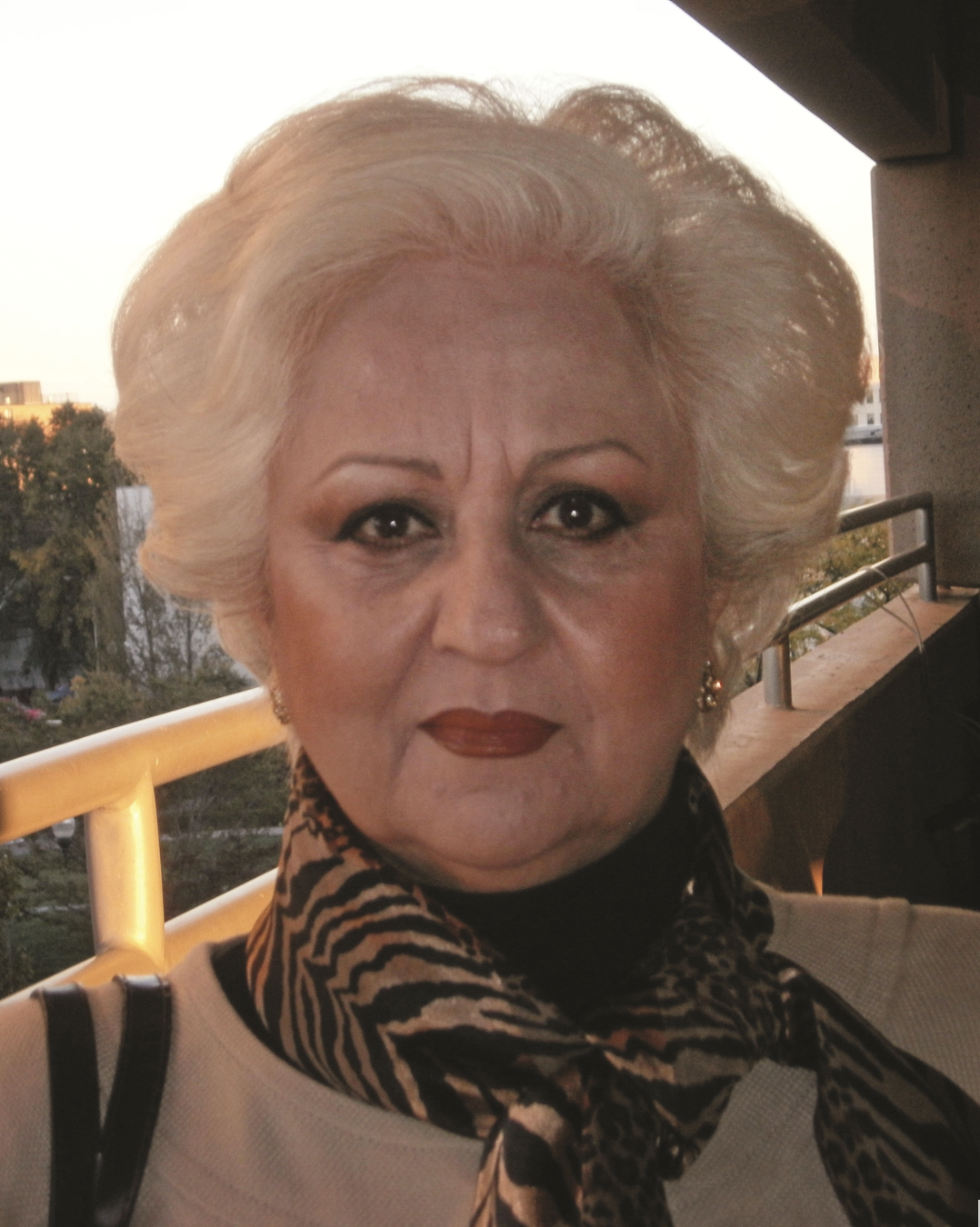
Born in the district of al-Khandaq in the old part of the ancient city of Aleppo in north Syria, I was baptized as Satenik, but renamed by my mother as Seta. My father, Grigor Barsoumian, a Genocide survivor, born in Ayntab, Cilicia, a descendant of a family of master casters/engravers, was in turn a very famous metal engraver. His ancestors are believed to have been from Van, deported to New Julfa/Isfahan in the first years of the seventeenth century, then migrated to Diarbekir/Tigranakert, ended up in Ayntab and in the early 1920s driven south to Aleppo. My mother Nazeli Yaylayan, an orphan born in a merchant family from Caesarea, a first graduate of the Melkonian Institution in Cyprus, was an educator and musician. After Karen Yeppē Jemaran (college) and before graduating, I decided to study Fine Arts in Beirut, a more liberal and at the time the most westernized city of the region. In 1965 I graduated from BCW (Beirut College for Women, presently Lebanese American University) with a Bachelor of Arts degree (with Distinction) in fine arts and philosophy. After marriage (to Arsen Dadoyan) and a year of studio studies in figure drawing at the City and Guilds School of Art in London, back in Beirut in 1969 I got my Master of Arts degree in philosophy from AUB (the American University of Beirut). While living in war-stricken Beirut (from 1975 to 1991), raising two children (Talin and Daniel) and teaching at AUB and part time at Haigazian College/University, I worked for, and was granted the highly exclusive degree of Doctor of Sciences in Philosophy in 1991 (awarded by the V.A.G. Moscow, via Yerevan State University).
My dissertation, published in 1991 as a book, on the hitherto unknown Islamic sources (Epistles of the Brethren of Purity, or Rasā’il Ikhwān al-Ṣafa’) of thirteenth century theologian-philosopher Yovhannēs Erznkats‘i was a discovery. The research put the beginning of a lone journey into the unchartered and vast territory of the Armenian historical experience of fourteen centuries in the Islamic World. In 1997, a volume on the Fāṭimid Armenians (Leiden, Brill) was in turn a total novelty in Armenian and Near Eastern Studies. Prof. Kamal Salibi of AUB (d. 2011), a prominent historian of the Arab world and Lebanon, then the director of the Royal Institute of Interfaith Studies in Jordan (that funded the research), also my mentor, wrote: “In the work of Dr. Dadoyan, the otherwise baffling phenomenon of the Fāṭimid Armenians is demystified.” Over the next decades, I published five more volumes and dozens of studies in the same line, thus literally developing a discipline of Islamic-Armenian Studies, as part of Near Eastern and Armenian Studies. “The field of Armenian-Islamic interactions is one she created or ‘resurrected’ from the primary sources herself… she is a trailblazer”, wrote historian Dr. Robert Bedrosian. [See blurbs of my trilogy The Armenians in the Medieval Islamic World – Paradigms of Interaction Seventh to Fourteenth Centuries in 3 vols. Transaction Publishers: New Brunswick, U.S.A. & London, UK: 2011, 2012, 2013.]
My teaching career started early as a graduate student. From 1981 to 1987 I taught courses in philosophy and Armenian Studies at Haigazian. My two-decade long teaching at AUB started in 1986 and ended in 2005 when I finally moved to New York. At AUB I taught cultural courses at the Civilization Sequence Program of the Faculty of Arts and Sciences, and the Faculty of Engineering and Architecture (from 1996). By my initiative, two courses in art (art appreciations and civilization through the arts) were created and introduced into the CS Program, and two in the Associated Courses (in history of science and technology and professional ethics) at the Engineering. In the US, I was twice appointed Ordjanian Visiting Professor at Columbia University (in 2002 and 2006), to teach courses in Islamic-Armenian interactive history at [then] the Department of Middle East and Asian Languages Cultures (MEALAC). From 2007 to 2011 I was adjunct professor of Armenian language and culture at St. Nersess Armenian Seminary in New Rochelle, NY (where we also lived from 2007 to 2023, at present are in Pelham, NY). In 2010 I was Ara and Edma Dumanian visiting professor at the Department of Near Eastern Languages and Civilizations of Chicago University, and in the Fall Semester of 2011, I was invited to teach at three departments of Yerevan State University, focusing on Islamic-Armenian interactive history. In the past fifteen years I have dedicated my entire time to research and drawing; I published five volumes and completed about thirty artworks.
Awards
Lifetime Achievement Award of SAS (Society for Armenian Studies) “in recognition and appreciation for outstanding service and contribution to the field of Armenian Studies.” November 6, 2021.
Mesrob Mashtots‘ Medal and Pontifical Encyclical for “exceptional scholarly contributions to Armenian history and intellectual culture.” Antelias, November 8, 2015.
Medal and Certificate of David Anhaght-Invictus, “the Highest Award of the Armenian Philosophical Academy – Armenian Academy of Sciences in Yerevan.” January 8, 1999.
Fellow of the Royal Institute for Interfaith Studies in Jordan “for the excellence of The Fāṭimid Armenians (Leiden: Brill, 1997) and distinguished contributions to the Academic Program of RIIFS (Royal Institute for Interfaith Studies).” August, 1997.
Haigazun Uzunian Prize for “Best Armenian Book of 1987 for Pages of West Armenian Thought”
(էջեր Արևմտահայ Մտածումէն), September, 1987.