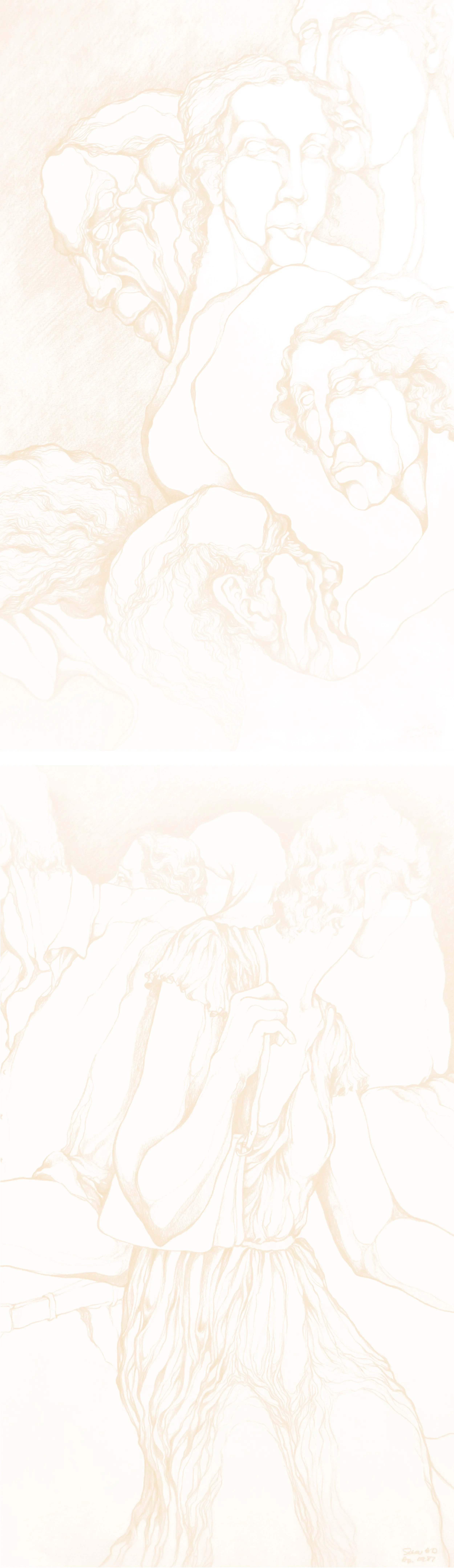
Counterpoints
Philosophy, Historiography, Aesthetics
Dialectics as Perception, Thought, Praxis
Aesthetics of Historical Thinking
The Artwork and the Dialectics of Truth Content
On the theme of counterpoints in philosophy, historiography and aesthetics, this is a sequence of three talks:
‒ Dialectics as Perception, Thought, Praxis
‒ Aesthetics of Historical Thinking/Writing
‒ The Artwork and the Dialectics of Truth Content
An initiative of Christopher Atamian of AHCP ‒ Atamian-Hovsepian Curatorial Practice ‒ the series was occasioned by the publication of my book Encounters and Convergences. A Book of Ideas and Art (2023). The first two talks were held at their NYC Gallery (March 14 and April 4, 2024), the third on March 3, 2025, at the AGBU center in New York.
Rather than a series of talks, this unusual text, that also features twenty-six of my works, is written as a single oeuvre, structured and developed thematically as a dialectical-hermeneutical-discursive triangle. The three corners or pillars are philosophy, historiography, and aesthetics. The various discussions in the three disciplines focus on the perceptions, sensibilities, thoughts, contradictions, tensions, insights, visions, also the formal and methodological criteria that go into the making of meaningful, relevant, engaging, and compelling works in the arts as well as the human sciences.
By its motives and objectives this triangle is inevitably discursive, because through counterarguments and counterpoints, it seeks to generate broad contexts or “horizons”, in Hans Georg Gadamer’s (1900-2002) term, for further questioning. The ultimate objective is to reach convergences in philosophical, historiographic and aesthetic discourses, the disciplines that I am involved in. Maintaining the primacy of questioning, this triangle is also dialectical because it is supposed to develop theoretical grounds for a continuum of interconnected arguments.
If cognitive as well as creative acts emerge, or must emerge, from lived experiences, or “Erlebnis” in Wilhelm Dilthey’s (1833-1911) term, then this triangle is also hermeneutical because it is deeply rooted in the relationship between the author/artist, as the interpreter, and direct experiences. At present concepts like understanding, interpretation, meaningfulness, are rooted in the dialogical and interactive nature of human experiences, as Edmund Husserl (1859-1938) argued.
Over two centuries ago, in 1805, Friedrich Schleiermacher (1768-1834) made an almost prophetic statement about the evolution of intellectual culture when he said that “what every child does in construing a new word he does not know ‒ is hermeneutics.” Indeed, my intellectual and artistic careers started as a perpetual process of questioning, trying to interpret, explain, and understand. I have not changed much. What I do ‒ reading, researching, writing and drawing ‒ is “construing.”
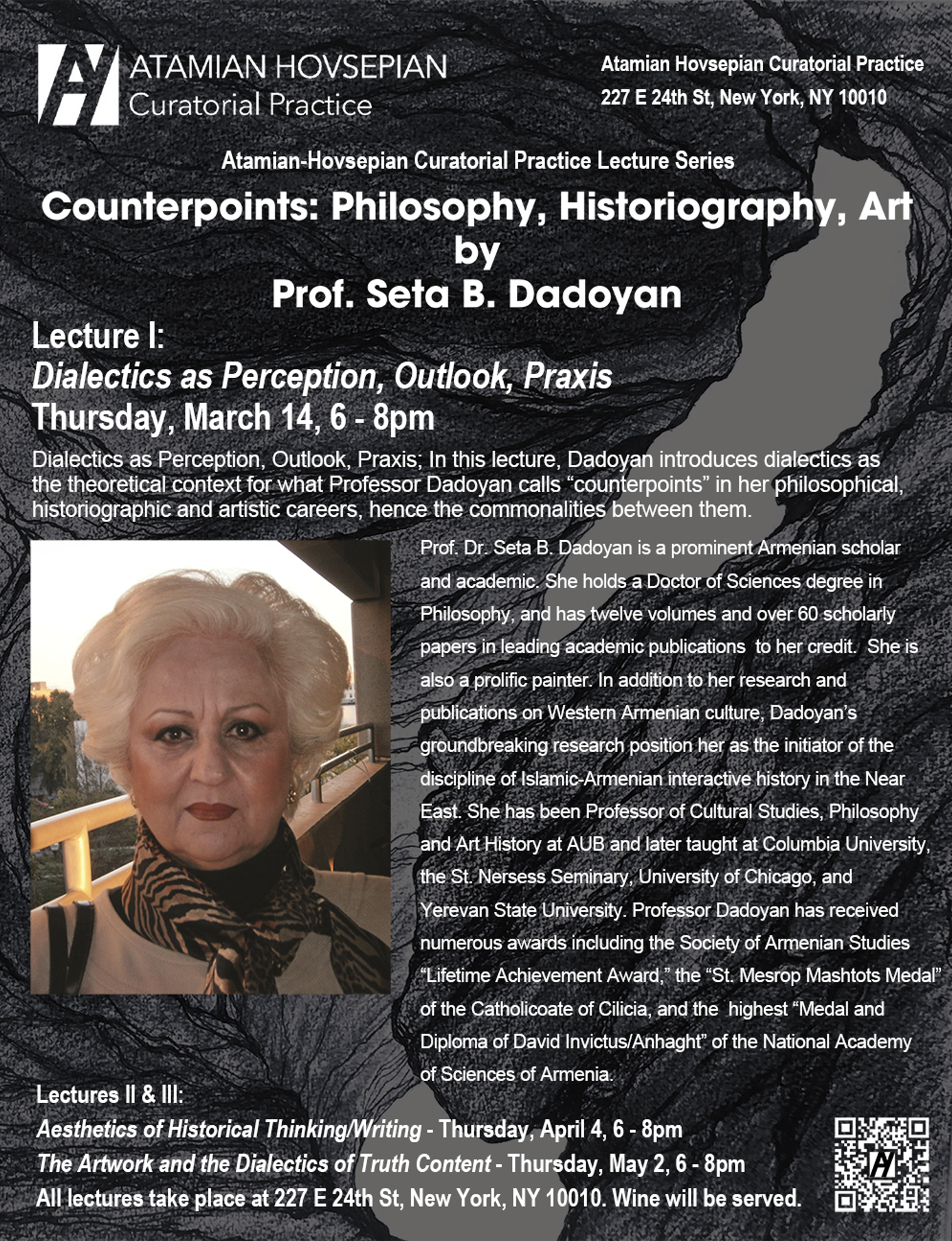
(AHCP, March 14, 2024)
Dialectics as Perception, Thought, Praxis
I. Dialectics in perspective
II. Dialectics as a manner of perception, outlook, and praxis
III. Counterpoints as tools
IV. Dialectics in contemporary perspective
V. A dialectical aesthetic
VI. Concluding with ‘modernism’ ‒ Courbet and Tolstoy
I. Dialectics in perspective
This talk, the most philosophical of the three, focuses on the perceptive, cognitive, and the creative aspects of the dialectical-hermeneutical perspectives. It is also a self-identification, of sorts, because as a thinker-writer-artist, I consider myself a critical/dialectical hermeneut.
By dictionary definition, dialectics is a method of philosophical reasoning and analysis that reconciles contradictory ideas to arrive at the truth. It views reality in constant change, working by juxtaposing opposites—such as a thesis and antithesis—to integrate them into a new, higher level of understanding. At present dialectics is a widely shared intellectual position. It is a synthesis of several trends that followed the Kantian and Hegelian legacies. It is also deeply rooted in the entire hermeneutical tradition from Schleiermacher, Dilthey, to Gadamer, Habermas and Gallagher, also in the existentialistic sensibilities of Kierkegaard, Dostoevsky, Nietzsche, Freud, Husserl, Heidegger, Sartre, and Camus. But most importantly, dialectics today is heavily influenced by the Frankfurt School and Critical Theory, in particular the thought of Theodor Adorno.
Furthermore, for almost two centuries the meaning and significance of the human condition/existence is viewed in existentialist terms, implicitly and explicitly. In turn hermeneutics, having its beginnings in the nineteenth century, is now understood in the broad context of critical theory and dialectical thinking. Culture in general, and ideologies and institutions that support or maintain and promote power structures are under scrutiny. Critical Theorists who appeared after 1930s and Theodor Adorno specifically, are critiques of what they call the “culture industry”. They focus on the urgency of emancipation from the hegemony of economic forces found in economic also political class systems.
Hermeneutics is now a philosophical tool in the humanities and the social sciences. The model/paradigm of the so-called “dispassionate observer”, the use and the significance of quantitative data collection and analysis methods in the human sciences as well, are no longer tenable. The inquirer is part of the cognitive activity itself, in search of deeper and more relevant meanings. There is a radical shift in the way things are perceived, thought of, and interpreted. My use of counterpoints as counterarguments is an aspect of my quest and questioning. By canceling what is untenable, a margin will be allowed to reach an existentially more relevant and philosophically more coherent meaning.
Dialectic is a very ancient, ongoing, controversial, but often misunderstood concept. It is sometimes oversimplified as just the triad of thesis/antithesis/synthesis, also often wrongly identified with Marxist dialectical materialism. Epistemologically, the term implies a critical perspective and a refusal of what is granted or assumed.
Closely associated with what is known as the Socratic Method, the word comes from the Greek dialogos, meaning conversation, debate. Plato (ca. 427 – 348 BC) developed it into a technique of philosophical argumentation/discussion, as well as a literary genre. All Platonic works are dialogues, where the questioner-protagonist is Socrates (d. 399 BC). Through his question-answer method he shows the absurdity of the other side’s assertions, and by consequence and implicitly, the validity of his point.
Historically, dialectics is a Heraclitean legacy, around 500 BC, almost a century before Plato. Heraclitus was a nobleman from Ephesus, a city in Ionia on the western coast of ancient Asia Minor. His concept of flux, or constant change, as opposed to essence and permanence championed by Parmenides of Elea (late sixth c. – mid-fifth c.), was the very first reference to dialectics.
In the Cratylus (probably his first dialogue), Plato wrote about the concept of dialectics, as reported to him by Cratylus, a sympathizer of Heraclitus: “I believe, [Heraclitus] says that all things pass, and nothing stays, and comparing existing things to the flow of a river, he says that you could not step twice into the same river.” (Cratylus, 402a). Heraclitean dialectics and Parmenidean metaphysics shaped Platonic thought. Plato limited Heraclitean flux to the world of appearances/phenomena, and granted permanence to the world of Ideals/Forms, hence Platonic Idealism. In addition to constant change, flux is also about the unity of opposites. Over time and through constant change, said Heraclitus, things are both the same and not the same. The major metaphysical implication is that there are no permanent essences; instead, everything is in constant change and motion.
Since these discussions are also about my understanding of dialectics, speaking of national identity, I wrote in my Encounters that it “… is not an immutable essence. It is like a flowing stream of water that starts at a source and flows in a bed. As Heraclitus said, the waters flow and “no man ever steps into the same river twice”, for it is not the same river and he is not the same man. Even though the source, my spirit is the same, my American Armenian experience made me seek different terrains and horizons to flow freely. After every bend and encounter…I metamorphosed differently yet kept flowing. Encounters are at the core … of both my art and writing…” [1]
Heraclitus was an adversary, a critic and an antithesis of sorts to the Early, or the First Philosophers of the sixth and fifth centuries BC (mostly from Asia Minor). He saw himself and wrote as a critic of the Milesian philosophers (Miletus was a city close to Ephesus in Ionia). He advised these early scientists and mathematicians to turn their attention to human affairs and conditions, instead of cosmological speculations, that would lead nowhere (not a very relevant criticism anyway). Chronologically, however, Heraclitus is also considered a “Milesian.”
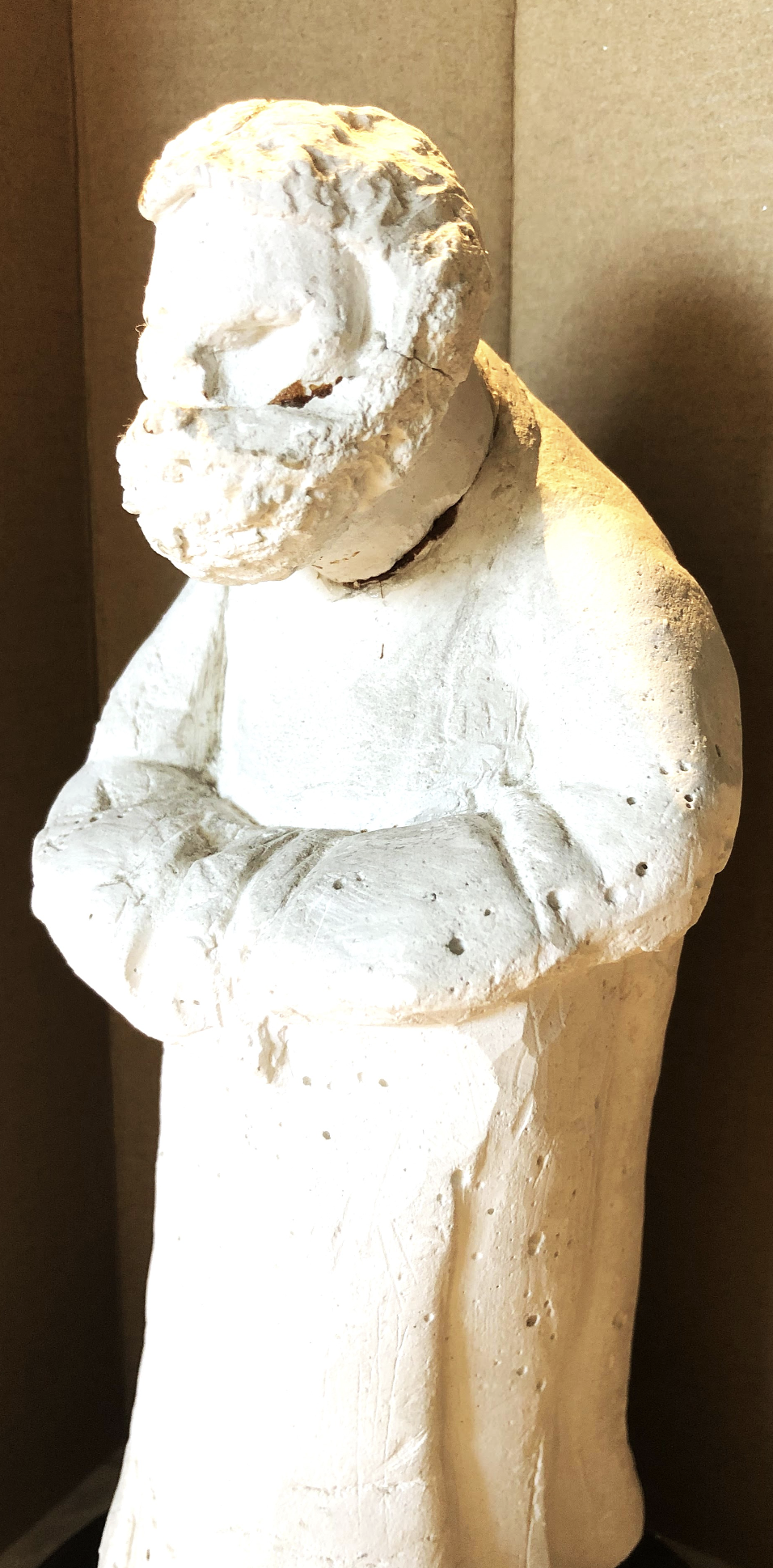
Socrates, Beirut,1963. Plaster cast, 18 cm.
Half a century after Heraclitus, Athenian Socrates followed in his footsteps. He too was an adversary and critic, a true dissident. My earliest plaster cast piece was a depiction of him as my hero. He addressed the same invitation to cosmologists to focus on man, morals, the polis or the city state, rather than the cosmos, which he thought lay beyond their investigations. He was also critical of Homer, the Olympian gods, and the leaders of Athens, who led the city to defeat in the Peloponnesian War (431-404 BC). Had Heraclitus lived in post-Peloponnesian Athens, he too would probably have been tried, accused by majority vote, and killed by poison, like Socrates.
As a very radical metaphysical and generally philosophical theory, dialectics was officially inaugurated twenty-three centuries after its initiator Heraclitus, as Dialectical Idealism in the metaphysics and logic of Georg Wilhelm Friedrich Hegel (1770-1831). If it were not for the latter’s genius, Heraclitean logic and metaphysics would have been lost. Hegel was the first to see and fully appreciate the theoretical and methodological potential of the critique of Heraclitus.
Later in the nineteenth century, dialectic logic was basic to Darwin’s (1809-1882) evolutionary theory, as well as to Marx’s (1818-1883) Dialectical Materialism (as opposed to Hegel’s Dialectical Idealism). The most recent and significant contribution to the concept of dialectics belongs to Theodor Adorno (1903-1966, see Negative Dialectic,1963). His so-called negative dialectic is a non-static and restless form of thinking. Since it does not proceed from, nor is expected to arrive at transcendental principles, as in Plato, Hegel and Marx, it is considered “negative.” Instead, negative dialectic offers a bold regime for self-reflexive critical philosophical disposition and methods. This type of dialectic also implies interfaces between the perceiving-thinking subject, concepts, objects, and the material world. More importantly, it is motivated by underlying utopianism.
At present, and two centuries after its formal introduction into philosophy and social sciences, dialectics is accepted by modern sciences, pedagogy, also widely used as a method of argumentation. It is the ground of process philosophies, such as Alfred North Whitehead (1861-1947) and for many, like me, it is the theoretical grounding for perception, thought, outlook and praxis.
In sum, philosophically, dialectical thinking is diametrically opposed to essentialism, which is the view that objects have sets of attributes and permanent essences. On the social level, dialectical thinking implies a rejection of authoritarianism, and control over free individual thinking and rights.
II. Dialectics as perception, thought, and praxis
The phrase ‘dialectics as perception, thought, and praxis’ implies a process-through-contradictions.
By dialectical perception I mean a critical-oppositional way of perceiving things, which follows a reluctance to grant seemingly ‘natural’ and ‘established, ‘universal’ truths. Because, often, these are reifications (abstractions about non-existent things) that may conceal agendas and certainly exertion of authority.
By dialectical thinking I simply mean systematic reasoning, which however is based on the juxtaposition of contradictory perceptions. The objective is not simply the refutation of a thesis, it is to arrive at novel and more relevant truths that are not static and permanent.
By dialectical praxis I mean the process by which dialectical thinking is applied, or put into practice, as my historiography and art are, for instance.
III. Counterpoints as tools
Taken generally, a counterpoint is an idea, an argument, a theme, or an image that creates a contrast with a another, dominant element and/or its environment. As a verb, to counterpoint means to oppose, to negate, to be an antithesis to an established/accepted thesis. The purpose of using counterpoints is to highlight a different and more relevant statement by juxtaposition of opposites.
Initially a musical term, counterpoint comes from Latin punctus contra punctum, which means ‘point against point’, or ‘note against note.’ It was first used during the Renaissance polyphony (which is different from heterophony). Based on an ideal of thematic, compositional, and formal unity, counterpoint is the art of combining different melodic lines, that are harmonically interdependent yet independent, composed around a central theme to develop it. It was J.S. Bach (1685-1750) who developed the technique into an extremely sophisticated form. At present counterpoint is a “travelling concept”, or a concept used in different meanings across disciplines, primarily music, as well as literature, film, argumentation, and pedagogy. [2]
In my literature and art counterpoints are primary tools in the dialectical and existential process of questioning, researching, also painting. They function as counterarguments, hence the inner tension both in writings and artworks. Through the interplay of contrasts and counterpoints, I try to open contexts or horizons for fresh insights and arguments. More than syntheses, these horizons are convergences, hence the title of my last book, Encounters and Convergences.
IV. Dialectics in contemporary perspective
In contemporary intellectual culture, dialectics is best understood and often referred to in Theodor Adorno’s writings. In 1930s, with his teacher, Max Horkheimer (1895-1973), Adorno formulated the theory of “culture industry.” According to this theory, an overwhelming and powerful culture industry mass-produces and controls the arts and culture in general, thus preventing autonomy of thought and taste. A monolithic culture industry needs a conformist society to dispense its goods. Those who control this “industry” do not expect, nor tolerate opposition by free-thinking autonomous individuals or groups. Therefore, they rely on the passive acceptance of the reader, listener, cinemagoer, the consumers of cultural goods.
Therefore, according to critical theorists, to be true to themselves and to the social-political environment to which they belong and which they must reflect, artists and intellectuals must be critical and oppositional. The arts and scholarship must be in a continuous state of social awareness and dissatisfaction. Dialectics requires being opposed to the mass-produced and controlled arts and culture, because their ultimate aims are homogenization and by consequence, suppression of autonomy and individuality. If we perceive reality as an evolutionary process, as all sciences do, and if we also look at society as being torn apart by injustice, fundamental antagonisms, and conflict, then we will have to accept that dialectical thinking is forced on us by reality itself. There is no other choice.
The most significant aspect of dialectical perception and thought is not just being oppositional. That would be adolescent at best. It is a utopian faith in the possibility of change. Therefore, meaningful form – both perceptual and cognitive – can only be conceived and achieved by the articulation of the contrasts or tension-producing elements.
V. A dialectical aesthetic
Perfect aesthetic form arises from the inner tension of the work. Consequently, the reason that contemporary trends in the arts suffer seriously from a lack of “truth content” – a theory of Adorno – is because they fail to fulfill their role of expressing cognitive insight, conceptual solidity and genuine existential tension.
The aesthetic form of an artifact is inseparable from its “truth content.” According to critical theorists, there is obviously an unscrupulous underestimation of the public’s taste and intelligence. One cannot talk in any seriousness on the aesthetic path drawn by so-called artworks, such as urinals, filthy beds, soiled diapers, scattered boulders on public squares and shark body parts in galleries and museums under a fantastic rainbow of conceptual, readymade, and generally avant-garde ‘contemporary’ art. Their message as well as their artistic legacy is limited and consumed in the initiatives.
No-boundary and subjective conceptualism, or what is called post-conceptualism cannot be sustained on verbal wings. Deliberately artless and accidental forms, or objects, artificially made rubbish piled up or hung in galleries and museums are now legacies of past times, even if they still have exchange value, institutional and media support. Books, articles, and lectures still ensure the sustenance and perpetuation of these works in public spaces, galleries, universities, and museums. It is not easy to derive coherent aesthetic theories or trace trends from such art and their verbal corollaries. The cognitive core in both the conceptual and artistic processes is lacking, and one wonders if an artwork can stand on an abstraction, or a reification in the mind of the artist, or an article in a national paper by an art-writer. Verbal appendices and footnotes may have a temporary role in propaganda and sales, but they are not part of the work, therefore aesthetically and in the long run irrelevant.
“One has to philosophize with a hammer”, said Nietzsche (1844-1900). This is the subtitle of his Twilight of the Idols: How to Philosophize with a Hammer. The full sentence is “If a shrine is to be set up, a shrine has to be destroyed, and in order to do this one has to philosophize with a hammer.” [3]
Some decades later, knowledge is “made for cutting,” said Michel Foucault (1926-1984) and added, “each society has its regime of truth, its general politics of truth. … It is the task of the intellectual to cut through manufactured regimes of truth, to be an antithesis, that is the meaning of their being intellectuals.” [4]
One does not have to be part of an institution or seek institutional legitimization. That would be vanity and clear-cut self-contradiction. The essence of being an artist and an intellectual is being critical. Ron Eyerman (1942-) says that the “intellectual is an identity formed in opposition, as well as in a special and temporal context.” [5] However, as we see, intellectuals and artists often turn into “self-interested collective actors rather than social critics or participants in an alternative culture on the margins of society.” [6]
VI. Concluding with ‘modernism’ ‒ Courbet and Tolstoy
In the end, and beyond complicated theories, the drive to think freely and seek change is imminent to both scholarship and the arts. [7] Two centuries ago, this drive was called modernism. It signaled the significance of intellectual and artistic autonomy with the implied necessity of social consciousness. The term comes from the late-Latin adjective modernus, a derivation from modo, presently, right now.
Édouard Manet (1832-1883) is often considered the first ‘modern’ artist to break with tradition, and the forerunner of Modern Art. However, I suggest that a closer look at the middle decades of the nineteenth century will show the beginnings of radical modernity in the works and writings of Gustave Courbet (1819-1887), a contemporary of Manet, Karl Marx, Dostoevsky and Tolstoy. As a true modernist and humanist, he not only contradicted aesthetic traditions and revolutionized subject matter but also captured the social-historical embeddedness of the arts, much more artistically than many impressionists, and more philosophically than the philosopher Marx.
In an open letter, labeled as his “Realist Manifesto” (December 25, 1861, Paris), Courbet wrote: “Each epoch must have its artists who express it and reproduce it for the future. The human spirit must always begin work afresh in the present, starting off from acquired results … The real artists are those who pick up their age exactly at the point to which it has been carried by preceding times…Beauty, like truth, is a thing which is relative to the time in which one lives and to the individual capable of understanding it.”
Some decades later, in his book What is Art? (1897) Lev Tolstoy (1828-1910) has the following about art, in two separate contexts, put together: Art is a human activity consisting in this, that one man consciously, by means of certain signs, hands onto others the feelings he has lived through, and that other people are infected by these feelings and experience them…If art is an important matter, a spiritual blessing, essential for all men…then it should be accessible to everyone. And if, as in our day, it is not accessible to all men, then one of two things: either art is not the vital matter it is represented to be, or that art which we call art is not the real thing.
A critical and perpetually creative spirit, also intellectual courage are at the core of both scholarship and art. Heraclitus considered himself an independent observer and thinker. He wrote, “Sound thinking is the greatest virtue and wisdom.” [Fragment 12] In another fragment he said, “Man's character is his fate”, or “The character of man is his guardian spirit” (Êthos anthrôpôi daimôn. Fragment 119). He simply turned one’s fate or path into a function of one’s spirit, his “personal daimôn”, as Socrates called it.
Aesthetics of Historical Thinking/Writing
(AHCP, April 4, 2024)
I. Historical narratives as artifacts
II. The aesthetics of historical thinking/writing
III. Counterpoints in my historical thinking/writing
IV. The beginnings and the path
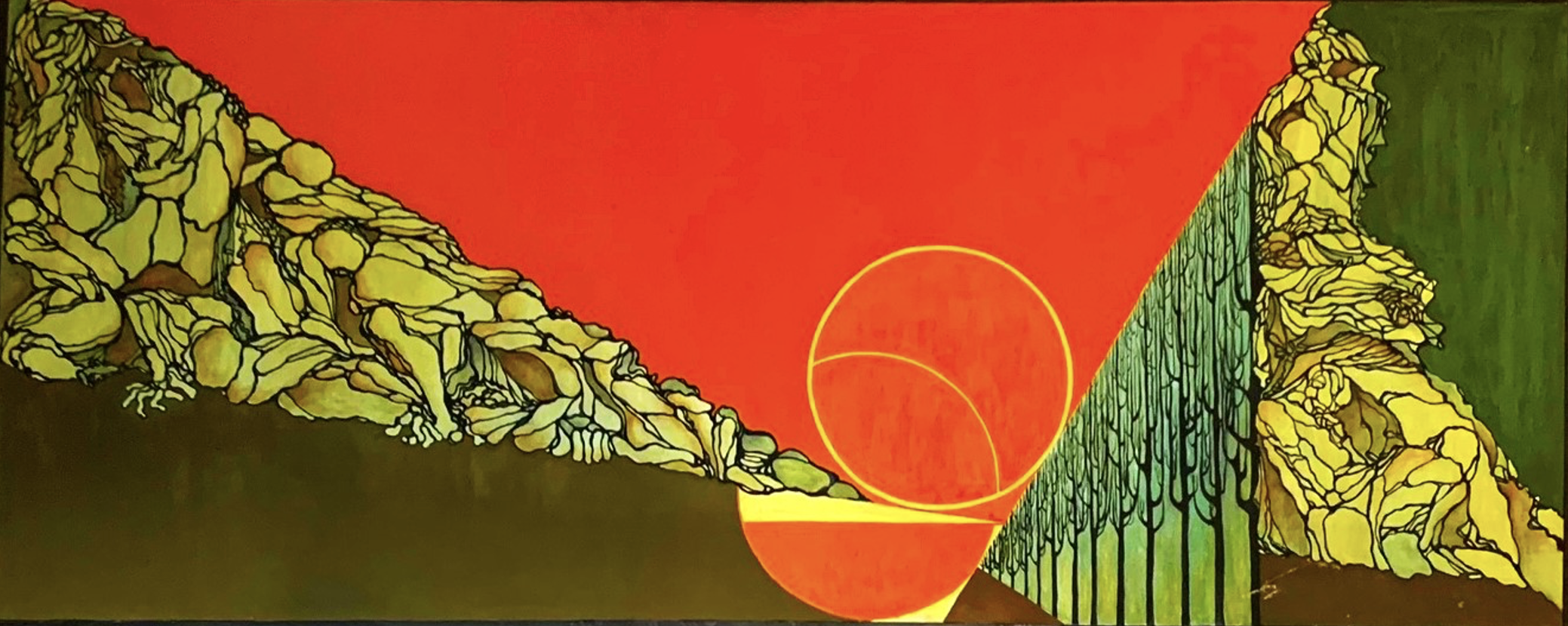
A mural in tribute, Beirut, I977. Acrylic, 203x81 cm.
Aesthetics and historical writing/thinking have rarely, if at all been brought into a single context. From a traditional-conservative-limited perspective the initiative may seem to be a travesty of the integrity of two distinct disciplines, as most people grant; aesthetics is a branch of philosophy, and history is a major social science. Indeed, recently I submitted the abstract of the theme to an SAS general conference, it was turned down. The committee was probably shocked to the point of losing even intellectual curiosity.
As an academic branch of philosophy, and by dictionary definition, aesthetics is defined as the systematic study of beauty and taste. It evaluates how we perceive objects and why certain things evoke positive-pleasurable emotional responses and others the contrary. The term comes from the ancient Greek word aisthetikos, which means ‘related to sense perception.’ German philosopher Alexander Baumgarten (1714-1762) defined it as the "criticism of taste." As a noun, ‘aesthetic’ refers to a look, a vibe, or a set of design principles that define something or a person.
By historical thinking/writing I mean the activity of studying/analyzing/interpreting texts about events and people in temporal-spatial context and producing/creating a text as a reflection-judgment.
In this context, I strongly suggest that a historical text is ultimately a writing by a person, who has his own perceptions, interpretation of texts/events, definitions of their truth, and accordingly, arranges a narrative that has certain prepositions and a literary form, hence the ‘aesthetic’ of the historical text. Like any work of art, a historical narrative/text is an artifact. Texts cannot claim to be objective and precise re-enactments and reflections of events as they happened.
This is a foundational preposition based on a non-essentialist and critical perspective. As such, it is diametrically opposed to mainstream Armenian historical thinking/writing, including and especially the so-called strictly objective historical studies of recent times. From medieval periods, narrow-essentialist and eventually nationalist paradigms in Armenian historical thinking/writing left out a vast amount of unstudied yet well-documented cases in Arab histories. The paradigm cases that I discovered over decades stand as counterpoints and counterarguments against commonly granted narratives also models of explanation in this discipline.
Furthermore, a critical and hermeneutical approach to historical thinking/writing, a phenomenological perspective and shift of paradigms will inevitably will open – as they did in my work - new and different geoglyphs of the Armenian historical experiences in the entire Near Eastern region. A novel discipline of Islamic-Armenian studies, to which I have dedicated six volumes and many studies, was the result. [8]
I. Historical narratives as artifacts
“Ceci n'est pas une pomme” (this is not an apple) is a painting by René Magritte (1898-1967) made in 1964. A seemingly simple sentence and bizarre reminder to the viewers that what they see is an image of an apple, as he saw and painted it, sums up a powerful aesthetic theory about the arts and literature.
Magritte, who painted fully dressed in a dark suit, tie and bowler in the corner of his living space, means that the painting is an artifact and as such a different entity with its own type of existence. In sum, the similitude of the object in the painting to something out there, in this case an apple, is irrelevant to its truth content and aesthetic value.
I suggest that the same can be said about a historical text. It is not history, it is an artifact. It is just an artifact made by someone at a certain point in time and circumstances, arrived at by certain methods, from certain sources, and with certain interpretations. It is very common to have different, even contradictory accounts of the same episode.
Even though Herodotus (484-425BC) is known to be the “father of history”, in my view The History of the Peloponnesian War by Thucydides (d. c. 400 BC), an Athenian general, is one of the earliest books of history. In the form of a meticulous report of the events of the war (431-404 BC) – as Thucydides repeatedly emphasized – the book is more of a sharp political-philosophical analysis of the war, politics and human nature in a superb narrative and refined language. It has its aesthetic as an artifact created by a superior mind about a specific episode in Greek history. The other mostly partial accounts of the war do not suggest a similar image of the war, even if the basic events are the same.
Another case of the same period is the story of the trial and death of Socrates in 399 BC, five years after the war, which ended in the defeat and downfall of Athens. The event has two accounts by two very different contemporaries: Xenophon, a military man, and Plato, a young, erudite Athenian nobleman. Even though the proceedings in both are similar, two distinct characters of Socrates and radically different images emerge from each. While the Socrates of Xenophon is a slightly boastful, annoying moralizing old man, it is hard to imagine Western philosophical thought and intellectual culture without the legacy and image of the Platonic Socrates, as drawn in The Apology of Socrates, one of the early dialogues of Plato. The Apology practically marked the beginning of the Western philosophical tradition, that Alfred North Whitehead described as a “series of footnotes to Plato.” A careful reading will detect the beginnings of the Socratic dialectic perspectives, existential, even critical thought there.
From epics, mythologies, poems, chronicles to modern histories, historical thinking/writing has been one of the most ancient and important literary genres. The Greek word historia meant inquiry, or search of knowledge, not story, account, report or record. Many tend to forget the roots of this discipline.
In recent times traditional historians have come under attack for logically loose narratives, unfounded criteria, unquestioned assumptions, and intuitive methods. Because mainstream approaches, still maintained by many, are based on a questionable epistemology, rigid essentialism and sometimes underlying ideologies and mere beliefs. One of these beliefs is that things have identifiable essences/meanings, and that based on this certainty, it is possible and necessary to construct historical narratives as unmediated reflections of the past. The confidence to have attained certain knowledge of things historical, past and present, lacks epistemological and empirical grounds.
The belief held by many mainstream historians that a historical writing is history, is like saying the image of an apple is an apple. Therefore, the idea that various studies are accurate reports and re-enactments of the past arrived at by ironclad research methods, is no longer acceptable. [9] The impassioned observer, and the “objective chronicler” are impossibilities, and there exists no comprehensive "recording machine.” [10] Almost canonical descriptions and grand narratives with claims to universality are things of the past, but they remain artifacts with their peculiar aesthetic. As H. White (1928-2018) says, history is “invented” as much as it is “found.” There is a subjective and deep structural content created by the historian/writer, which is the "metahistorical element”, that cancels the claim to universality. [11]
Philosophy of history, or critical examination of historical thinking/writing is very recent. It concerns not just philosophers, but all scholars in social sciences and the humanities because historical knowledge concerns everyone. It is not only philosophers who ask questions. The opening up of historical analysis to interrogation is at the heart of contemporary thinking, and there can be no sharp distinctions between so-called history proper and philosophy of history. Furthermore, philosophically sound perspectives are vital for everyone, because people learn about themselves and their world from history books too. What they learn makes a difference in what they do or may and will do. As someone said, “history is too serious to be left to historians alone.”
II. The aesthetics of historical thinking/writing
Both the process and the product of historical thinking/writing have their aesthetic. By the aesthetics of historical thinking/writing I mean the totality of the questions, perceptions, sensibilities, contradictions, tensions, insights, visions, as well as the formal and methodological criteria that go into the making of a relevant and engaging text in historiography, which by dictionary definition is the critical study of historical narratives, writing and accounts, also widespread beliefs in the public.
I also posit that this comment applies to any artifact in many disciplines and areas. Because all meaningful artifacts are/must be essentially autonomous responses to lived experiences, Elbernis, and never commodities on the academic and the intellectual/academic ‘markets.’ I totally adapted the concept of Heideggerian “situatedness”, almost instinctively long before I even read him, comes in this context.
For Martin Heidegger (1889-1976), a student of Husserl, the scientific attempt to step back and examine an object ‒ in the social sciences and the humanities one may add ‒ leaves it out of its actual context. He therefore introduces his notion of “Dasein”, literally “being there/here”, in which the self and the world belong together in a single entity. The concept focuses on the contingent situatedness of the human condition in a set of spatial-temporal circumstances, that are not entirely of their own making, and that they cannot leave behind at will.
There is an ontological unity in the concept of Dasein or “being-in-the-world.” This is ‘situatedness.’ It means the interconnectedness of perceptions, reactions, social-historical experiences and circumstances. Understanding and reflecting human situatedness are simultaneous motives and objectives. We can never achieve a complete, or so-called objective interpretation since we are limited not only by language but our historical situation as well, our situatedness. [12]
For philosophical hermeneuts, and Hans-Georg Gadamer (1900-2002) in particular, what matters is not the process of reaching understanding, it is what happens to us over and above it. Furthermore, hermeneutics is not about the recovery of existing meanings, but instead, it is the creation of meaning. There is an intersection, rather, a convergence, and a fusion of “horizons.” Understanding combines previous and new meanings, Gadamer defines “horizon” as the range of vision that includes everything that can be seen from a particular vantage point. The horizon of the past, out of which all human lives and traditions come, is dynamic, and the hermeneutic act is a fusion of horizons of the past and present. In the end, as Gadamer suggests, truth does not necessarily exist in the world alone, it is continually fixed and unfixed in our continual relationships with our world/s, hence its essentially dialectical nature.
Both my scholarship and art are essentially occasions and contexts for encounters and convergences. While the former mean confrontations and dynamic relationships with everything, the latter are meetings, and the generation of new “horizons”, where things come together both for understanding and aesthetic enjoyment. Circumstances change, so do the “horizons” of encounters and fusions. As new writings and artworks unfold new insights, and despite bleak foresights, possibilities of change seem to be more possible. The sensitivities of artists and intellectuals, also the depth of their understanding vary, but always their work reflects their distance from and concern for these issues. In the end, the “truth-content” of the given work becomes the measure of its significance and value.
III. The counterpoints in my historical thinking/writing
Clearly, my perspectives are critical-hermeneutical, non-essentialist and not Armenocentric. My works deviate from, and often contradict mainstream traditions, norms and practices in Armenian Studies. My last and sixth volume in the subject of Islamic-Armenian interactions was Islam in Armenian Literary Culture. Texts, Contexts, Dynamics (Louvain, 2021). I wrote and published five other volumes and a few dozen extensive studies in the same line. The discipline that I initiated is novel, not only for the data discovered, but because it could only be possible by a radical shift in philosophical and methodological vantage points on the Armenian historical experience. A phenomenological, holistic and critical approach to historiography as a critical and interdisciplinary field opened novel aspects of the Armenian historical experiences. The resulting panorama, rather geoglyph manifested an infinite variety of Armenian historical experiences and new paradigms in the broad Near Eastern region. Inevitably, my works stand in direct contradiction to mainstream accounts, including recent ones.
From the beginning, my foundational argument was the following: If, from the middle of the seventh century all the Armenians in their homeland and the larger habitat from eastern Asia Minor to the South Caucasus and the Tigris, including the modern Republic were part of the Islamic world, and if until a few decades ago the entire region, from the Black and Caspian seas to the Mediterranean, including Iran, Iraq, Syria, Lebanon, Palestine and Egypt, was still the oikumene or habitat of most of the Armenians, their history too was naturally part of these locations and peoples. This is an obvious situation. Armenians lived there as integral elements and their world was governed by the same laws that governed the region. In elementary Newtonian terms, the law that makes the apple fall is the same that keeps the moon in orbit.
However, this is a rarely adopted or even accepted perspective on things Armenian. But in most Arab histories of the region, this is how Armenians were seen and referred to. In these texts, the Armenians and what is known as Armīnyah are very broad concepts. Not because in Arab histories Armīnyah is a much larger area than the one referred to in Armenian histories, but because the Armenians, or al-arman are considered as natives of the larger region and referred to whenever and wherever found. In contrast, in traditional also modernist Armenian histories restrictions on class, faith and location greatly narrowed and distorted all accounts. Many episodes and phenomena that I discovered in Arab sources, such as the Fāṭimid Armenians, are instances. Therefore, I argue that since history has no secret pockets and private laws, things Armenian are also things Near Eastern and must be conceptualized as such. This has not been the case, and this is where my historiographic position and work take their urgency, relevance and legitimacy.
As referred to earlier, countercases have been my tools to reveal discrepancies. They are counterpoints. These are well-documented paradigmatic cases that stand against and contradict traditional perspectives and narratives. Over decades, the counterpoints that I excavated from primary, and mostly Arab sources, were counterarguments for a broader, multidimensional, and dialectical expanse of the lived experiences of the Armenians in the Near and Middle Eastern worlds. This philosophical-critical approach suspended commonly accepted narratives and practices of mainstream Armenian histories.
Someone has said that cultural meanings and images are like traffic lights, they are valid only for those who move on those roads. However, if someone decides to take other, more direct and “scenic” routes s/he will bypass those lights, and they will simply lose their significance and legitimacy. Obviously, mainstream ‘traffic lights’ are not routes to so-called historic ‘truths’, they seem to be paths to public legitimacy and positions. For fresh starts, these ‘lights’ must be set aside, because explicitly and/or implicitly they are based on assumptions and agendas. As accounts of the past or present, they are simply symptoms of existing problems. Furthermore, like Adorno’s “culture industry”, the historical ‘goods’ of Armenian mainstream narratives are not only mass produced but also designed as per the criteria of the cultural diplomacy of local, partisan and/or national Armenian institutions in dominance in the Republic and everywhere. In view of the relativity of most, if not all cultural ‘traffic lights’, all accounts will have to be deconceptualized or simply overlooked. The paradigm cases that I found were practically counter-cases, counterarguments, or counterpoints. I therefore took counter-routes with no institutional ‘lights’ to move to new and unbroken grounds.
IV. The beginnings and the path
On the existential level, for me personally – a multi-lingual and multi-cultural Armenian native of the Arab world with ancestors from the East and the West of the West Armenian World – being an intellectual and a historian meant actively participating in the traditions of my region and ‘being’ historical and philosophical, not just ‘doing’ history and philosophy. Art too was just a manner of responding, perhaps a talent too, but always a regulative-balancing force. From the beginning, as a perceiver-thinker-writer-artist, in my responses, thoughts and praxis, I was aware of the inherently hermeneutical nature and the liminality of my opposition. My understanding of things Armenian seemed to cross the limins, or the thresholds, connecting different worlds, the known and the unknown, the concealed and the unconcealed.
My interest in the Armenian historical experiences in the Islamic Near Eastern world was triggered by a ‘discovery’ I made as a graduate student in philosophy. I demonstrated that an obscure medieval text entitled Views Gathered from the Writings of Tajik Philosophers by Vardapet Yovhannēs Erznkats‘i (d. 1292/3), written around 1260 – as I showed ‒ was simply a beginner’s summary of the tenth century Islamic esoteric compendium of sciences, known as the Epistles of the Brethren of Purity or Rasā‘il Ikhwān al-Ṣafā’. In Armenian Studies the Views was believed to be an original work but with a reference to Islamic culture, made at a much later period in the career of Yovhannēs. I demonstrated that this could not be the case, and more importantly, the initiative to summarize an esoteric compendium in a beginner’s language and background revealed a very different social-cultural urban stage at the time in Erznka and Asia Minor, or the Western Armenian World, that was very different from the one granted in Armenian sources.
“Humble” Vardapet Yovhannēs from Erzinjān/Erznka, as he identified himself, threw an even bolder, more intriguing, and in turn undetected bridge into Islamic urban culture: In 1280, he wrote the Constitution for the “reform and regulation” of the urban coalitions, or the Armenian Brotherhoods of the manuks (synonym of Islamic fatā) of this cosmopolitan city. As I demonstrated in several studies textually and in detail, this Constitution had no precedent in Armenian literature and was a direct adoption. Yovhannēs simply Christianized and Armenized ‘Abbāsid Caliph al-Nāṣir’s (r. 1180-1225) reform decree and futuwwa literature of the early thirteenth century.
I also argued that it was the cosmopolitan urban circumstances and extra-ethnic and religious nature of the Armenians that allowed the application of an Islamic Futuwwa Constitution, by the Church, at Erznka and the other cities of the Eastern Asia Minor. Much later, in the sixteenth, seventeenth, eighteenth and nineteenth centuries, the Constitution was still applied in the Armenian communities in even East European cities.
Furthermore, based on the poetry of a younger contemporary and compatriot of Yovhannēs, Costandin Erznkats‘i (b. circa 1250) – also closely related to Arab-Persian futuwwa poetry and coalitions – I argued that often described as hedonistic and chaotic young men of the cities — which in fact they were — both by medieval Armenian and Islamic authors, the folklore of these youth coalitions lay the grounds for the secular and post-medieval and cosmopolitan culture of the urban lower and middle classes in the entire Near East. This is basically my initial argument: the Armenians were integral parts of this wide world, hence the interactive nature of their lived experiences and the necessity to review mainstream historical accounts.
In philosophical hermeneutics the case of the Views- Rasā‘il would be called “relevant information.” It means new knowledge, which becomes a new tool for understanding a problem. It has an ontological significance too: given this new knowledge, the same topics and objects will not be seen in the same light anymore. New knowledge will smash our horizons and force us to seek and form new ones for inquiry and understanding. “Relevant information” may overturn all relationships, because it has transformative dimensions. Our awareness of ourselves will increase and both as individuals and community, we may find alternative ways of seeing and interpreting things.
Indeed, the case of Views-Rasā’il signaled the beginning of a long path before me. With no roadmap or institutional or even moral support from peers, the journey into understanding the Armenian historical experience in the Islamic worlds started as a lone venture into twilight zones and unchartered territories of things Armenian. Specific cases, or counter-cases were my guides and tools.
The obvious hypothesis, which was also my foundational preposition and from the beginning, was that there are things in Armenian and Near Eastern intellectual and social cultures that must be specifically categorized and studied as primarily ‘things Islamic-Armenian.’ Furthermore, taken as distinct themes, they generated their own peripheries for a novel discipline of Islamic-Armenian studies, which was relevant, contemporary, otherwise interdisciplinary, holistic, and critical.
The discipline, that I initiated was an alternative route that would break the impasse created by mainstream, often nationalist and presumably academic accounts of things Armenian. More importantly, it would also reveal the methodological and philosophical insufficiencies of the micro-Armenological and verbose studies recently at large.
Begun in 1987, the research and studies for the degree of Doctor of Sciences in Philosophy literally marked the beginning of a new discipline, Islamic-Armenian Studies. It was a response to my condition as an Armenian native – including all my ancestors – of the Near Eastern World, simple as that. My Dasein, or ‘being there’, my ‘situatedness’ in that world of which I was part, was the context for all the processes. The work made sense and pleased me to have opened a new Armenian geoglyph much closer to and expressive of the lived experiences of all the Armenians, and in particular those in the western Armenian World. I started composing – as one does in a painting or a musical piece ‒ a novel, rich, and beautiful expanse of things Armenian in unique patterns and dynamics, hence the aesthetic of these texts (six volumes during three decades from 1991 to 2021, and many studies). [13]
The Centenary of the Genocide in 2015 prompted my bilingual book on the Armenian Conditionin Hindsight and Foresight. As editor and author, I worked on a mammoth “catalogue” of sorts, entitled The Catholicosate of Cilicia - History, Mission, Treasures. [14]
Situatedness also implies a temporal unity of the given situation: the past is also part of the lived experiences, therefore it must be made relevant to it. This is a ‘modernization’ of sorts. Recently, as I worked on the peculiar case of an otherwise a ‘saint’ of the Armenian Church, Nersēs IV Shnorhali (1100-1173, r. 1166-1173), otherwise a “most familiar stranger”, I raised the necessity to modernize historical data to make them relevant and relatable. Sainthood, and the actual careers of saints are almost vacuous concepts that also drain meaning and relevance wherever applied.
In contradiction to most studies, and they are very many, I focused on the political-diplomatic aspect of the legacy of Shnorhali, as “saint” and “diplomat” on the regional level. At least two other “saints” of the Armenian church were shrewd political actors in the Islamic world, catholicoi Sahak III Dzorap‘orets‘i (r. 677-703), and Yovhan III Odzets‘i (r. 717-728) (the theme of another book, also published in 2025). Yovhan III Ōdznets‘I Saint, Jurist and Great Master of Armenian Mesopolitan Culture and Diplomacy. [15]
The portraits of Shnorhali and Yovhan III as diplomat-saints has a far superior aesthetic, as well as truth-content than the two-dimensional medieval figures of the manuscripts. This compounded and complex portrait of the saint-diplomat is a novelty and a counterpoint. As such it is a starting point to review similar personae over the entire expanse of Armenian history.
In general, the Armenian historical experiences in the medieval Near East as well as the modern Middle East were and still are too diverse, mobile and complicated. Constructs based on the idea of an ancient, heroic, persistent and struggling Christian people in the move, are too narrow.
To avoid dangerous essentialism and anachronisms, Armenian histories should try to comprehend and reflect this condition. Unfortunately, there is a diplomacy of Armenian mainstream historical writing, and an underlying grid that is obstructive. Younger academics seem to float on the current too.
At present, being a historian and a scholar in general is more than just self-identification and self-categorization. It means making a choice between being part of this mainstream ‘politics of truth’ or a critic of it, being a contributor to the “culture industry” or its adversary and reformer. The latter describes my position. The arguments in my studies reflect this polarity. Despite the odds, this has been my path in an unchartered territory with “forbidden” stops as well.
To be an authentic historian will probably mean to face up to one’s career as an intellectual and stay away from “traffic lights” for easy fame, institutional validations and popularity. People will have to understand themselves not by mass-manufactured narratives and so-called scholarly ‘goods’ at Armenian centers and clubs, but also from without and through their existential connectedness to all things, and their dynamic cognitive experiences. By its motives and objectives my historiographic work is a statement very different from what mainstream historians understand as history. It is an oeuvre of aesthetic concerns and dimensions by the existential tension in its making and methods, hence its truth content.
My most significant contribution to Armenian historiography will probably be the aesthetic of my historical thinking and writing, as mentioned. By the motto of Plus Ultra, or “further beyond” the Pillars of Hercules between the Mediterranean ‒ or the small pond of Armenian studies ‒ my journey aimed at crossing into the Atlantic, the broad ocean of contemporary Near Eastern studies. There is a more intriguing and aesthetically superior Armenian history out there, in the “land of unknown” beyond those pillars, as Plato would call it.
The Artwork and the Dialectics of Truth Content
(Scheduled for May 2, 2024 at AHCP, delivered at AGBU, NYC, March 3, 2025)
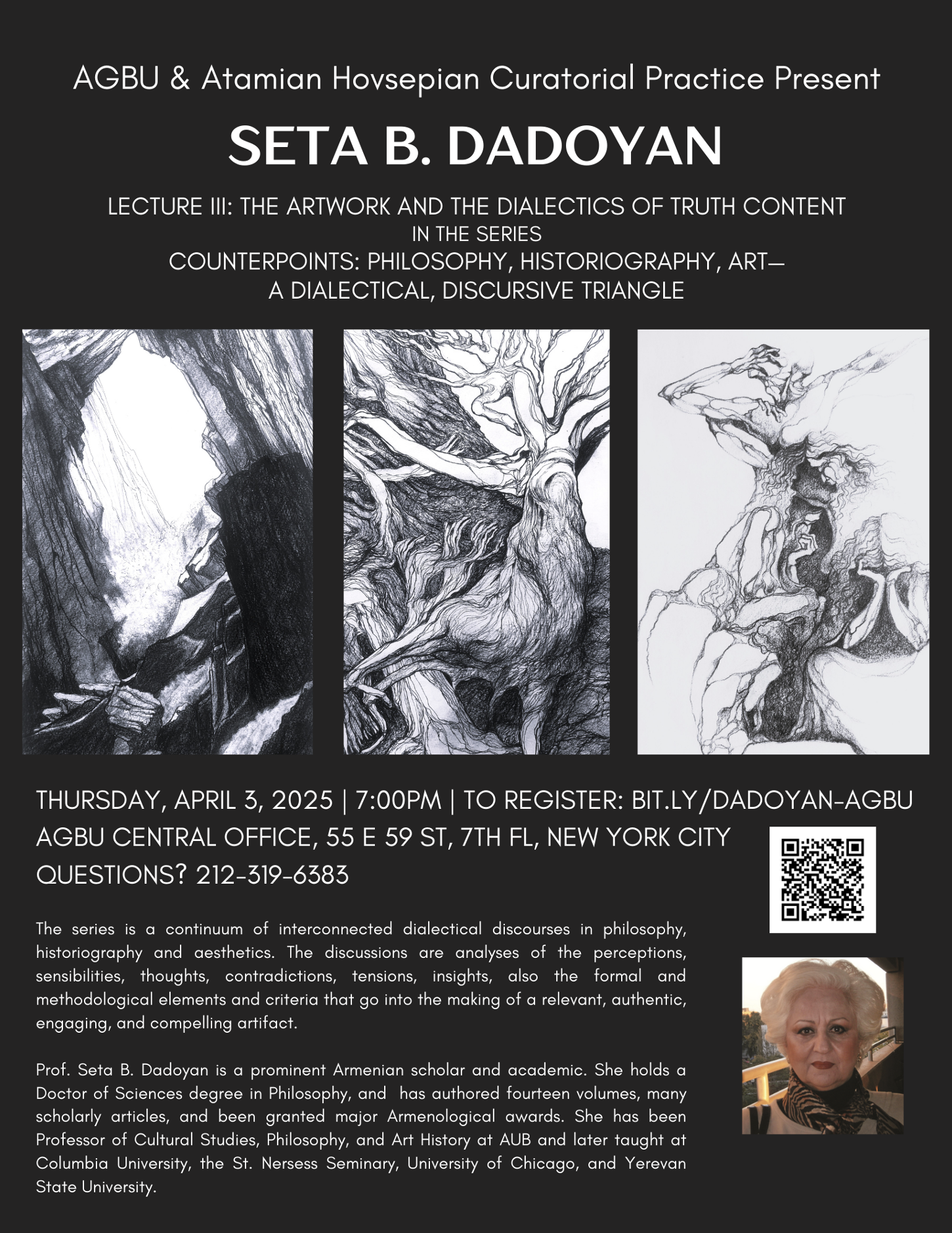
Theoretically, this is the most ‘aesthetic’ pillar of the dialectical-hermeneutical-discursive triangle. The first pillar was philosophy, the second historiography, the third art. It is in two parts.
In Part One, after a brief discussion of aesthetics as a branch of philosophical sciences and its development, the focus is on some foundational concepts: the autonomy of art, its cognitive import, the social-historical embeddedness of arts, the ‘culture industry’, hermeneutical ‘horizons’, and ‘truth-content.’ In the end I propose my theory of concretization as an alternative theory of aesthetic judgment. Part Two is dedicated to the presentation of the book, Encounters and Convergences. A Book of Ideas and Art, which occasioned the talks. Twenty-one of my drawings from 1975 to 2022 (in two phases, 1975-1991, and 2022) are featured in this part.
PART ONE
I. Aesthetics, theories and development
II. My aesthetic and four foundational themes
A. The autonomy of art and the “culture industry”
B. The cognitive import of art
C. The social-historical comportment
D. An alternative approach: Concretization and the artwork
I. Aesthetics and Foundational Concepts
Coined during the Enlightenment after the Greek word aisthetikos or sensory perception, aesthetics is the ‘science of perception’, because all artworks are objects of perception. Since they are objects of knowledge too, aesthetics is often called philosophy of art.
The first to reflect upon the arts were Plato and Aristotle, the latter more systematically. Most philosophers refer to art, focusing mainly on its ontology, or ‘what art is’ also its status and role. Art has been defined differently, as imitation, madness, catharsis, beauty, taste, judgment, pleasure, understanding, play, expression of emotion, psychological needs, spirituality, and insight. At present the question about the nature of art is essentialist, too narrow and somehow anachronic, leaving out vital issues related to the arts.
At the end of the eighteenth century, or the Age of Enlightenment, Kant’s (1724-1804) Critique of Judgment (or the ‘third critique’, written in 1790, after the Critiques of Pure Reason, then Morals) was the first modern book of aesthetics. For the first time Kant introduced the concepts of the formal autonomy of art and aesthetic judgment. A few decades later, in the nineteenth century, Hegel (1770-1831) brought up the intellectual import of art, and especially its cognitive and historical significance. Marx’s (1818-1883) contribution was to highlight the social embeddedness of the arts. Nietzsche (1844-1900) defined art in existential terms as a necessity to survive the suffering and chaos of life. Soon, Freud (1856-1939) explained its deeper psychological dimensions. In 1930s and later, the Critical Theorists of the Frankfurt School, and Theodor Adorno (1903-1969) in particular, developed a most intriguing aesthetic theory since Kant, Hegel, Nietzsche, and Freud. Adorno made a synthesis of the previous theories but in an original and powerful critical-dialectical context. Practically, he is the initiator of a contemporary discipline of aesthetics as an important part of the humanities and social sciences.
II. My Aesthetic and the Four Foundational Themes
A. The autonomy of art and the “culture industry”
First formulated by Kant, the concept of the autonomy of art metamorphosed into a more comprehensive aesthetic theory in Adorno’s work. However, while by autonomy Kant meant the independence of art from desire and practical purpose, Adorno brought autonomy into the artist and the creative process. In this perspective art is defined as an autonomous expression of total human freedom, opposed to all that hampers it. This is indeed an idea that is hard, rather impossible to ignore or dismiss.
As discussed earlier, the concept of autonomy is central to the theory of “culture industry” initiated by Adorno and his teacher Max Horkheimer around 1930s. A legacy of the Frankfurt School, it is now a widely accepted theory. As a societal phenomenon, the content of an artifact – be it scholarly or artistic – is inseparable from its truth content, hence its legitimacy, while untruth and irrelevance mark its failure. As we look at the marketplace of the arts, culture and entertainment, and despite seeming and apparent liberalism, abolition of criteria and rules, there is massive standardization as a powerful policy. As Arthur Danto (1924-1913) puts it, there exists an “artworld”, and there are art-markets. Therefore, the focus is on the marketability of the artworks, meaning and relevance seem to be irrelevant. Inevitably, artworks have become commodities, accents and often screams. Mixed with mass media, social media and entertainment, the arts are also instruments of homogenization and standardization. The public stands outside and anyway is a captive audience that often cannot even enjoy the artworks because it cannot relate to or understand them. Fashion and pop arts are in the same situation as instruments of homogenization.
Over a century ago, in totally different social-political-cultural circumstances, most artists of the absurd, Dada, readymade, avant-garde, and related movements presented their works on wings and cushions of certain philosophies of “contemporary art.” These practices are still very dominant and assimilated into the fabric of consumer society.
However, as Jorgen Habermas (1929-2026), another critical theorist, says, their modernism is now “dead.” One cannot talk in any seriousness on the aesthetic path drawn, truth content and justification in the works like Tracey Emin’s (1963-) “My bed” (an actual filthy bed), Mary Kelly’s (1941-) postpartum “stuff”, the cut-out-dead sharks of Damien Hirst (1965-), and thousands of similar works. Their aesthetic message and legacy are limited and consumed in the initiatives. There is no cognitive nucleus or challenge, and it is hard to imagine that an artwork can stand on an abstraction, a reification in the mind of the artist, or an article in a national paper by a self-proclaimed art-expert. Major museum shows, verbal appendices in papers, publicity and sale value may have a temporary role in the propaganda and sales, but they are not part of the work, therefore aesthetically and in the long run irrelevant.
B. The Cognitive import
Initially a legacy of Hegel, the cognitive aspect of art was further elaborated by Adorno, but differently. “Every artwork”, says Adorno, “if it to be fully experienced, requires thought, therefore stands in need of philosophy.” [16] As carefully planned artifacts, works of art have their inner logicality, which however is different from discursive reasoning. Yet, like in a syllogism, one step follows the next by a formal necessity, and the work gains its logical consistency, coherence and unity. For Adorno aesthetic logic has a greater degree of latitude than ordinary logic. [17] I believe that great artworks defy ordinary reasoning without negating it.
C. The social-historical comportment and embeddedness of the arts… was an aspect of aesthetics that developed during the nineteenth century and metamorphosed with greater force in Critical Theory. According to the latter, contradictions in social-political circumstances crystallize in the “truth content” (in Adorno’s phrase) of the work, hence their social comportment.[18] Therefore, the “truth content” of an artifact is necessarily historical by the objectivation of genuine perception and social consciousness. [19][19] Ibid., p. 191. It is the historical outcome of an artist’s response and treatment of an experience. Authentic works, says Adorno, are the “self-unconscious” historiography of their times, [20] and La Guernica of Picasso immediately comes to my mind.
D. An alternative approach to aesthetic judgment: Concretization and the artwork
Based on these few concepts outlined above, and as an alternative approach to aesthetic judgments, I suggest a paradigm shift from the artist to the artwork. My alternative theory is that the artwork is all there is. I suggest shifting the focus from the ontology of art, or “what art is/should be,” to the artwork itself as a concrete entity, a thing-in-itself. It is something created in solid aesthetic form and a content that has a specific social and historical comportment, or a bearing. By truth content I understand the unity of the formal structure and the meaning of the artwork, which develops through their internal tension. Critical judgments about the work must therefore consider the internal dynamics of the work and the aesthetic-intellectual-social-historical totality, or its situatedness, at which it starts and which it reflects. Therefore, truth content is not a metaphysical concept, or some sort of essence that hovers outside the artwork in the mind of the artist; nor is it a construct. It is deeply human, historical, utopian in its reach, yet firmly rooted in specific circumstances. It is the way in which an artwork simultaneously challenges the way things are and projects how they could be existentially more relevant. [21] A true artifact is a journey to encounter new knowledge and sensibilities, both by the artist and the viewer. It must be worth taking, and the more enriching it is the greater is the work is.
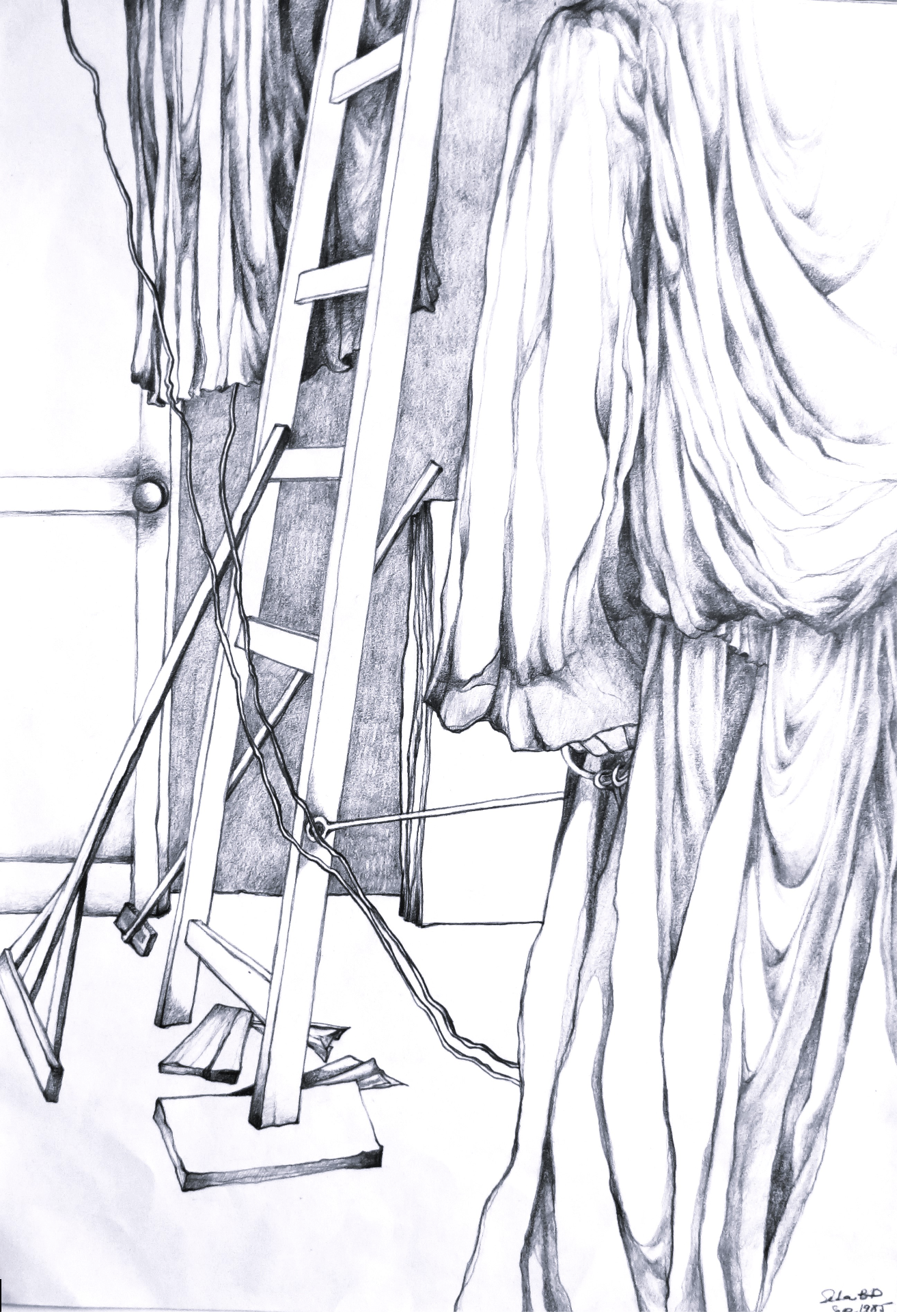
Situatedness, Beirut, 1985. Pencil, 36.5x25.5 cm.
PART TWO
I. Encounters and Convergences. A Book of Ideas and Art
II. The Quest and the Path
Encounters with strife and suffering
Wartime Art and Aesthetic
III. Spirit of matter
I. Encounters and Convergences. A Book of Ideas and Art
An amalgam of philosophy and art, this Book of Ideas and Art, as per the title, is written as an oeuvre, or a statement about my art and scholarship in terms of encounters and convergences. While encounters mean confrontations and dynamic relationships with everything, convergences are meetings and the generation of new “horizons” where things come together for understanding and aesthetic enjoyment. Circumstances change, so do the “horizons”, both in writing and art.
The purpose of the book is to communicate in words and images encounters and convergences with challenges and contradictions at different phases of my life. It is therefore self-reflective in conception, cross-disciplinary in scope, dialectical in method, hermeneutical in approach, and artistic in expression.
In the case of both my scholarship and art, the effort to arrive at “horizons” for convergences has been existential or directly related to the meaning of my existence. I strongly share the hermeneutical perspective on the relationship between the inquirer and the object of knowledge. The researcher is part of the research, so is the artist of the work. They are one in the cognitive as well as the creative process to reach new meanings and understanding. The sensitivities of artists and intellectuals, as well as the depth of their understanding, vary, but their works always reflect their distance from and concern for these issues. In the end, the truth-content of the given work becomes the measure of its comport and value.
Understanding my social-historical situatedness, or my condition, has always been both a motive and a purpose. This condition, that I share with a great number of Armenians, is being a multilingual and multicultural Armenian native of the Near East, with immediate family and ancestors driven from the extreme West and the extreme East of the Armenian World. It means having multiple hyphenated identities and inheriting multiple legacies of ancient and modern civilizations, peoples, cultures and faiths, including my own. In the processes of acculturation, this condition required an urgency to understand the Armenian historical experience in comprehensive and critical terms, and not through assumptions and semi-epic narratives on the cultural marketplace, hence my work in philosophy and history. Researching, writing and painting meant engaging in discourses and debates within myself and with the different worlds and communities I was part of. Both my scholarship and art required ‘being’ historical and artistic in a personal and direct manner, and not just ‘doing’ history, philosophy and art by training and career. I wrote and painted at specific periods and in response/reaction to specific circumstances. Therefore, the second part of the book, ‘The Quest and the Path’, had to be structured on a schematic autobiographical grid.
Opposed to conventional and so-called strictly academic or primarily artistic practices, this book is also an illustrated argument, of sorts, in support of my aesthetics (as briefly outlined earlier), and my interdisciplinary perspectives and career. Like other contemporary thinkers, I consider dichotomies between disciplines, and narrow specializations artificial and “schizophrenic,” as F. Jameson (1934-) puts it. Furthermore, isolating art and artists as distinct entities miss and distort their social, historical, intellectual and aesthetic significance and dimensions.
II. The Quest and the Path
This part is in four chapters. I trace my path from my birthplace Aleppo to universities in Beirut (majoring in fine arts and philosophy), marriage, travel to London to study figure drawing – that I immensely enjoyed ‒ then back to Beirut for graduate studies in philosophy, teaching at AUB, working for my Doctor of Philosophical Sciences. A cataclysmic experience with an art instructor in my undergraduate years halted my art. I returned to art in 1975, at the beginning of the civil war in Lebanon that ended seventeen years later in 1991, so did my first phase of drawing. Only after three decades, in New York and during the Covid 19 Pandemic, I went back to my art.
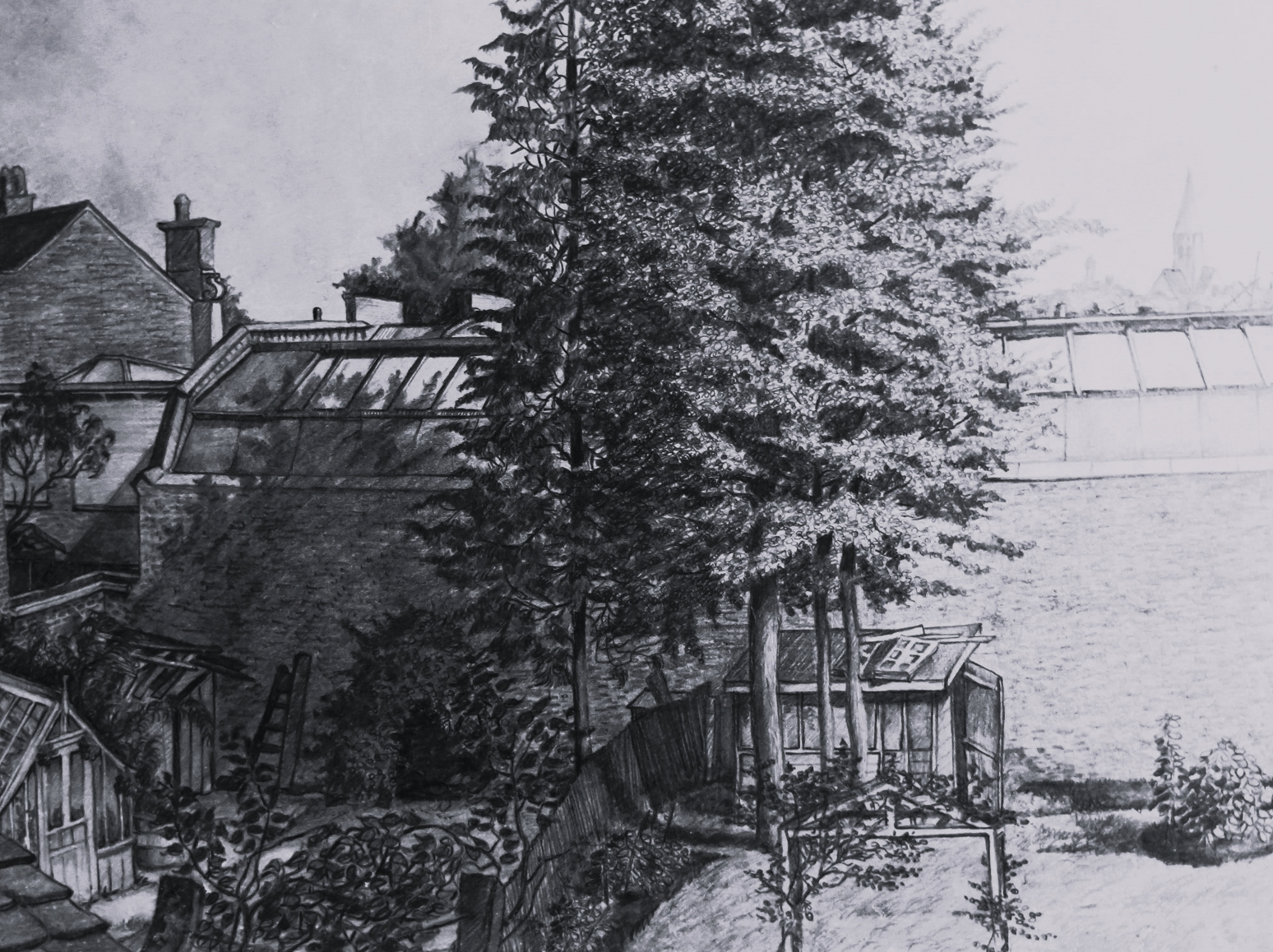
Our backyard, 56 Woodstock Rd, London, 1966. Pencil 56.5x35.5
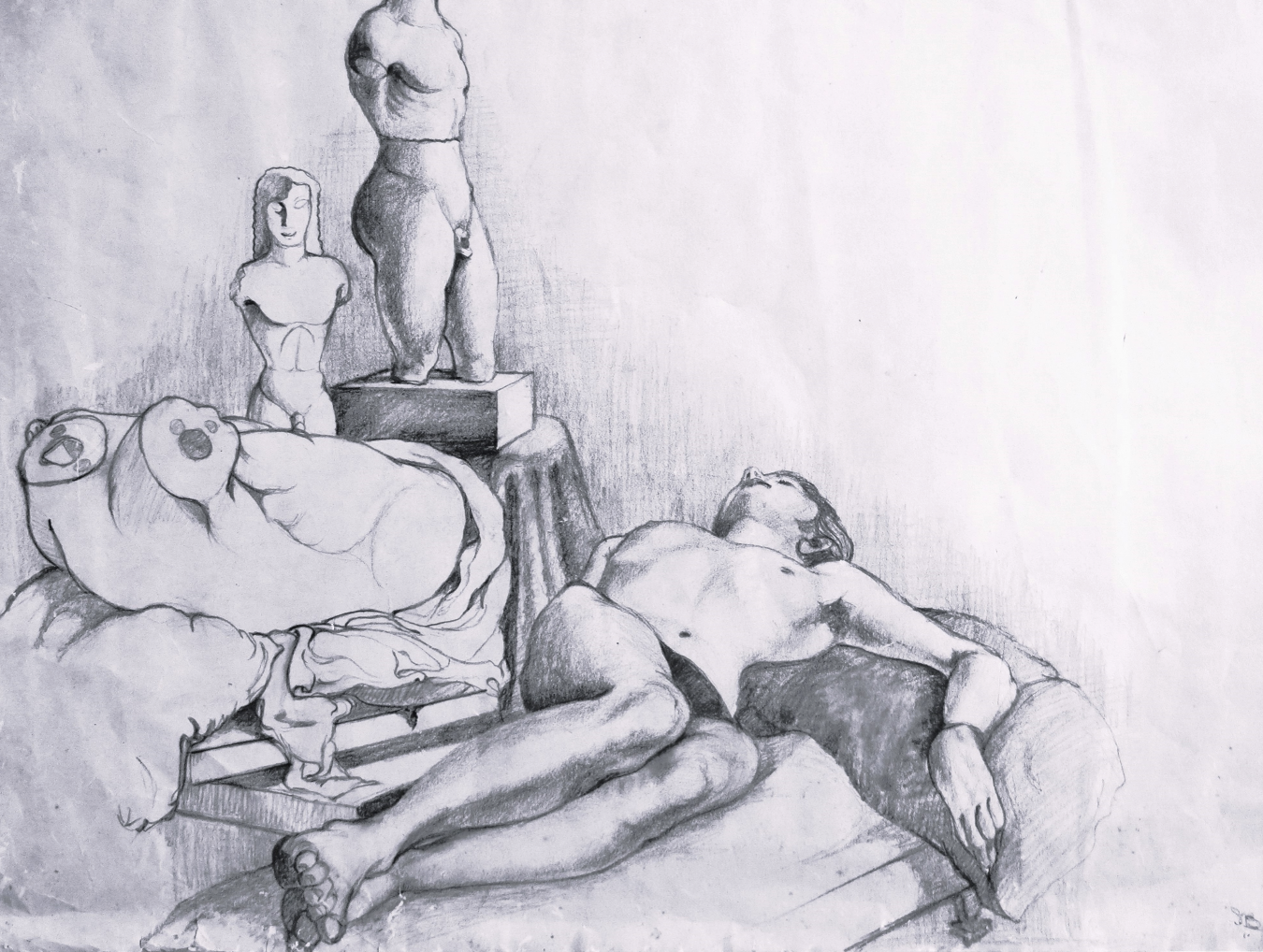
The classics of the studio, London, 1966. Pencil, 23.5x35 cm
Encounters with strife and suffering
We were in Dayton, Ohio, when the war started in Lebanon in the spring of 1975, ad I immediately made the First News. Back home, “encounters with strife and suffering”, as I put it, forced me to return to the drawing board.
My situatedness, both as a Lebanese and an Armenian witnessing turmoil and migrations within my community because of insecurity and uncertainty, were the motive force for two important studies in Western Armenian culture, the first in art history and the second in philosophy (both in Western Armenian). The first, Lebanese-Armenian Painting in the Light of the Crisis of Identity (1984) was on the phenomenon of Armenian painting in Lebanon. This was an art that Armenians never had back in their habitats in Turkey. It first appeared in Lebanese post-Genocide circumstances and as a response to them. I therefore argued that it should be studied and classifications be made based on the types of responses to the Armenian condition and crises of identity in a different world. The second book, Pages of West Armenian Philosophical Thought (1987), was an extensive study of the intellectual aspects of and trends in the literature of Western Armenian Awakening during the late nineteenth and early twentieth centuries. [22]
Clearly, I wrote and painted in response to challenges and contradictions seeking terms of understanding. My research and artworks simply sum up my encounters and convergences in the process. The initiative was a Nietzschean reversal of the Cartesian cogito. Instead of ‘Cogito ergo sum’—I think therefore I am—, I started at my existence and moved to the thinking about it, I exist therefore I think or must think, ‘Sum ergo cogito’.
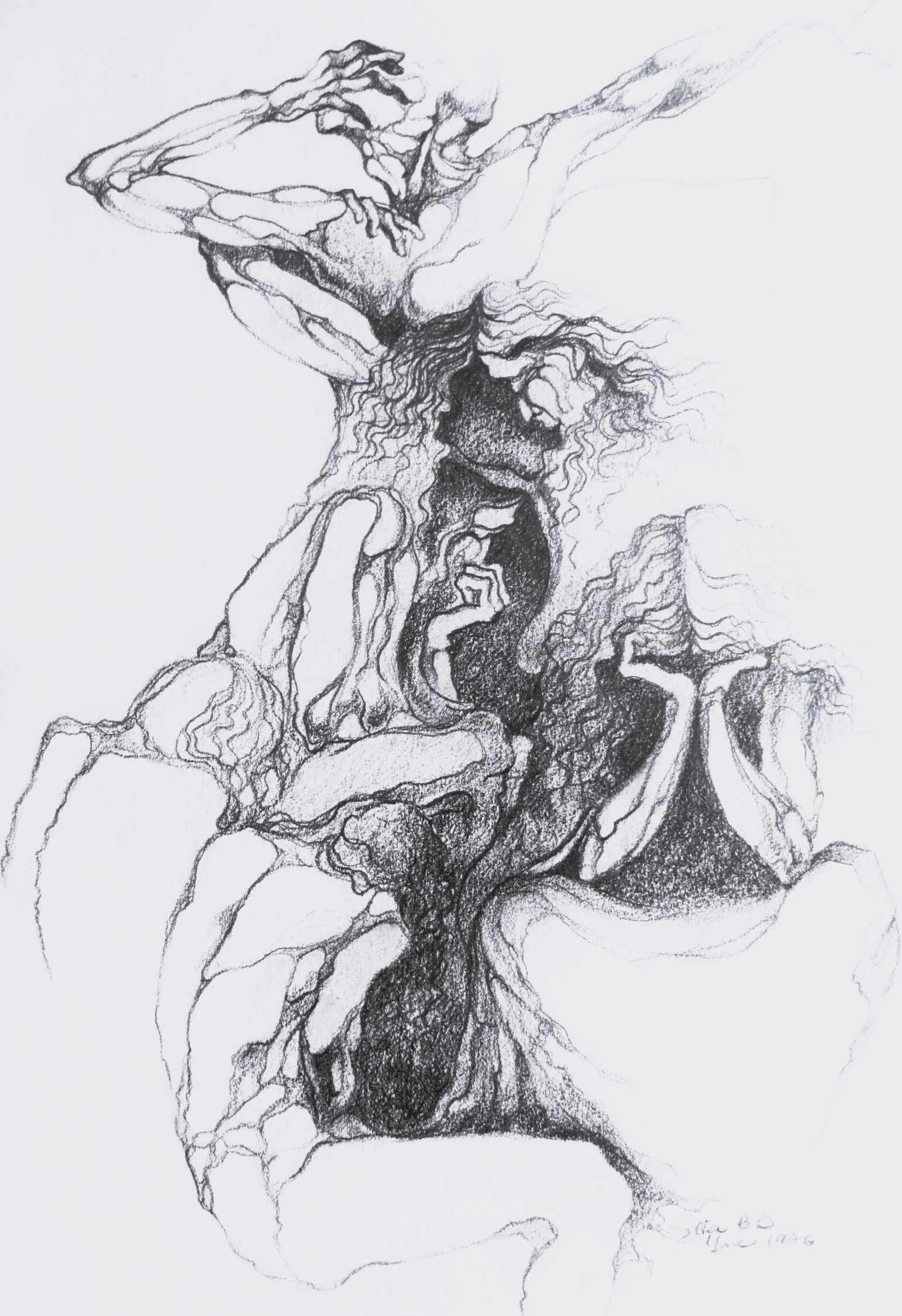
First news, Dayton, OH, 1975. Pencil, 30x21.5 cm
Wartime Art and Aesthetic
This is the title of the third chapter of Encounters. During the seventeen years of the war and perpetual street battles, from 1975 to 1991, just as life was wartime-life, in turn art could only be wartime art. It traced a trajectory which took its beginning in the immediate realities of the war, and by the force of its convergence in the present moment, gave the works their truth-content and aesthetic legitimacy. Under the circumstances, I could not understand salon, studio, so-called abstractions, and decorative artworks, nor the assumed freedom of art of the mundane. I often wrote in the papers but was not lauded for my critique.
The human condition in wartime and massive suffering was central to my thinking, and inevitably, the human figure became dominant in my work. For right or wrong reasons, wars were fought by people and affected all people in every possible respect. While somehow life went on, many suffered, many died, many survived, yet everywhere all waited for deliverance.
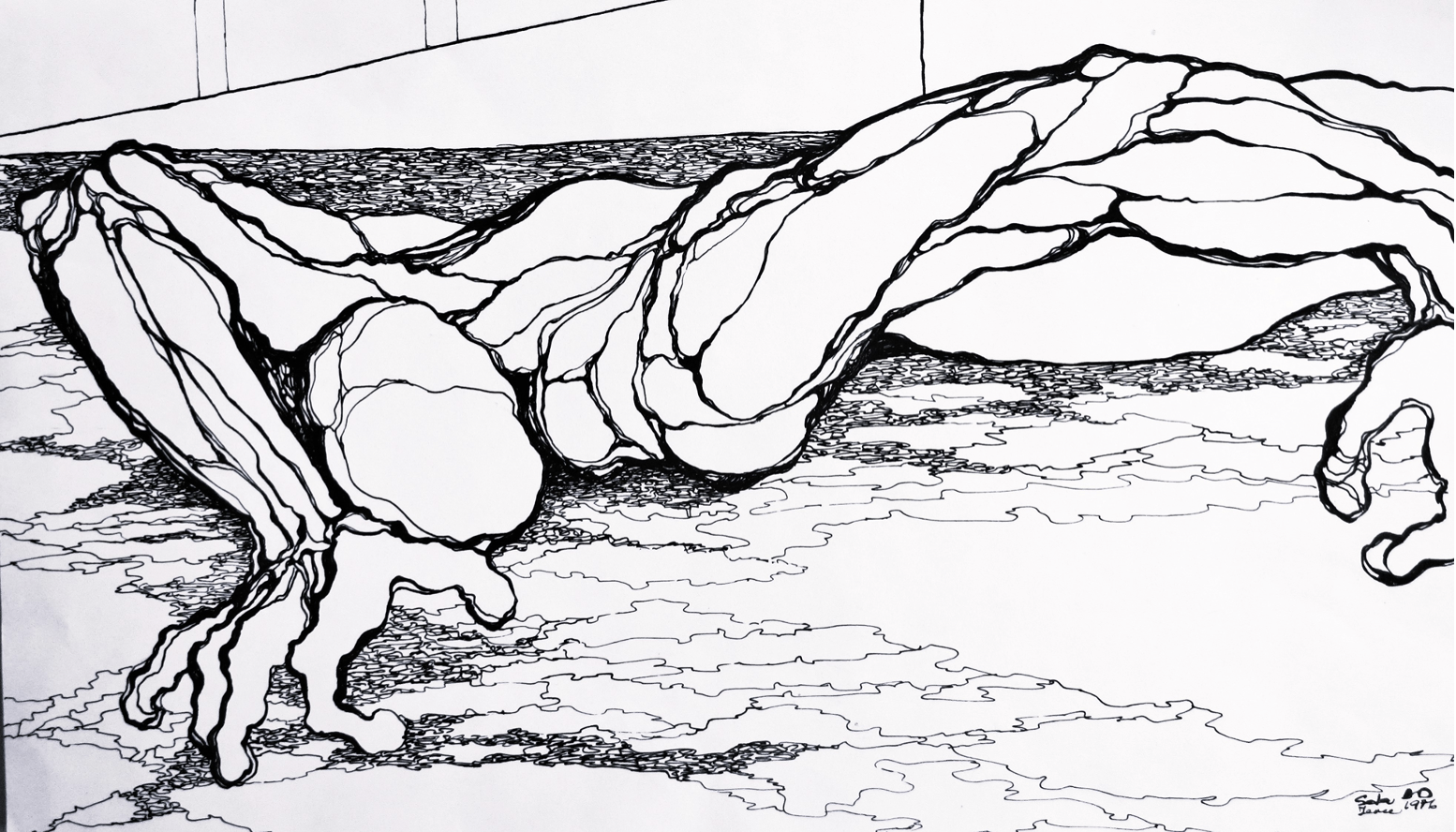
Sniper fire, Beirut, 1976. Ink, 42x25 cm.
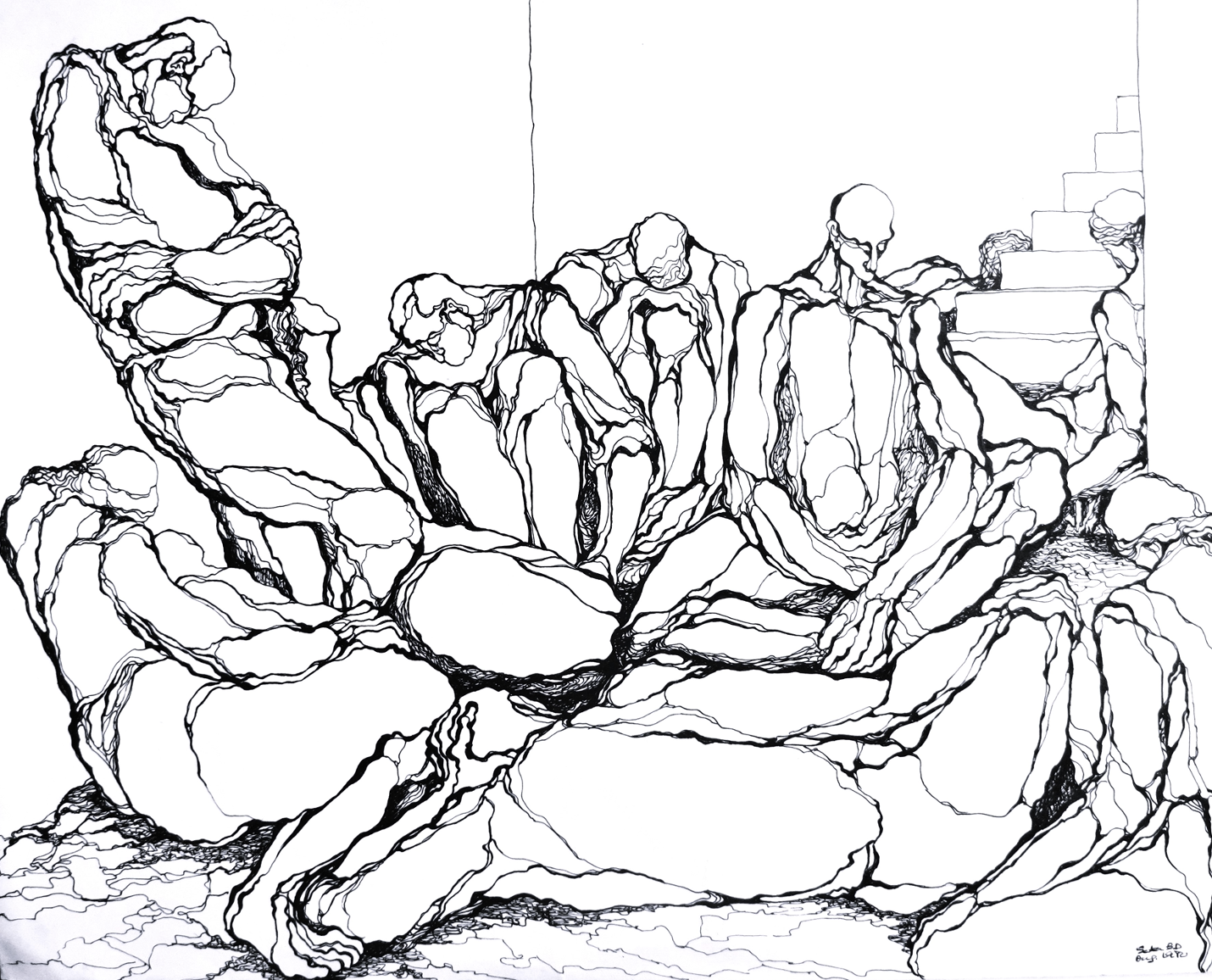
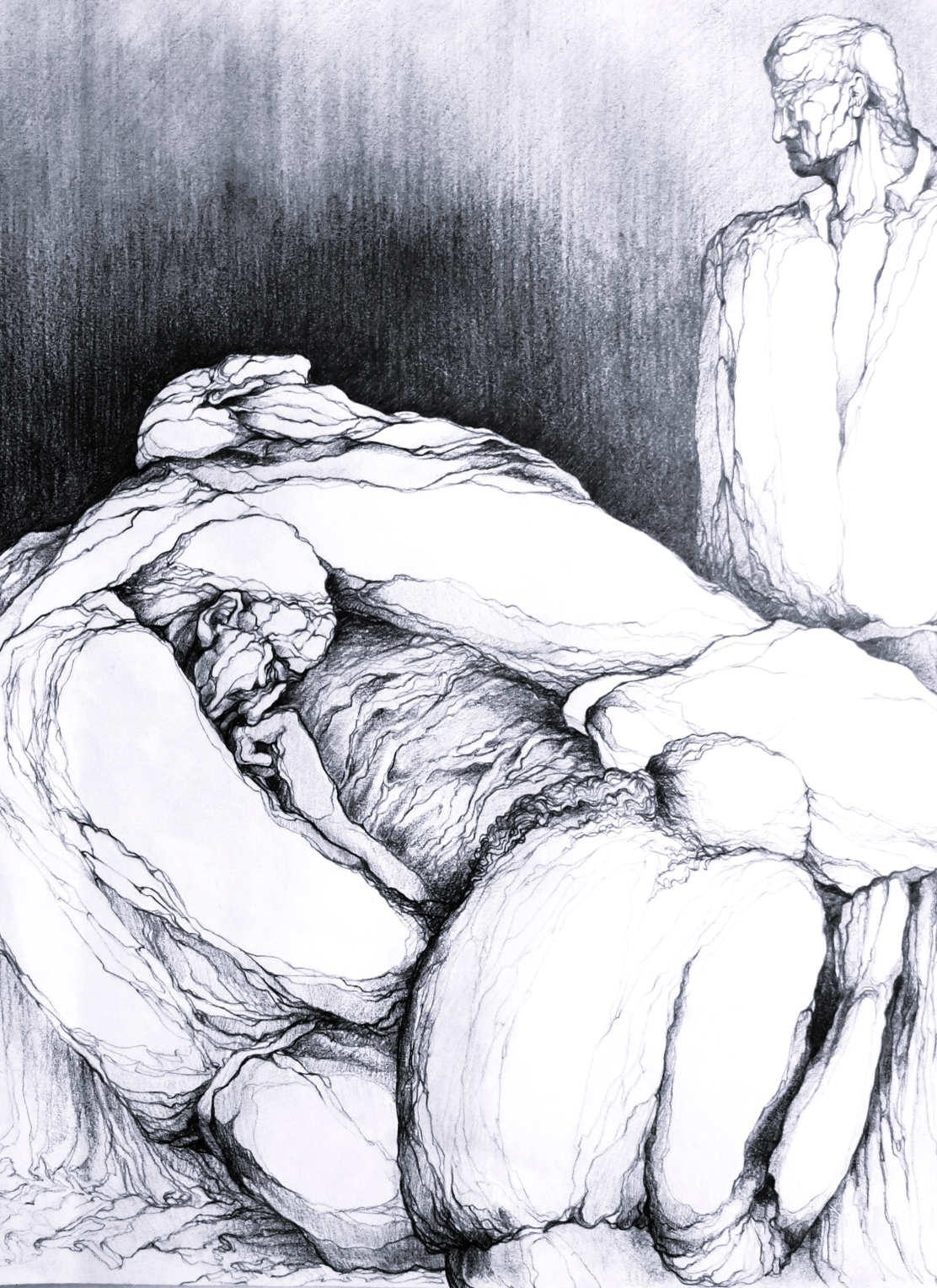
The shelter, Beirut, 1980. Ink, 46.5x34.5 cm.
The comrade, Beirut,1980. Pencil, 47x40.5 cm.
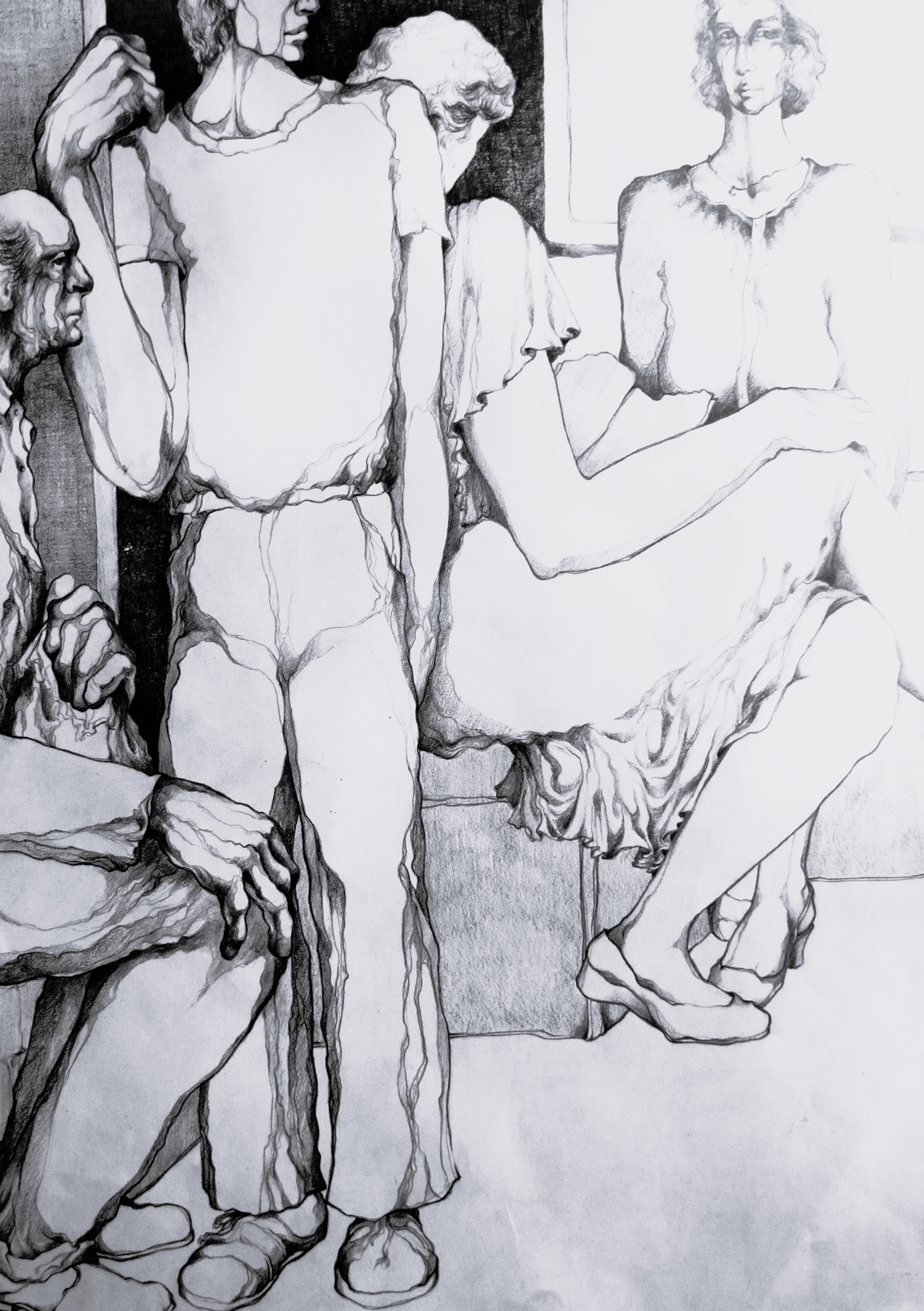
The wait, Beirut, 1980. Pencil, 49.5x38 cm.
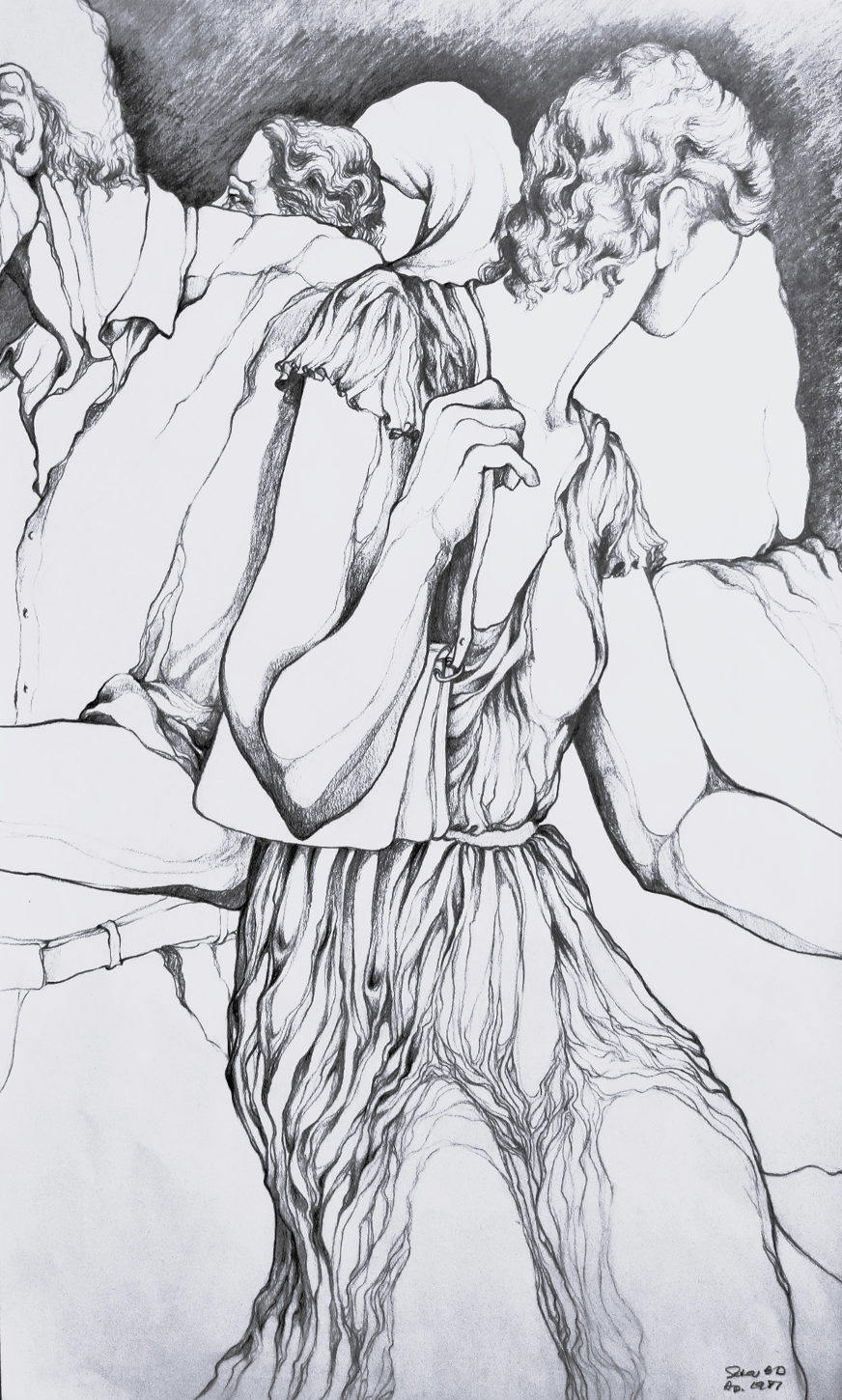
Qasf (bombardment), Beirut, 1981. Pencil, 48.5x30 cm.
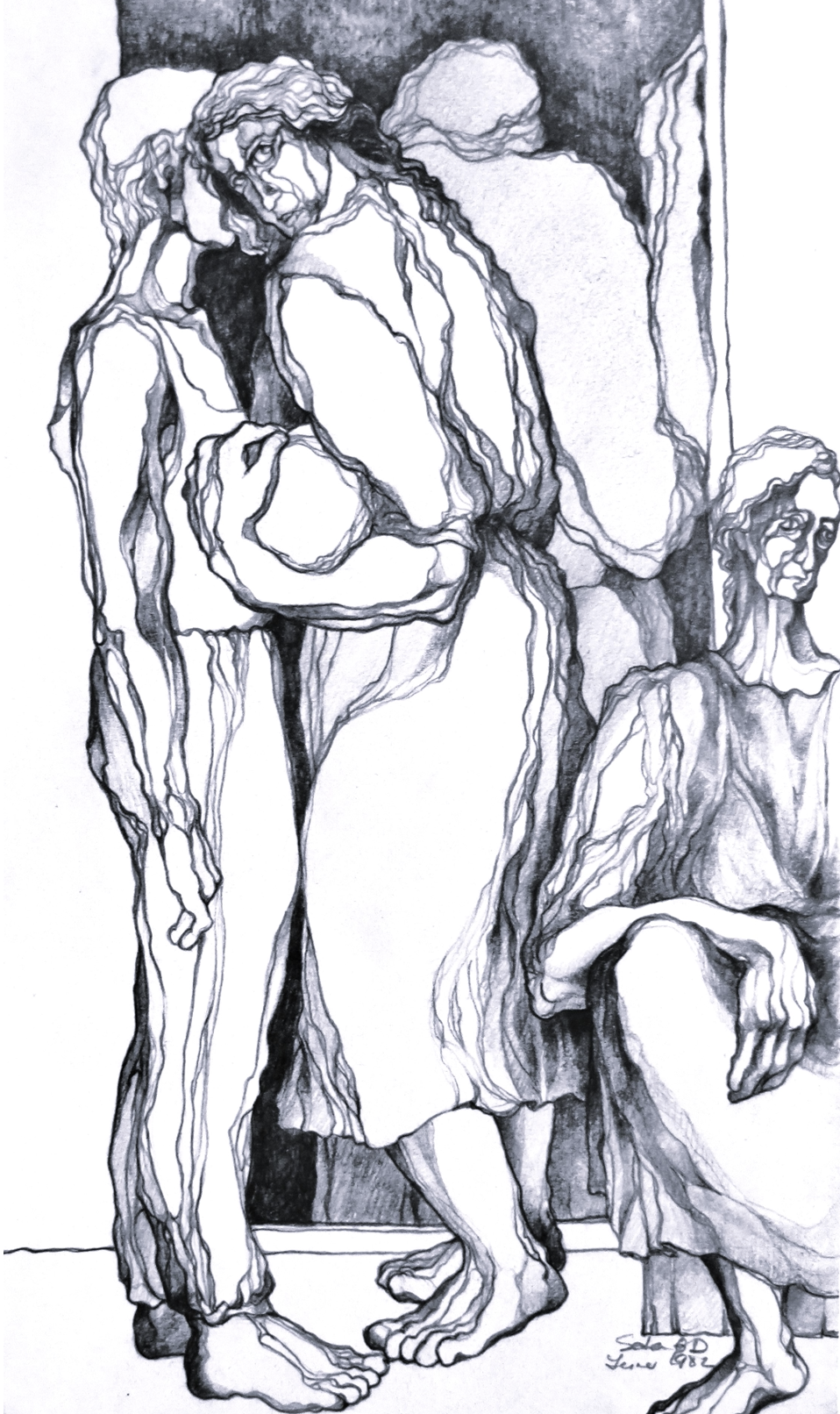
Malja' (shelter), Beirut, 1982. Pencil, 29.5x18 cm.
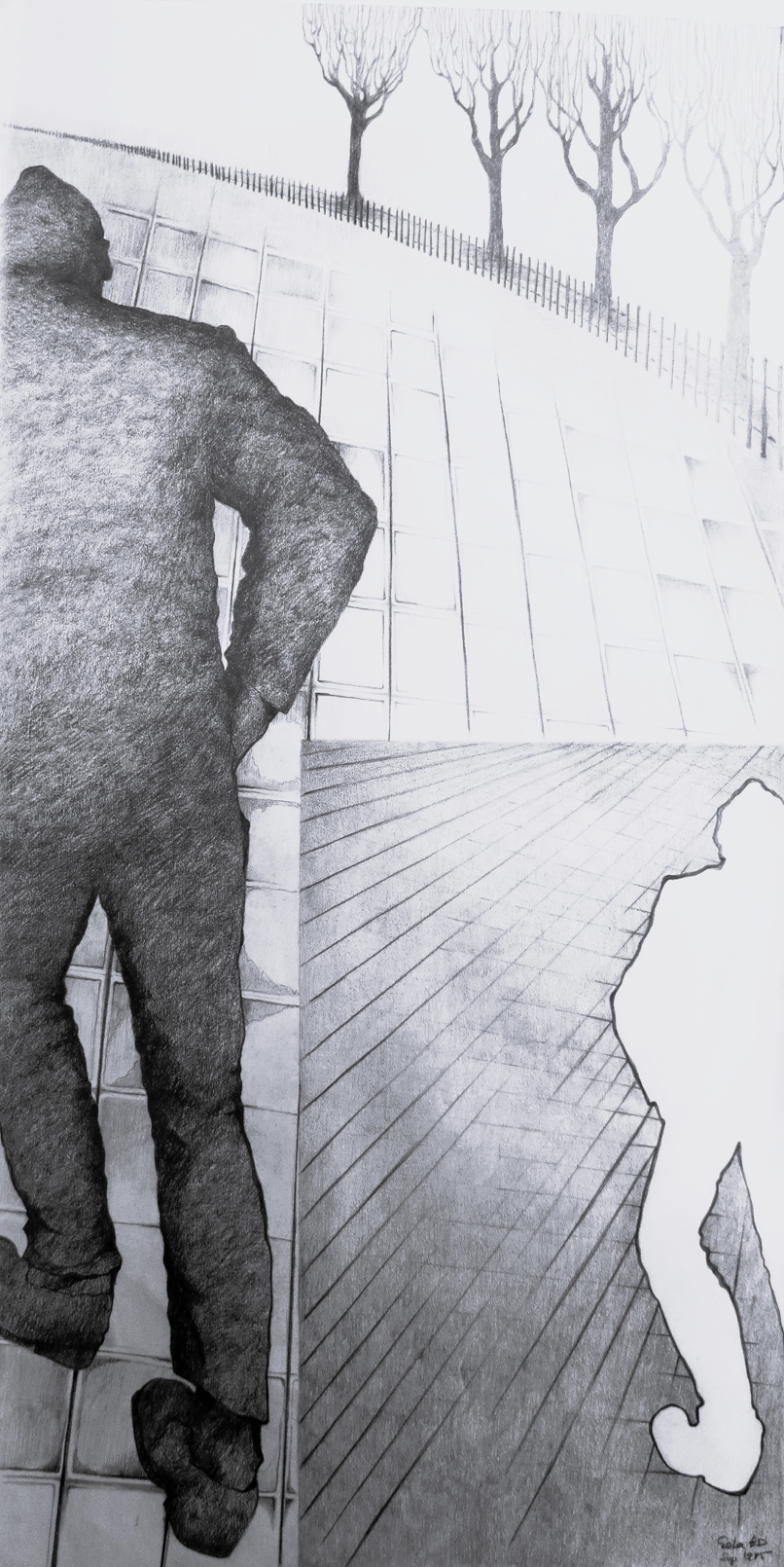
The stride, Beirut, 1985. Pencil, 55x30.5 cm
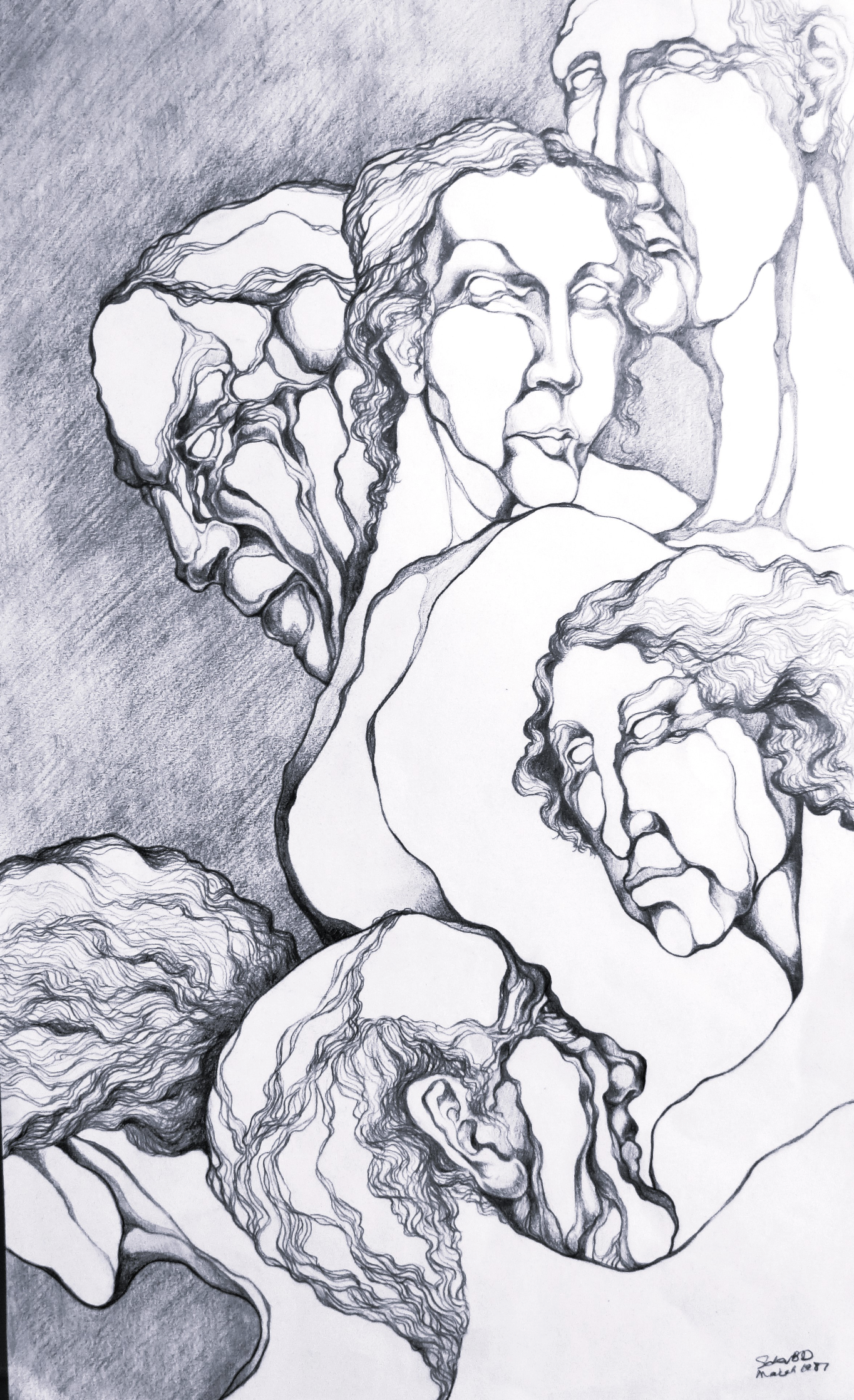
Colleagues at AUB, Beirut, 1987. Pencil, 46.5x28 cm.

III. Spirit of Matter
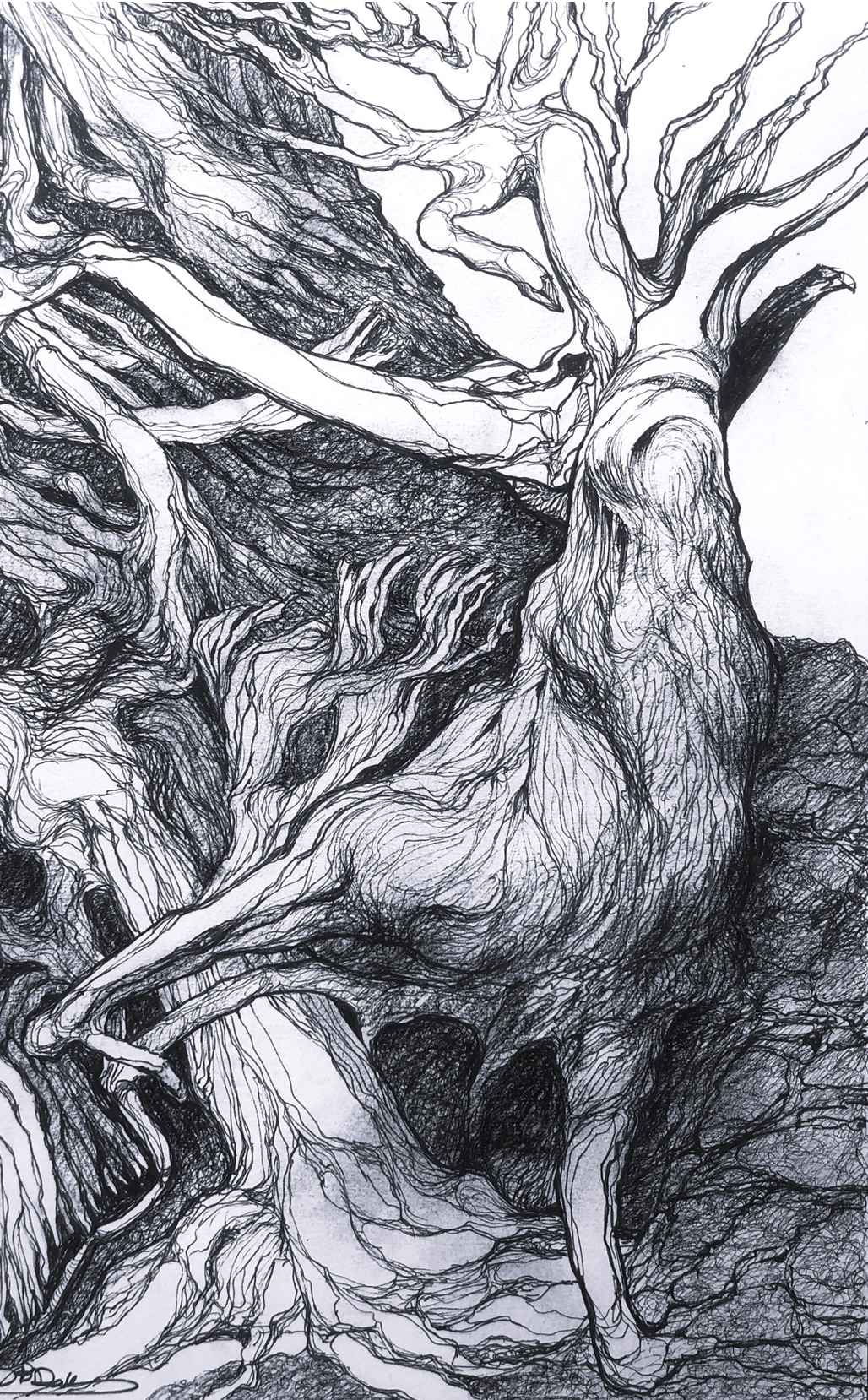
Spirit of matter. New York, 2022, mixed media, 21x33 cm
My American-Armenian experience began in in 2002, when I was appointed visiting professor at Columbia University (and again four years later, in 2006), after which we did not return to Lebanon.
This experience, to which I dedicated a whole chapter in the book, caused a radical intellectual re-positioning and change of perspectives on things Armenian. Hoping that new ideas would stir questions beyond the marketplace of recycled concepts and folkloric practices, I tried to reach the public and academics. I lectured and interacted quite frequently. By the end of 2016 I realized that my perspectives and dispositions seemed to run counter to local norms as well as those of the Armenian Studies centers. I withdrew from Armenian social circles and events, despite the popularity of the talks and my genuine enthusiasm to meet people and audiences.
Exposure to and interaction with changing, contradictory, and sometimes disappointing encounters kept me at a distance. I pondered about the problem of ethnic background and the “identity” I shared with the community here. I believe that so-called national identity is not an immutable essence. It is like a flowing stream of water that starts at a source and flows in a bed. As Heraclitus said, “the waters flow, and “no man ever steps in the same river twice.” Even though the source, my spirit is the same, my American-Armenian experience made me seek different terrains and horizons to flow freely. As in previous encounters too, I metamorphosed differently yet kept flowing.
I dedicated over five years to a most complicated and hitherto undone study of the manners in which Islam was viewed and responded to in Armenian literary culture. The book was published by Peeters at Louvain in 2021.
As planned, on January of 2022, still in Covid 19 pandemic circumstances, when I sat at the drawing board with a range of themes in mind, to my surprise I realized that as a form and means of expression, the human figure did not come forward. I also realized, sadly too, that a part of me had gone into “concealment”, in Martin Heidegger’s term, and decided not to pursue the matter. Even though I have always been, and still am, a politically and ideologically very concerned and committed person, on the immediate level of human relations, I sometimes hesitated to take the initiative to connect. Here in New York, where everyone and everything intrigues me, and despite my absolute fascination with every aspect of this city, still, I could not return to the human figure.
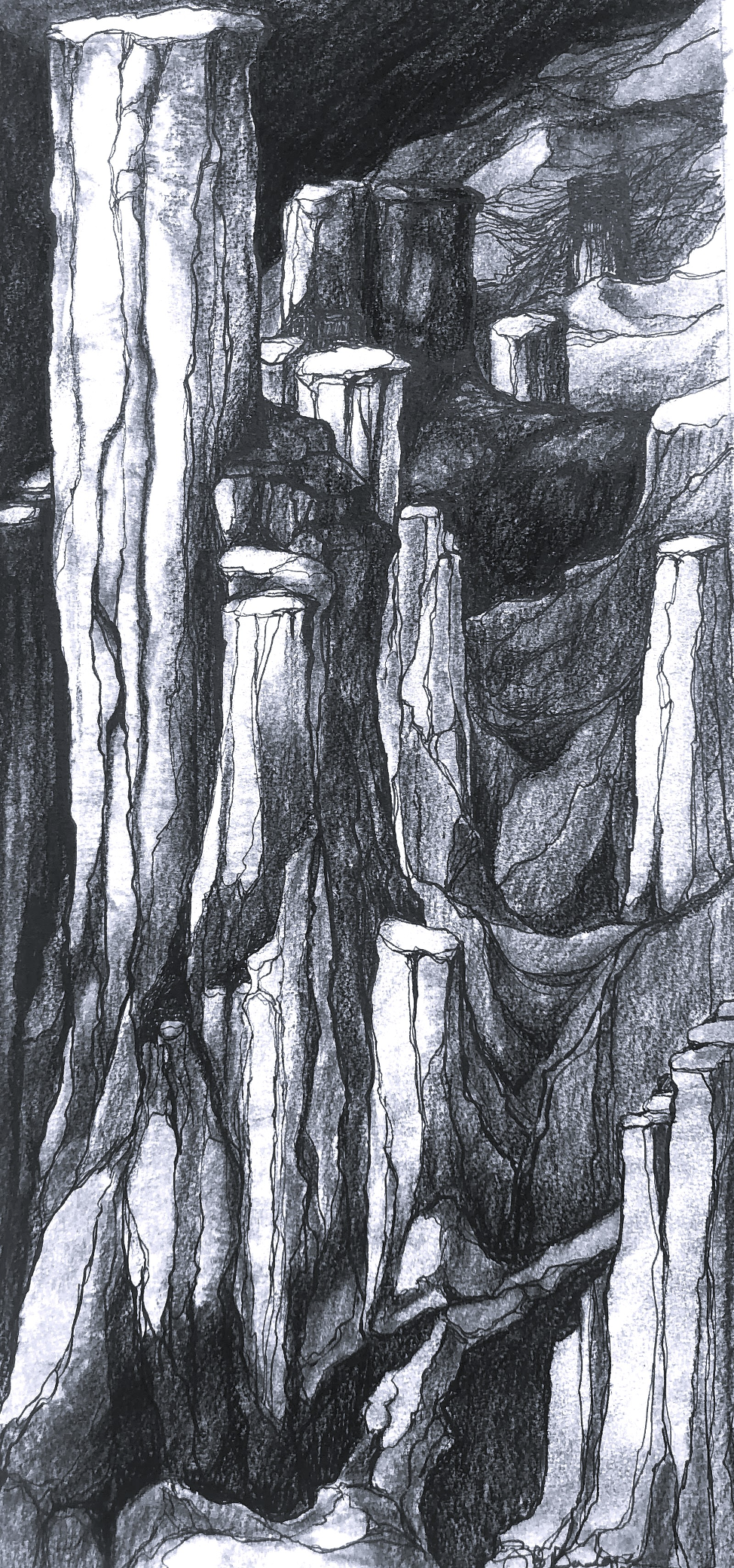
I turned to nature, as many have and still do, at least artistically. Rocks, and especially the dark gray/green rocks of the state of New York fascinated me since 1970, when I first visited. I see infinitely intriguing shapes, volumes, and movements in the rocks by the side of roads and highways, in vast expanses and mountains, yet did not stop to draw them. When I finally decided to go back to the sketchpad, I could think of no other subject than the rocks.
Also, like my wartime drawing, I could only think and work in black. At the time I did not seek an explanation, but an intriguing paragraph in Adorno’s Aesthetic Theory expressed my disposition best: “… to survive reality at its most extreme and grim, artworks that do not want to sell themselves as consolation must equate themselves with that reality. Radical art today is synonymous with dark art; its primary color is black. Much contemporary production is irrelevant because it takes no note of this and childishly delights in color. The ideal of blackness regarding content is one of the deepest impulses … It may well be that the current trifling with sound and color effects is a reaction to the impoverishment entailed by the ideal of black; perhaps art will one day be able to abolish this axiom without self-betrayal…”[22]
After three decades of a withdrawal of sorts, my return to art was a crossing, and the idea of a bridge seemed most appropriate. Simultaneously connecting, and dividing, as well as suggesting passages to other worlds, bridges are also things-in-themselves, or entities. I drew a natural rock-bridge that swirled into another unseen platform outside the frame. The climber on this rock-bridge would simultaneously escape and defy the Nietzschean “abyss” below. Dangerous stairs lead to a couple of dark and narrow entrances into another level, or a world, perhaps into a part of me that is in concealment.
Stairs in turn, are intriguing entities. So far, no artist other than Moritz Escher (1898-1972) has even come close to expressing the complexity, the beauty, and the symbolism of stairs. The “Stairs”, the next work, is a dramatization of dangerous movements into other levels with feelings of instability in perilous and dark spiritual states. I was soon surprised by another direction that I had not planned nor predicted.
This was my humanization of matter, in this case the rocks, the earth and trees. I seemed to be trying to reveal and speak of the ‘spirit of matter’, the title of this last group. I was not avoiding my basic humanism; I had developed a form of ‘hard humanism.’ The 28 works I made within a year started at the Bridge and ended at a drawing called Homes and graves following the earthquake in southeastern Turkey, Cilicia an Armenian habitat, even my hometown Aleppo. The images brought back memories of the war when bombardment buried people under the rubble of their homes.
In the past four decades, after sixteen books, more than a hundred studies and over a hundred artworks, it is obvious that they were distributed over specific phases, and I devoted more time to my scholarship, even though from childhood my sole aim was being a painter. My peculiar circumstances, my situatedness however, drove me to seek broader “horizons” to understand and come to terms through scholarship as well. The convergences happened both in the artwork and scholarship. They constitute the truth content of all my works, in writing and images. If wartime Lebanon re-triggered my art, my condition as an Armenian native of the Islamic World put me on a long and difficult path of research into unbroken grounds. The objective of both activities was not capturing immutable truths or eternal beauties; there are no such things. My works are simultaneously counterpoints and paths to deeper yet not final understandings. An interdisciplinary look at my last drawings and my recent literature will immediately detect their unity, even in style and the aesthetic of writing and drawing. The banyan trees penetrating the forest and breaking through brick walls, spiraling rock-bridges, steep stairs, and rocks sprouting spirits are essentially images of confrontations and convergences, in drawing and writing.
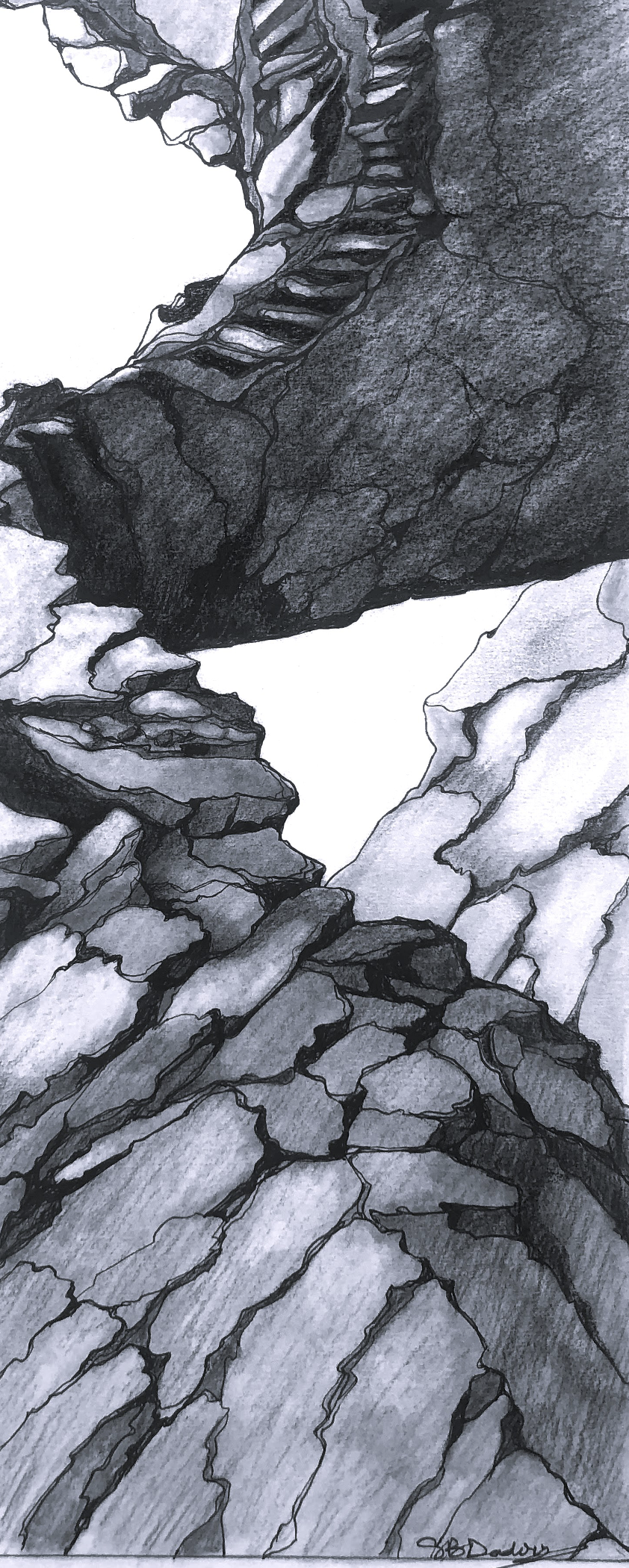
The bridge, New York, 2022. Mixed media, 18x37 cm.
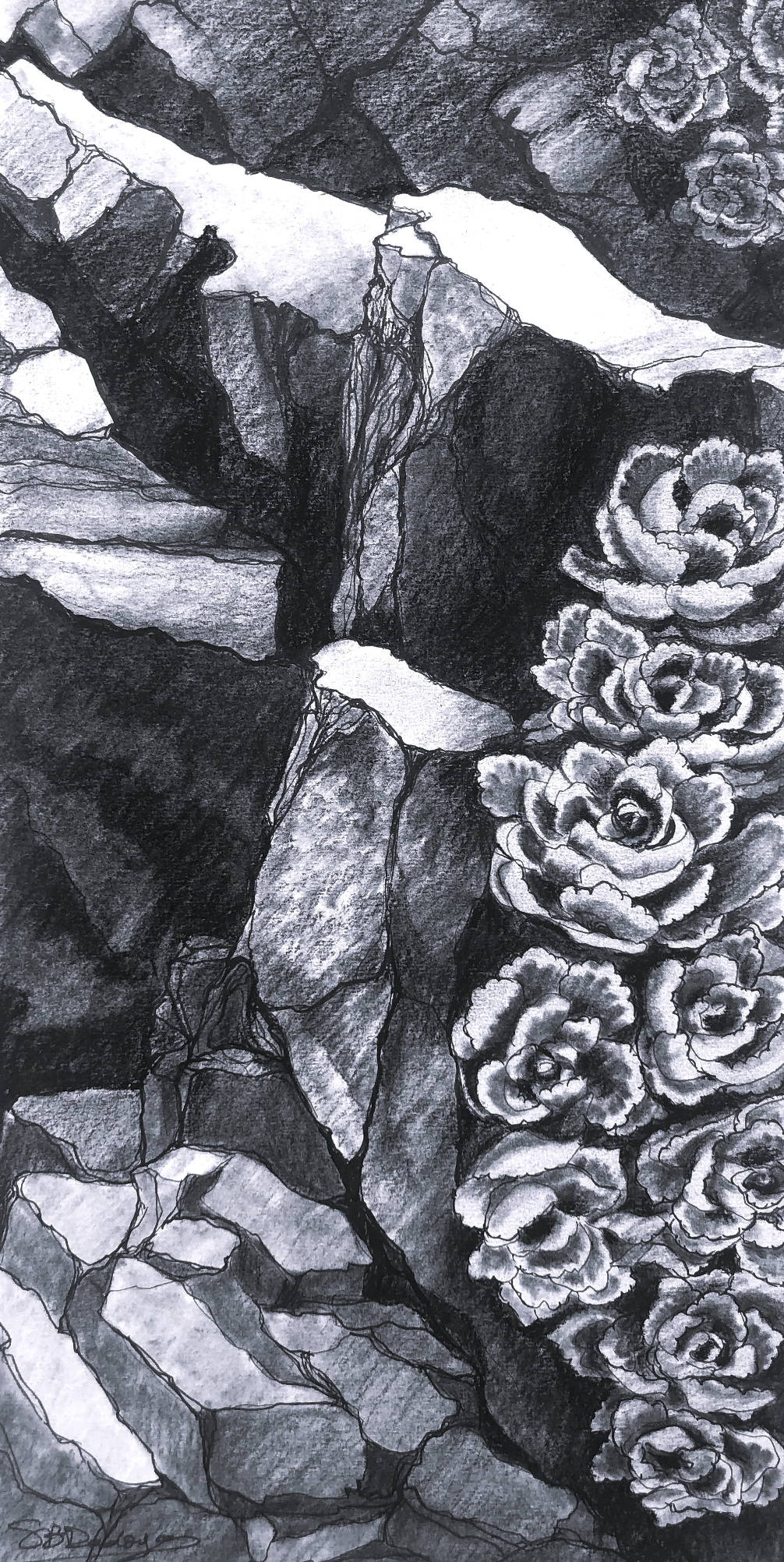
In memoriam, New York, 2022. Mixed media, 18x36 cm.
Ritual, New York, 2022. Mixed media, 17x37.5 cm.
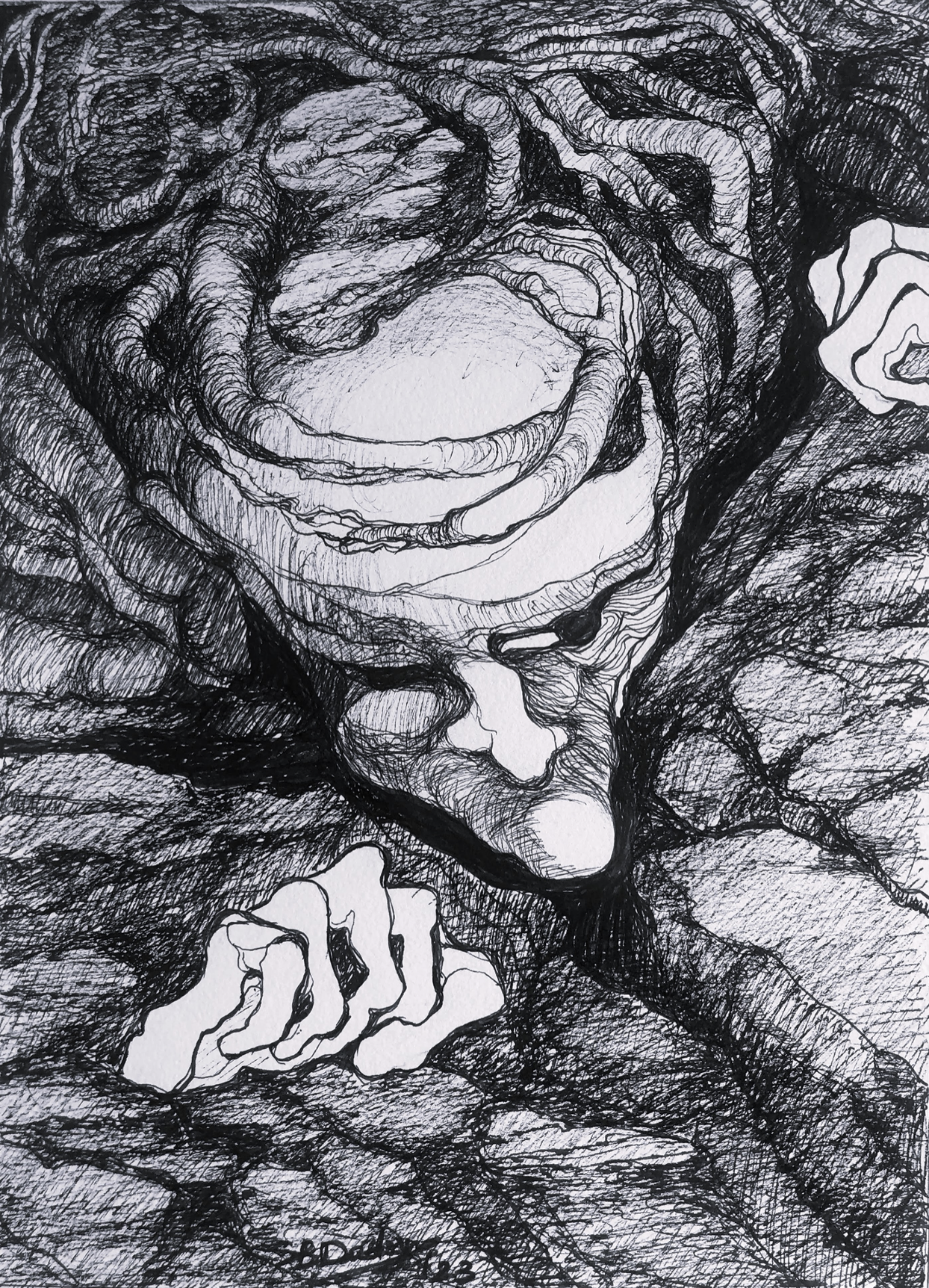
Resurrection, New York, Jan 2023. Mixed media, 18x25 cm.
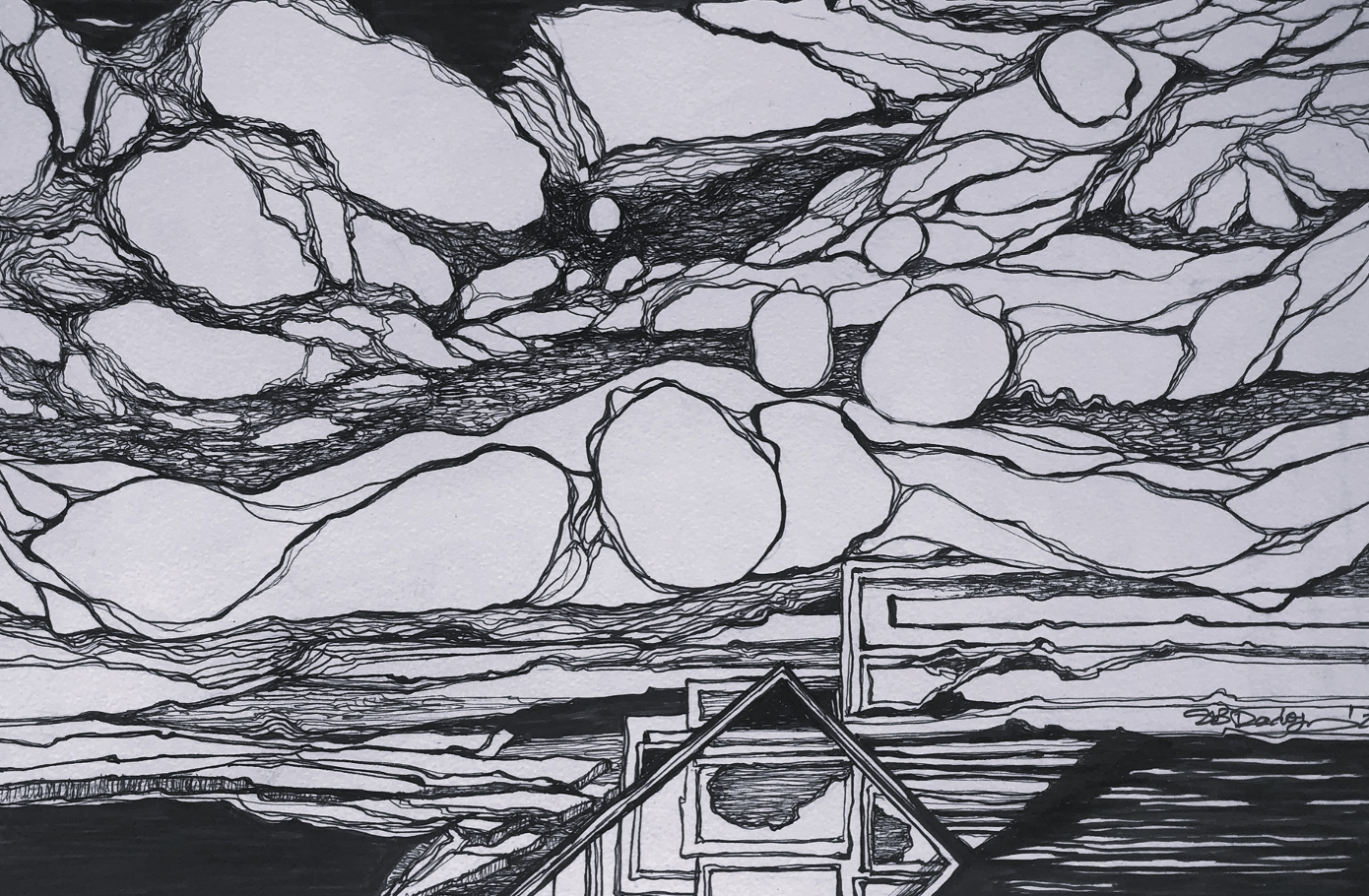
Homes and graves, New York, Feb 2023. Ink, 20x30 cm.
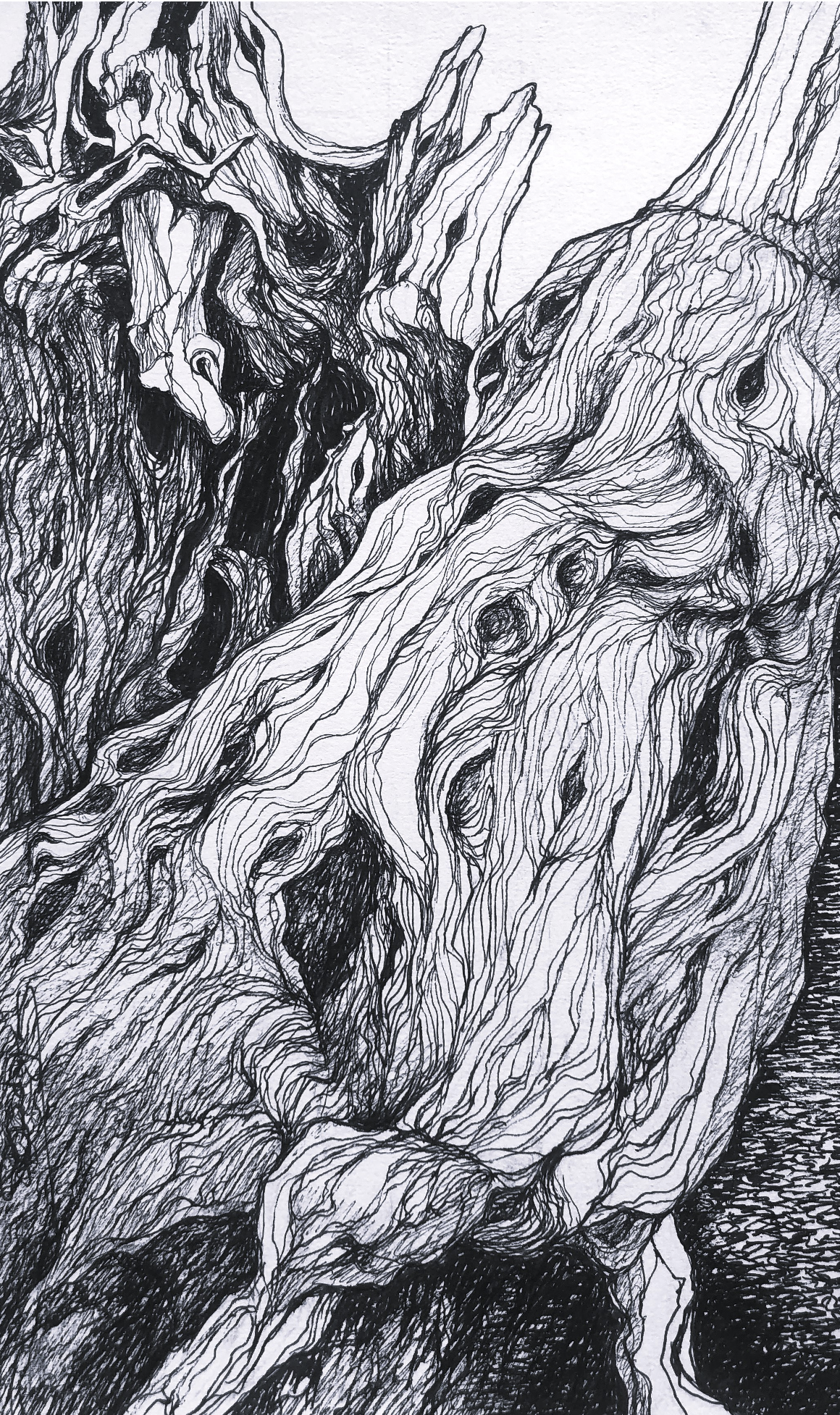
Concealment, New York, 2022. Mixed media, 20x32 cm.
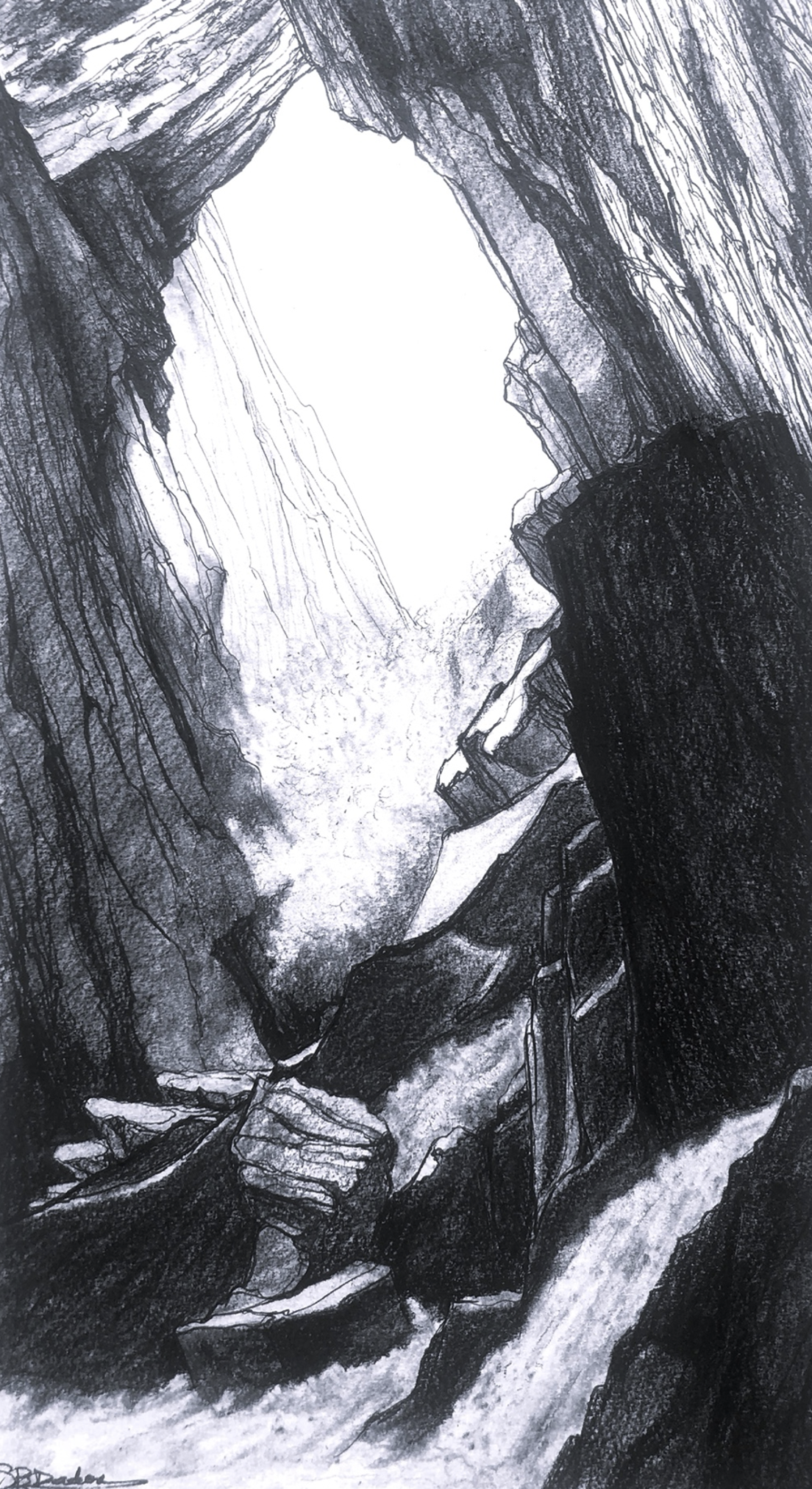
Unconcealment. New York, mixed media, 34x18.5 cm
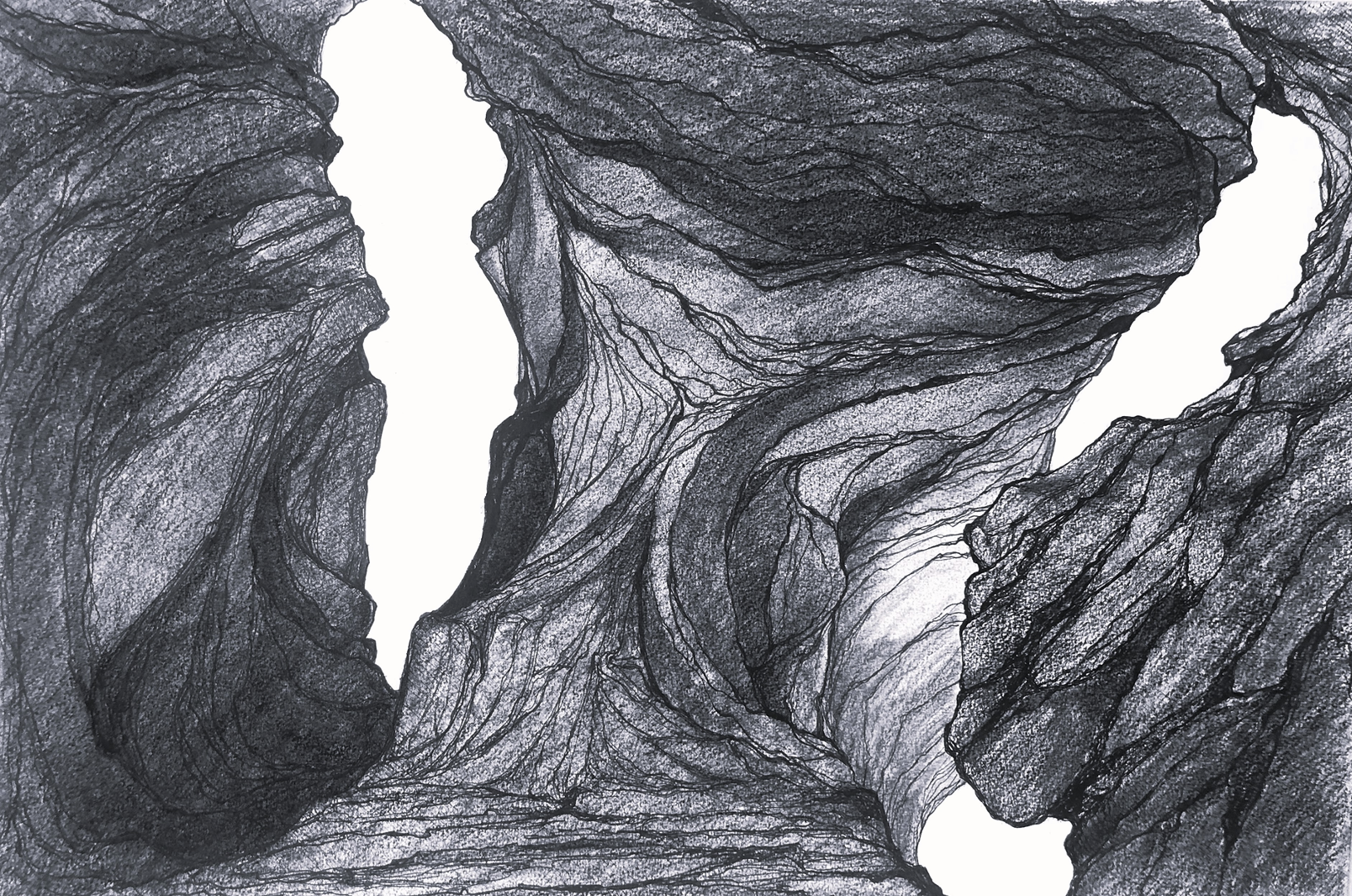
Encounters and convergences, New York, Feb 2023. Mixed media, 30.5x45.5 cm. (9''x12'')
BANYAN SERIES
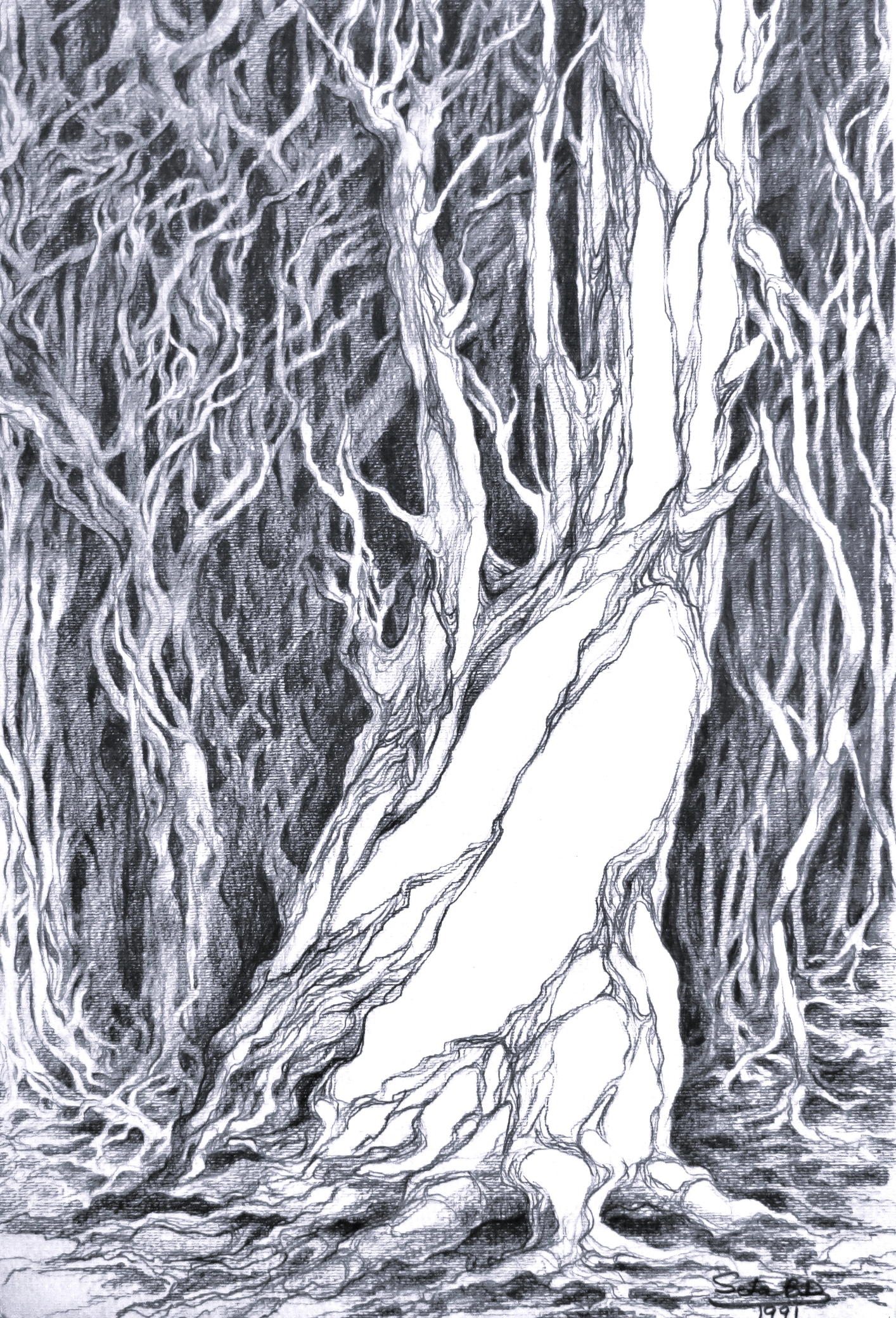
The banyan tree of AUB, Beirut, 1991. Pencil, 31.5x21.5 cm.
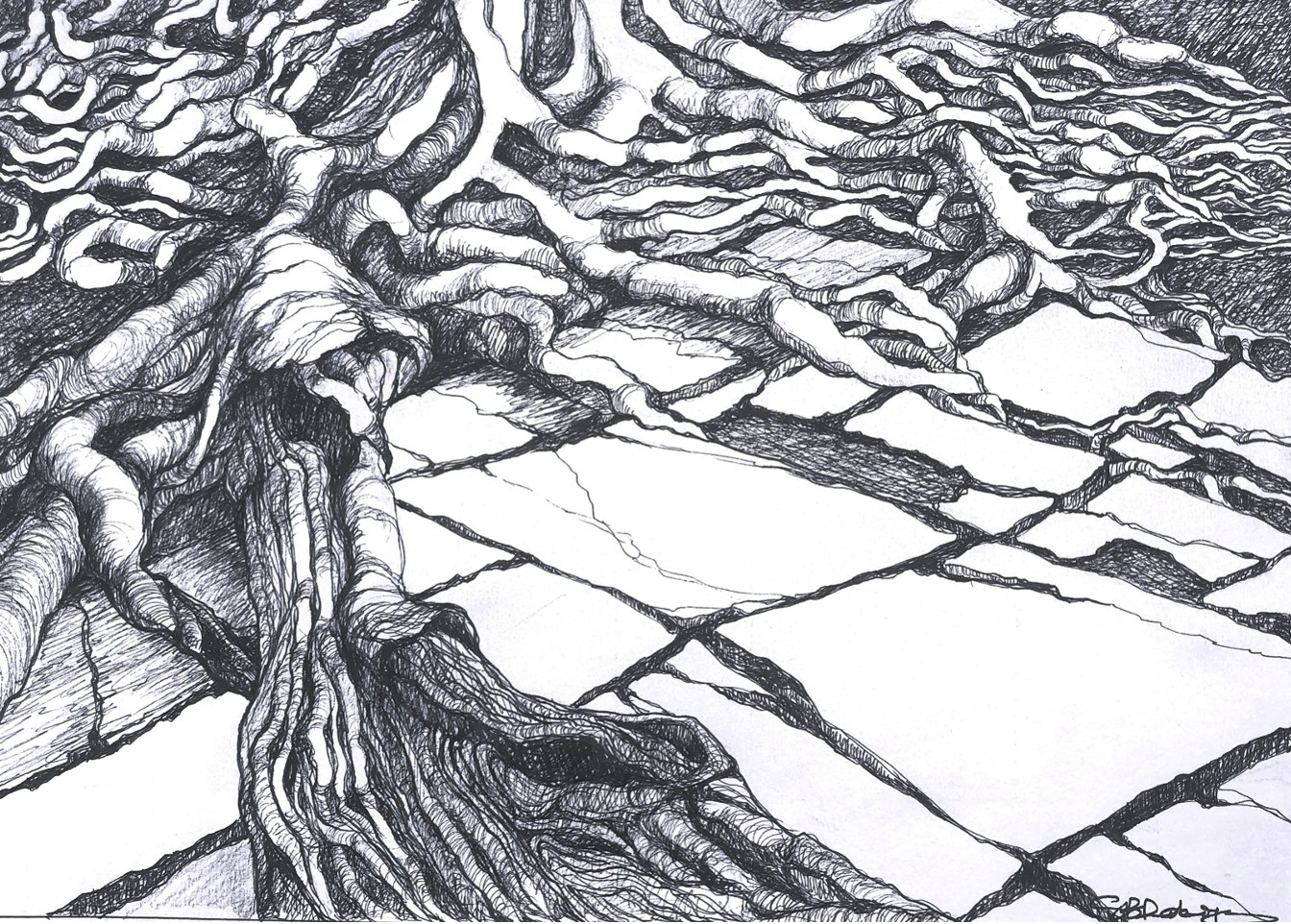
Banyan tree 2, New York, 2022. mixed media, 30x21 cm.
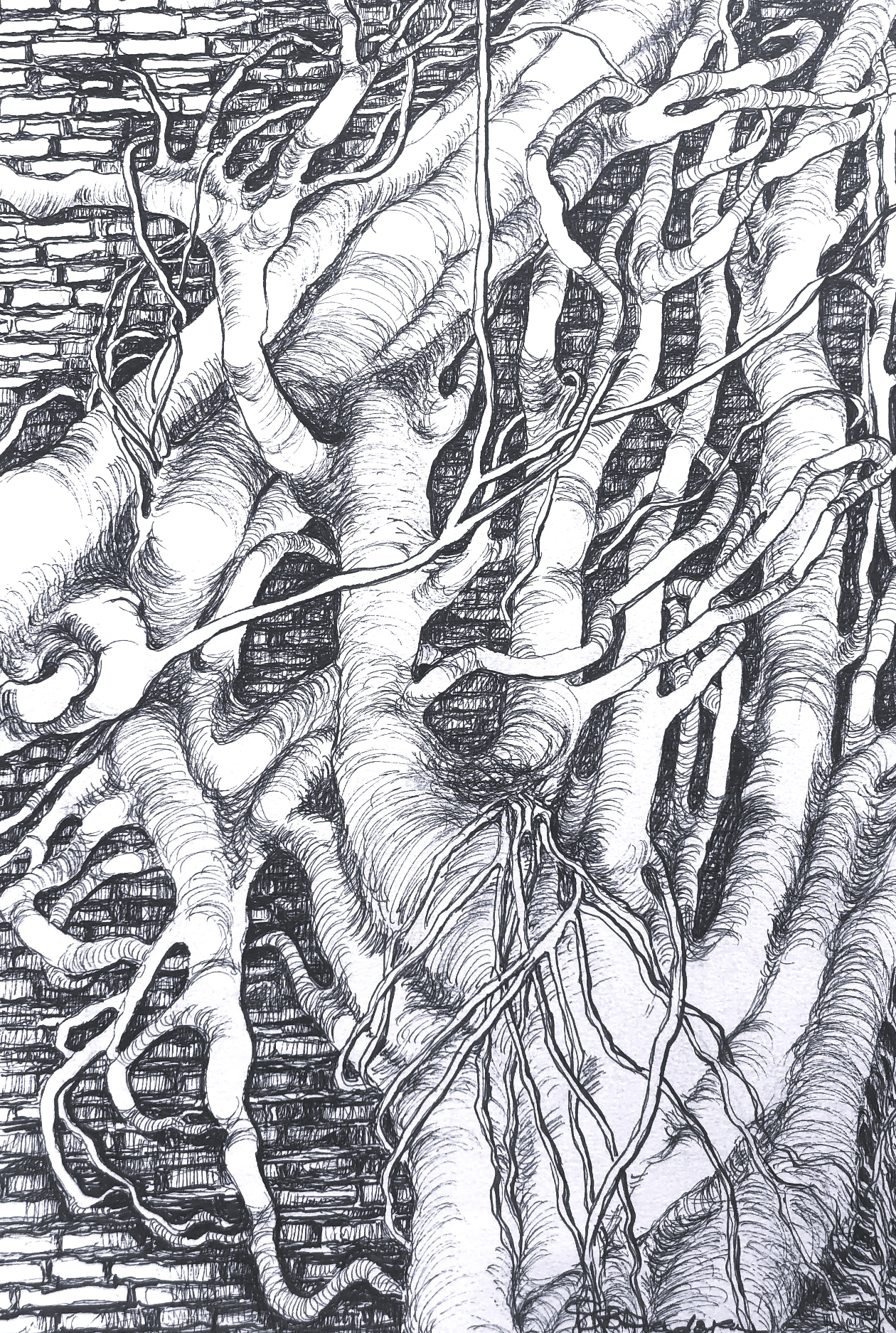
Banyan tree 3, New York, 2022. Mixed media, 20x30 cm.
Notes
[1] Encounters and Convergences. A Book of Ideas and Art (USA: 2023), p. 131.
[2] See: Mieke Bal, Travelling Concepts in the Humanities: A Rough Guide (Canada: University of
Toronto, 2002).
[3] F. Nietzsche (trans. C. Diethe, ed. K. Ansell-Pearson), On the Genealogy of Morality. A Polemic
(Revised Student Edition) (1887; Cambridge 1997), pp. 65-66.
[4] M. Foucault, Power/Knowledge (New York: Pantheon Books, 1977), p. 131.
[5] Ron Eyerman, Between Culture and Politics: Intellectuals in Modern Society (Cambridge UK, Polity
Press, 1994), pp. 33-34.
[6] Ibid., p. 190.
[7] See Philip Barker, Michel Foucault—An Introduction (Edinburgh: Edinburgh University Press, 1998),
p. 119.
[8] See my “A Phenomenology of Armenian Studies: The Discipline and the ‘National’ Meta-Polis”, Le
Muséon, vol. 121(2008) 1-2, pp. 213-229; “A Hermeneutic Phenomenology of the Armenian Experience in the Islamic World − Paradigms of Interaction and Historicity,” Lecture at the Workshop of Padus-Araxes Association, University of Venice (Ca’ Foscari), Department of Asian and African, Mediterranean Studies, May 5, 2015; “Taking Things Armenian Beyond the Pillars of Hercules: Plus Ultra - A Discourse”, Lecture at ARPA Institute (Analysis Research & Planning for Armenia), November 12, 2016.
[9] See, Alun Munslow, Deconstructing History (London: Routledge, 1997), pp. 2-3.]
[10] Gordon Graham, The Shape of the Past- A Philosophical Approach to History, p. 21.
[11] Hayden White, “The Historical Text as Literary Artifact”, in Tropics of Discourse: Essays in Cultural
Criticism (Baltimore, Johns Hopkins University Press, 1978), p.82.
[12] See, Shaun Gallagher, Hermeneutics and Education (Albany, NY: State University of New York
Press, 1992).
[13] Islam in Armenian Literary Culture: Texts, Contexts, Dynamics Leuven: Peeters, 2021; A trilogy: The
Armenians in the Medieval Islamic World – Paradigms of Interaction Seventh to Fourteenth Centuries. Transaction Publishers. New Brunswick, U.S.A. & London, UK: 2011, 2012, 2013. Vol. One: The Arab Period in Armīnyah. ‒ Seventh to Eleventh Centuries (2011); Vol. Two: Armenian Realpolitik in the Islamic World and Diverging Paradigms - The Case of Cilicia - Eleventh to Fourteenth Centuries (2012); Vol. Three: Medieval Cosmopolitanism and Images of Islam ‒Thirteenth to Fourteenth Centuries. (2013); The Fāṭimid Armenians ‒ Cultural and Political Interaction in the Near East. Islamic History and Civilization Series. E.J. Brill. Leiden: 1997; Յովհաննէս Երզնակացիի 'Ի Տաճկաց Իմաստասիրաց'ը և Իմաստասիրական Արձակը Իսլամական Աղբիւրներուն Լոյսին Տակ [John of Erznka: 'Views from the Writings of Islamic Philosophers' and Philosophical Treatises in the Light of their Islamic Sources – Ikhwān al Ṣafā’]. (Beirut: 1991).
[14] 2015 −The Armenian Condition in Hindsight and Foresight – A Discourse/ 2015− Հայ Վիճակը
Յետահայեցութեամբ և նախահայեցութեամբ - Վերլուծում մը (Canada: 2015); The Catholicosate of Cilicia - History, Mission, Treasures. Editor, Co-Author (Antelias, Lebanon: Catholicosate Publications, 2015).
[15] Nersēs IV Shnorhali Saint and Diplomat and the Persistence of the People and the Church in the
Western Armenian World / Nersēs IV Shnorhali Saint and Diplomat and the Persistence of the People and the Church in the Western Armenian World / Ներսէս Դ. Շնորհալի Սուրբ Եւ Դիւանագէտ Եւ Ժողովուրդին ու Եկեղեցիին Գոյատեւումը Արեւմտեան Հայաշխարհին Մէջ (Los Angeles: 2025); Yovhan III Ōdznets‘I Saint, Jurist and Great Master of Armenian Mesopolitan Culture and Diplomacy/Յովհան Գ. Օձնեցի ‒ Սուրբը, Կանոնագէտը եւ Մեծ Վարպետը Հայ Միջնաշխարհեան Մշակոյթի եւ Դիւանագիտութեան. (Los Angeles: 2025).
[16] Theodor W. Adorno, Aesthetic Theory, Trans. Introduction, Robert Hullot-Kento (New York:
Continuum, 2002), p. 262.
[17] Ibid. p. 136.
[19] Ibid., p. 191.
[20] Ibid. p. 183.
[21] Ibid., p. 132.
[22] Լիբանանահայ Նկարչութիւնը Ինքնութեան Տագնապին Լոյսին տակ (Beirut: 1984); (Beirut,
1984); Էջեր Արևմտահայ Մտածումէն ‒ Ե. Տէմիրճիպաշեան, Տ. Չրաքեան-Ինտրա, Շ. Պէրպէրեան, Գ. Գավաֆեան, Դանիէլ Վարուժան); [Pages of West Armenian Philosophical Thought – E. Demirjibashian, T. Chrakian-Indra, Sh. Berberian, G. Kavafian, Taniel Varujan] ( A.G.B.U. Beirut: 1987). (Winner of H. Uzunian Award for Best Armenian Book of 1987).
Bibliography
Adorno, Theodor W. Aesthetic Theory, Trans. Introd. Robert Hullot-Kento. New York: 2002.
Bal, Mieke. Travelling Concepts in the Humanities: A Rough Guide, Toronto:2002.
Barker, Philip. Michel Foucault—An Introduction. Edinburgh: 1998.
Dadoyan. Seta B. Encounters and Convergences. A Book of Ideas and Art. USA: 2023.
Eyerman, Ron. Between Culture and Politics: Intellectuals in Modern Society. Cambridge UK, 1994.
Foucault, Michel. Power/Knowledge. New York: 1977.
Gallagher, Shaun. Hermeneutics and Education. Albany, NY: 1992.
Graham, Gordon. The Shape of the Past- A Philosophical Approach to History. Oxford, UK: 1997.
Munslow, Alun. Deconstructing History. London: 1997.
Nietzsche, Friedrich, (trans. C. Diethe, ed. K. Ansell-Pearson), On the Genealogy of Morality. A Polemic (Revised Student Edition). Cambridge: 1997.
White, Hayden. “The Historical Text as Literary Artifact”, in Tropics of Discourse: Essays in Cultural Criticism. Baltimore, 1978.