
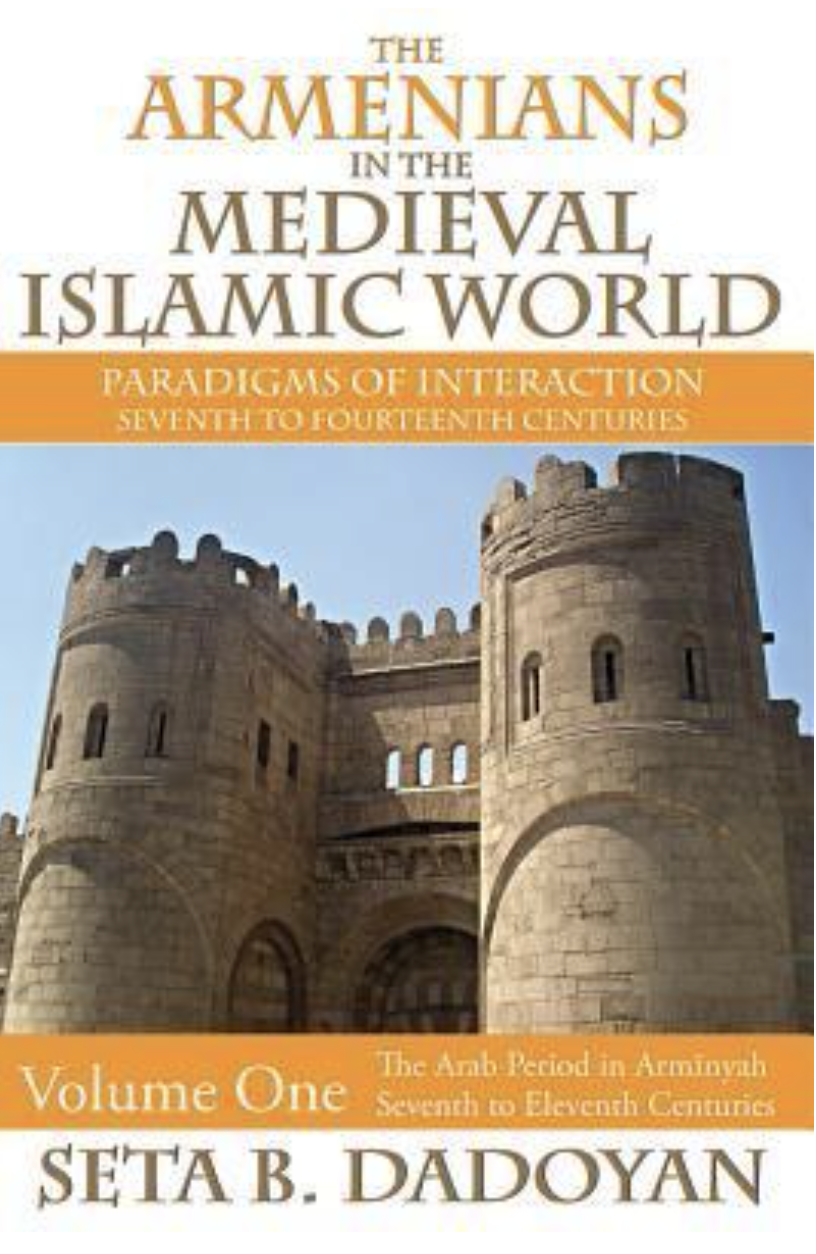
The Armenians in the Medieval Islamic World: The Near East through
Paradigms of Interaction - Seventh – Fourteenth Centuries
Blurbs and Full Comments by Peers For
In this book, Dr. Dadoyan projects the logic of her powerful thesis regarding Islamic-Armenian interactions on a broader spectrum to produce a truly comprehensive work – what one may call a summa. Here the medieval Armenian heritage is placed and studied in its natural ambiance, which was the medieval Islamic world … In its scope, novelty of themes, and above all, the dynamic, dialectical approach that brings into relief hitherto unnoticed aspects and unstudied issues, along with a panoramic view of the Medieval Islamic world seen through “Paradigms of Interaction” is indeed a novel and intriguing type of academic exercise for scholars to whom history is not a mere and often subjective narration of a past, but a limitless field for critical study and intellectual enjoyment.
Kamal Salibi Professor
American University of Beirut
Founding Director of the Royal Institute for Inter-Faith Studies
Amman, Jordan
This is a long-awaited book which fills up a gap in our understanding of Armenian history. It brings along a new picture of the Armenian people, more diverse than the traditional view of a monolithic culture surviving through centuries of struggle. Seta Dadoyan demonstrates that Armenian diversity is part of the Near East, for this part of the world has always been a place of encounters, though at times harsh and difficult, rather than a juxtaposition of independent cultures, not to speak of nation states. The book paves the way for similar innovative approaches which could be applied to other constituents of the historical Near East. And the author should be thanked for having selected Armenia for this purpose.
Bernard Coulie Professor and Honorary Rector
UC Louvain
Features of this impressive work challenge received ideas about Armenian integrity and history and the interaction between Armenians and their neighbors. It will undoubtedly provoke debate. But its value cannot be underestimated. It brings into the light of the day a history that has mainly been forgotten, and sets the whole history of the Middle East into new frameworks where encounters were frequently more meetings of the like than clashes of the opposites.
David Thomas
Professor of Christianity and Islam
University of Birmingham
Edgbaston
We can say without any exaggeration, that Seta Dadoyan’s recent work, The Armenians in the Medieval Islamic World, is a first in the field, also novel in its content and approach through paradigm cases. It fills in a gap and as such is an overdue task for both Armenian and Near Eastern scholars. More significantly, along postmodern lines, in historiography and contemporary intellectual cultural concepts, it also inaugurates a different style and methodology in Armenian social sciences and humanities.
Arch. Boghos Levon Zekiyan
Pres. Armenian Studies, Professor Universita Ca’ Foscari Venezia
In a recent review article Peter Brown, the seminal historian of Late Antiquity, laments the relative ignorance of the Christian East in academic writing on early Islam. His focus is the corpus of Syriac literature, but the Armenian dossier is incomparably vaster and has awaited the historian with the tools of an Arabist master of the sources. Seta Dadoyan is that person, and her work … comes to fruition in this series, which redefines Armenia’s history in local context and makes the Armenian case essential to any serious student of the Islamic medieval period.
Professor James R. Russell
Harvard University
On the margins of Armenian history Seta Dadoyan offers an incisive insight on the making of traditional historiography and modern philology. She has an incredible knowledge of the Arabic sources that had never been read before her in the same perspective – if at all. This new type of historical writing not only aims at establishing new paradigms, but also has a powerful deconstructive effect on the way we understand history since the nineteenth century. Boldly bypassing the usual constraints in terms of discipline, Dadoyan’s trilogy contributes to post-national redefinitions of identity and renewed accounts of the Armenian experience in diasporic terms. It is not an exaggeration to say that her work is revolutionary.
Professor Marc Nichanian
Columbia and Sabanci Universities
Dadoyan is to be commended for undertaking such a bold, innovative project. …Her methodology in this groundbreaking study has been to focus attention on a set of counter cases that problematize the teleologically-constructed narrative of a stable collective sustained up to the present, as postulated by modern nationalism. In this final volume Dadoyan completed her pioneering oeuvre by illuminating the little studied question of medieval cosmopolitanism and Armenian intellectual and spiritual engagement with an encompassing Islam, to arrive at a modus vivendi.
Professor S. Peter Cowe
UCLA
Seta Dadoyan belongs in the pantheon of celebrated Armenists which includes such scholars as Nicholas Adontz, Hagop Manandyan, and Cyril Toumanoff. She is a pioneer in the study of cultural interactions between diverse Armenian societies and Armenia’s diverse neighbors. Using innovative methods and a brilliant investigative style, she has uncovered an alternate reality for Armenian Studies, revealing materials always available but never comprehended in their proper contexts until now …She is a trailblazer. The field of Armenian-Islamic interaction is one she created or ‘resurrected’ from the primary sources herself.
Dr. Robert Bedrosian, Independent Scholar, NY NY
Full Comments For
The Armenians in the Medieval Islamic World: The Near East through
Paradigms of Interaction - Seventh – Fourteenth Centuries
Professor Kamal Salibi, AUB – Jan 31, 2011
To specialists in medieval Islam, the Armenian dimension to the subject has always been tantalizing, yet scholarship, to date, has normally given it little more than the cavalier treatment. For the story of the medieval Islamic world to be told in full, the Armenian dimension to it needs to be fully addressed by imaginative scholars having complete command of Armenian humanities, and at the same time
fully conversant with the Islamic side to the equation. This is the kind of scholar one rarely comes across, but it can exist, as is demonstrated by the pioneer work of Seta Dadoyan in the field.
In an earlier work, The Fatimid Armenians, Dr. Dadoyan advances a most original thesis. To religiously orthodox Armenians, orthodox Islam was the Islam of political dominance which, in principle, needed to be resisted or guarded against in any way possible. But this was not the case with heterodox Armenians to whom the heterodox on the Muslim side of the divide could be potential friends and allies. Between heterodox Armenians and heterodox Muslims, there were no hard and fast lines defining who are the rulers and who the ruled. Rather, there was a natural understanding, as well as exchanges of social, political and doctrinal influences, so that heretical Armenians could find themselves exercising power over Muslims in Muslim states such as the Fatimid caliphate, where a markedly heterodox form of Islam – which was Ismailism – prevailed. Thus, in the work of Dr. Dadoyan, the otherwise baffling phenomenon of the Fatimid Armenians is demystified.
Seta Dadoyan’s long research and publication in Islamic-Armenian interactions – an important but rarely researched interdisciplinary field – seems to have culminated in this very original and fascinating magnum opus. It brings into a comprehensive whole her “discoveries”, such as Armenian-Islamic urban or futuwwa coalitions, the Armenian translation and adoption of the Epistles of the Brethren of Purity (Ikhwān al-Ṣafā’), Armenian realpolitik in al-Shām, the Fatimid Armenians, Muslim Armenians, mutual images and apologetic-polemical traditions, etc. As her other books and articles in this subject, this work in turn distinctly stands out of other Armenian medieval histories in its scope, novelty of the themes, and above all, the dynamic dialectical style in bringing out hitherto unnoticed aspects and unstudied issues, and formulating arguments in both Armenian and Near Eastern Studies. Looking at the medieval, and the contemporary Near East as well “through Paradigms of Interaction” is indeed a novel and intriguing exercise for scholars and those for whom history is not a mere and often subjective narration of a past but a perpetual critique and enjoyment.
Professor Marc Nichanian, Columbia – August 13, 2013
In these volumes on the margins of Armenian history Seta Dadoyan gives a new life to texts that are understandable only if we consider the relationship of native Armenians with the surrounding Islamic world, in the form of a direct influence, a syncretism of sorts, or a criticism of Islam in the name of established powers. As a result, we are offered an incisive insight into the making of traditional historiography, and the limits of modern philology. Dadoyan has an incredible knowledge of the Arabic sources that had never been read before her in the same perspective — if at all. This new type of historical writing does not aim only at establishing new paradigms for understanding the numerous interconnections between Islam and Christianity in the Near East. It has also a powerful deconstructive effect on the way we understand history since the 19th century. It resolutely and sometimes boldly bypasses the usual constraints in terms of discipline. It questions the national confines of historical investigation and it offers a fresh account of the sectarian movements that for centuries flourished on the borderlines of the Armenian habitat in the Middle Ages and were later exported to Europe. By exploring pre-national avenues of sovereignty, religious exclusion, and social turmoil, Dadoyan's volumes contribute to post-national redefinitions of identity and thus pave the way to a renewed account of the Armenian presence in the Near East (and elsewhere) in diasporic terms. Their narrative can be read as an anthropology in the past tense. It can also be read as a manual of heterodoxy. On all these accounts, it is not exaggerated to say that Dadoyan's work is revolutionary.
Professor Bernard Coulie, Professor, Rector - Catholic University of Louvain – April 3, 2011
Armenian history has always been considered as the history of a people trying to adapt to a context most often hostile. Seta Dadoyan proposes a new look and presents the Armenians as an intrinsic element of their Near Eastern environment. Focusing on the period from the advent of Islam to the end of the Mongol period (7th-14th cent.), the author shows how interactions between Armenians and Islam are here more important and more meaningful than mere oppositions, and so can the Armenian sources be re-read.
This is a long-awaited book which fills a gap in our understanding of Armenian history. It brings along a new picture of the Armenian people, more diverse than the traditional view of a monolithic culture surviving through centuries of struggle. Seta Dadoyan demonstrates that the Armenian diversity is part of the Near East, for this part of the world has always been a place of encounters, though at time harsh and difficult, rather than a juxtaposition of independent cultures, not to speak of nation-states. The book paves the way for similar innovative approaches which could be applied to other constituents of the historical Near East. And the author should be thanked for having selected Armenia for this purpose.
Professor S. Peter Cowe, UCLA - July 13, 2013
Dadoyan is to be commended for undertaking such a bold, innovative project, reconceptualizing Armenian history from the 7th to the 14th century over three volumes through the prism of the Armenians’ increasing integration into the sociopolitical, religious, and cultural structures of the broader Islamic Near East, arguing that it was within this milieu that they expressed their agency in various domains and negotiated their complex, multilayered identity in a dynamically evolving process. In an approach amenable to the perspectives of world history, the author contends that to attain a richer, more comprehensive understanding of the Armenian historical experience at the micro level one must contextualize it within wider developmental patterns at the overarching regional level. Achieving greater cohesion between those spheres would then facilitate a more nuanced appreciation of their interrelation and stimulate new interdisciplinary research on the deeper issues that inquiry uncovers.
Her methodology in this groundbreaking study has been to focus attention on a set of countercases that problematize the teleologically constructed narrative of a stable collective sustained up to the present, as postulated by modern nationalism. In exploring these examples of dissidence, syncretism, hybridity, and symbiosis she appeals to a plethora of Arabic sources to illumine Armeno-Islamic interactions and breaks with the dominant paradigm valorizing events on the Armenian Plateau to emphasize the importance of the expanding Armenian dispersion and its significant role in the political, military, and economic fabric of the polities where those communities were established. Concentrating on militant heterodox Armenian factions on the Arab-Byzantine borderland and Fatimid Egypt in the first volume and on the diverse attempts at state formation and alliance building by a new breed of Armenian Christian and Muslim
military leaders in the aftermath of the Seljuk occupation of Anatolia in the second, in this final volume Dadoyan completes her pioneering oeuvre by illuminating the little studied question of medieval cosmopolitanism, illustrating urban life with the contemporary transformation of confraternities and their ethos, in counterpoint to a review of Armenian intellectual and spiritual engagement with an already physically encompassing Islam to arrive at a modus vivendi with it as the period draws to a close.
Professor James R. Russell Harvard - Sep 2013
In a recent review article Peter Brown, the seminal historian of Late Antiquity, laments the relative ignorance of the Christian East in academic writing on early Islam. His focus is the corpus of Syriac literature, but the Armenian dossier is incomparably vaster and has awaited the historian with the tools of an Arabist master of the sources. Seta Dadoyan is that person, and her work … comes to fruition in this series, which redefines Armenia’s history in local context and makes the Armenian case essential to any serious student of the Islamic medieval period.
Dr. Robert Bedrosian, Independent Scholar, NY NY
Seta Dadoyan belongs in the pantheon of celebrated Armenists which includes such scholars as Nicholas Adontz, Hagop Manandyan, and Cyril Toumanoff. She is a pioneer in the study of cultural interactions between diverse Armenian societies and Armenia’s diverse neighbors. Using innovative methods and a brilliant investigative style, she has uncovered an alternate reality for Armenian Studies, revealing materials always available but never comprehended in their proper contexts until now …She is a trailblazer. The field of Armenian-Islamic interactions is one she created or ‘resurrected’ from the primary sources herself.