
THE WESTERN PRELACY OF THE ARMENIAN CHURCH OF AMERICA
BOOK SERIES
AS
HISTORIOGRAPHY, META-HISTORIOGRAPHY and SOUL-SEARCHING
The project of Western Prelacy Book Series was prompted by a talk on Nersēs Shnorhali (Nov. 23, 2024). Even though the subject was circumstantial (to mark the 850th of his death in 1173) the approach was not. Because it focused on the diplomatic-political career and legacy of this ‘saint.’ The case of Shnorhali (r.1166-1173) was an occasion to raise often unnoticed or misunderstood aspects of many figures, and especially the historical experiences and the evolution of the people in the Western Armenian World. The talk developed into a bilingual book, the first in the Western Prelacy Book Series. The title is: Nersēs IV Shnorhali – Saint and Diplomat and the Persistence of the People and the Church in the Western Armenian World / Ներսէս Դ. Շնորհալի Սուրբ եւ Դիւանագէտ եւ Ժողովուրդին ու Եկեղեցիին Գոյատեւումը Արեւմտեան Հայաշխարհին մէջ (2025).
Like Grigor Narekats‘i in the tenth century, and many others, Shnorhali is probably one of the most familiar names to the public. However, like Narekats‘i too, he remains a “most familiar stranger” [ամէնէն ծանօթ անծանօթը], as I put it. The actual personalities and careers of these figures remain concealed and seldom studied in critical historiographic perspectives. This is a historiographic failure.
One reason is the focus only on narrow aspects of the given subject. St. Nersēs Shnorhali is known for his theology and the sharakans, St. Grigor Narekats‘i for the healing powers of his Narek, or Matean Oghbergut‘ean. Approaching Shnorhali as a diplomat and Narekats‘i as a revolutionary social reformer (as I have done), is not common practice. But this is what they were, and it was because of their uniqueness that the common people made them ‘saints.’ The real problem therefore lies in the perspectives in which we look at ‘things Armenian’ and understand/interpret history and culture.
Some of the novel perspectives and approaches made explicit and applied, as per the title of the book on Shnorhali, the first in the WP Book Series, are:
1. The interdisciplinary nature of the approach – This means looking at sainthood and diplomacy, or spiritual and political cultures in a single context. There are not two Shnorhalis, one a saint, the other diplomat. There is one Shnorhali with one rich career and legacy. If we take one aspect of the person, we will kill the rest.
2. The focus on the political-diplomatic history and career of the Armenian Church and its clergy is new, and an overdue task. Wherever they were, in their native land or outside it as in the Western Armenian World, all the institutions were involved in all the political events. The Armenian Church had to be particularly more involved. But its political history is not studied critically and in depth, it remains unwritten.
3. Furthermore, probably for the first time too, we are initiating the millennial historicity of the Western Armenian World, along the Eastern Armenian World (around the mainland).
Already from the late tenth century, these two worlds developed differently, each in their region. This is a radically new way of looking at the Armenian condition. The paradigm of a Center-Periphery ‒ the ‘center’ being the mainland, and the ‘periphery’ the so-called Diaspora ‒ is not based on historical facts. The model developed into the more recent dualism of Hayrenik‘ (Fatherland) and Sp‘iwṛk‘ (Diaspora), a legacy of the Soviet era and the Cold War. The historical record and experiences of the Armenians on the ground do not support this perspective. The situation in the Western Armenian World was very different from the East and surely much more complicated. For a millennium, there are simply two different worlds.
As discussed in the book on Shnorhali, during 1165, while trying to reconcile the rival houses of the Latinophile Rubenids and Hellenophile Hetumids in Cilcia, Shnorhali was drawn into church union negotiations with Byzantine Emperor Manuel I (r. 1143-1180), obviously by the latter’s initiative. Few authors on the subject noticed or pointed at the facts on the ground. Manuel I was a defeated emperor, and Shnorhali was speaking from Hṛomklay, on the border of Cilicia, and on the land of Turkish Zankīs, the enemies of Manuel I. The emperor had almost lost Cilicia, but he was still in power in other parts of the Western Armenian World. The circumstances were complex for the Church and generally in the entire Western Armenian World. While in difficult debates with the arrogant delegates of Manuel I, Shnorhali was trying to explain to the Eastern Vardapets of the great monastic centers in East ‒ but in vain ‒ the differences in the conditions of the Armenians in the West and south, and the significance of diplomacy for survival.
These and other themes are the subjects of the first book in the Series.
Since the factors that led to the formation and development of the Western Armenian World had their beginnings five centuries earlier, in the late seventh-early and eighth centuries, a broad step back had to be taken to the age and the exceptional legacy of Yovhan III Ōdznets‘I (r. 717-728) another “saint” and “diplomat.” The next bilingual book is:
Yovhan III Ōdznets‘i (r. 717-728) Saint, Jurist and Great Master of Armenian Mesopolitan Culture and Diplomacy/ Յովհան Գ. Օձնեցի (իշխ.717-728) Սուրբը, Կանոնագէտը և Մեծ Վարպետը Հայ Միջնաշխարհեան Մշակոյթի եւ Դիւանագիտութեան. (2025)
Known as a most handsome and well-groomed catholicos, Yovhan III was born around 650 at Odzun in the north. He grew up and studied in the metropolis Dwin with Ararat in the background and soon Zwartnots‘ too. Most of Armenia was taken and occupied by the Arab armies. When he died in 728, the Armenians had lost sovereignty exactly three hundred years earlier in 428. The land was divided even earlier between the Byzantine and the Sassanian Empires.
During the incumbency of Yovhan III, the Armenians were between and under the rule Byzantium and the Islamic Empire. This is what I call the mesopolitan – being between two states/poleis – condition of the Armenians and their land and in the Near Eastern World. This is a novel and primary paradigm, or model to understand the Armenian condition. This condition gradually led to the division of their world into Western and Eastern sides. Each had a different path. Yovhan III fully understood the mesopolitan status, rather predicament and acted accordingly, as a master of appropriate diplomacy. Hence his relevance and legacy.
Many times bigger than the first two, the third book is in English. The reason is purely technical. The translation of over 250 page book takes a considerably long time. The first two books on Shnorhali and Yovhan III were designed to prepare the thematic-historical context for the third one. Therefore, there should not be a long interval. The title is:
Prolegomenon to the Millennial History of the Western Armenian World ‒ The First Phase Tenth to Fifteenth Centuries ‒ From Kingdoms to an Awakening Politics and Culture. (2026)
As per the title, and the first in its kind, the Prolegomenon is a critical-discursive introduction to the history of the Western Armenian World.
The Prolegomenon traces the metamorphosis and the growth of the nation with all its political and religious institutions west and south of the native land, and its extraordinary persistence to this day. The study stops at the end of the Middle Ages in the fifteenth century. The next phases during the Ottoman then the Safavid periods are very different. The Western Armenian Awakening of national consciousness and the culture are major themes put in different perspectives.
A Thematic Geoglyph
To provide a very broad geoglyphic panorama drawn by the three books of the Book Series, this section is a miniature journey through the new perspectives and themes in the Book Series.
1. The first basic idea that anyone interested in Armenian history should consider is the mesopolitan nature of the Armenian condition, as briefly mentioned. One of the implications of this condition is the problematic nature of Armenian sovereignty and political as well as cultural independence. Armenians survived through very long periods of total loss of sovereignty.
Another important implication of the mesopolitan condition is polarization and internal division between sympathizers /followers of rival powers. As early as in the fifth century, when the Arshakuni dynasty fell in 428, the country and the aristocracy were divided. In the lifetime of Yovhan III, in the late seventh and the early eighth centuries, at times of no sovereignty, most of Armenia was under Arab rule, while Byzantium ruled over other parts. Throughout, there were Hellenophiles and Arabophiles, contradictory policies and conflict. In Cilicia, the Church and Shnorhali himself acted between two diverging projects for an Armenian sovereign state: Prince T‘oros II’s Latin-Armenian Cillicia, and his brother, Prince Mleh’s Zanki Armenian Cillicia. But the Catholicosate survived and with dignity at Hṛomklay under Muslim rule, on the border of Cilicia.
2. The political history of the Church has often been marginalized and surely understudied. In the absence of sovereignty, even in periods of self-rule, the Church was inevitably an institution with a political-diplomatic career and role. Especially in the Islamic system, the Church was considered the head and representative of the dhimmī community,or the non-Muslim subjects of the State. Already, in the eighth century, Yovhan III and his predecessors played exceptional political roles. He took a personal initiative to travel to the Umayyad capital Damascus and managed to obtain a fifth peace treaty and protection from Caliph ‘Umar II in 719.
At the time the region and Armenians were divided and between Byzantium and the Umayyads. Yovhan III not only insured some stability but he drove the heterodox Paulicians, the allies of the Muslims, out of the country, by the consent of the caliph himself. This is a masterclass in mesopolitan diplomacy. Unfortunately, no contemporary or later Armenian historian has detected or appreciated this aspect of the legacy of Yovhan III. It was in Cilicia that Yovhan III was understood and followed, hence the difference in responses in the East and the West. The same is the case of another “saint”, Grigor Narekats‘i, as discussed in the Prolegomenon. If it was not for the intervention and rescue of Shnorhali and Nersēs Lambronats‘i, the only surviving copy of the Matean Oghbergut‘ean smuggled to Hṛomklay, would have been lost, and with it the greatest figure of medieval literature.
3. The legacy of Yovhan III, that Shnorhali adopted too, was his realpolitik. It marked the political culture of the Western Armenian World, thus contributing to its persistence. In the aftermath of grave events and between polarized and a non-sovereign Armenian stage, this catholicos bravely took a bold decision to side with the Arab side, and to insure peace against Christian Byzantine Greeks, who were oppressors of Armenians anyway.
4. The theme of the Armenian Pax Islamica ‒ or terms of peaceful coexistence and freedom of faith with the Islamic rulers ‒ from the seventh to the nineteenth centuries begins in the lifetime of Yovhan III and ends over eleven centuries later. In my book on Islam in Armenian Literary Culture (Louvain, 2021), I have dedicated a large part to this subject from the first Pact in 652, to the last in 1811.
5. The strong link between the independence of the Armenian Apostolic faith/Church and national identity was first directly addressed and dealt with by Yovhan III. He summoned two important councils and wrote the first Armenian Book of Canons (Կանոնագիրք Հայոց). The disputes and pressures by Byzantium to force the Church to accept the Chalcedonian creed from the fifth century to the end of the twelfth, the age of Shnorhali, were in essence political pressures to subjugate the Armenians. During the twelfth century in Cilicia it was the Western-Latin side that initiated extreme pressures to convert to Catholicism. From 1165, through his entire incumbency, Shnorhali was involved in Church Union negotiations with Manuel I. His successor Grigor IV Tghay (r. 1173-1193) followed the tradition, and in the meantime tried to explain to the Eastern Vardapets (on the mainland) the complexities of the circumstances in the Western Armenian World.
6. This is what I call the realpolitik of the Church, a legacy of figures like Sahak III Dzorap‘orets‘i (d. 703) and surely Yovhan III Odznets‘i and his successors.
7. The Western Armenian world came about during what I call the Armenian Intermezzo in the entire Near Eastern World. This is another novel paradigm to understand Armenian and regional history during the period of almost two centuries from the tenth to the twelfth. It is an interval between the weakening and eventual fall of the Armenian dynasties (Tayk‘, Artsruni, Pagratuni, Siwni) to Byzantium and the proliferation of Armenian political energy in the West and south from Cappadocia to Upper Mesopotamia, al-Shām and Egypt.
8. The next theme is in turn a novel perspective on the period between the twelfth and fourteenth centuries. I call it the “Dynastic Triangle or the Second Age of Kingdoms.” These are Cilicia, the City State of Erznka/Erzinjān, and the Georgian-Armenian Zak‘arians at Ani. The period from the ninth to the eleventh centuries is known as the “First Age of Kingdoms.”
Armenian Cilicia is truly a mesopolitan phenomenon between the Christian West and the Muslim East. It is the first and longest lasting ‘body politic’ in the Western Armenian World, also its nucleus. The history of over three centuries, from the fall of the last dynasty, the Bagratunis of Ani in 1045, to the fall of the Cilician Kingdom in 1375, the various regional factors, external pressures, threats, internal problems and patterns of response are presented in novel terms and in some detail. Cilician realpolitik and success are unparalleled. The Cilicians managed to maintain a largely sovereign land amid rival and always hostile factions/powers, such as Chalcedonian Byzantines, Latin Crusaders, Seljuk Turks, Zankīs, Ayyūbids, Mongols, and Mamlūks.
Cilicia was not an ephemeral or passing phenomenon. It marked the historical beginning of another and much bigger, prosperous and dynamic Western Armenian World, that continues to the present.
However, sovereignty had its price and the State and Church in Cilicia could not avoid confrontations also compromises. The problematics of sovereignty, orthodoxy and identity are discussed at some length in the Prolegomenon. Princes, monarchs and catholicoi are referred to in peculiar circumstances.
The relations between the institutions of the Eastern and Western Armenian Worlds were bound to be uneasy and sometimes tense, because already from the eleventh century, each world had its own circumstances and patterns of response. The Western Armenians were in constant and close contact with many ethnic, religious and political trends and changes. A more liberal and experimental spirit was the immediate effect, and it contributed to an early awakening already in the Silver Age during the twelfth century.
The book has a special section dedicated to a different and novel perspective on the ‘1441 Movement’, or the proclamation of the See of Ējmiatsin, while Grigor IX Musabekiants‘, the catholicos of All Armenians resided at Sis, in Cilicia. The last part focuses on the mesopolitan culture of the Western Armenian World, the paths to the national Awakening in the seventeenth and the next two centuries. Grigor Narekats‘i and Grigor Magistros are discussed as the forerunners of liberal thought and secularization of knowledge. Aspects of the theological-philosophical legacy of the Silver Age in the Western Armenian World are also presented briefly. In the last section the poetry of the period is analyzed as a bridge to an Early Awakening in the Western Armenian World.
Historiography, Meta-Historiography, Soul-Searching
Anyone will consider these books ‘medieval history books’, or ‘medieval literature’, մատենագրութիւն. A librarian will index them accordingly.
This classification is wrong and unfortunate. It shows limited understanding of contemporary social sciences. Even though I am trained in philosophy and the arts, my philosophical-analytical and dialectical methodologies and perspectives make these three, and my other works ‘philosophies’ of history, culture and arts. Surely, historical, literary and aesthetic research principles, sources and criteria are applied, but the core and the objectives are critical.
Over three decades ago, when in my dissertation for my Doctor of Sciences Degree in Philosophy, focusing on Islamic Armenian philosophical interactions, I discovered very new and unexplored links between Armenian and Near Eastern cultures, I decided to move into the discipline of historiography. My scholarship in this direction has been a lone journey to unchartered territories, to make sense in existential terms – out of near no-sense – of my condition as a native of the Near Eastern World, an Arab-Muslim country, speaking the local languages and living in the rich yet stormy history of the region. My ancestors ‒ to whose bold spirit I tried to dedicate the third book ‒ come from different places in the Western Armenian World, not from the mainland. I had to redefine my “Armenianness” in the Western Armenian World. These books are historiographic, and going beyond it, meta-historiographic, for collective soul-searching.
What is Historiography?
Rather than dealing with just the events themselves, historiography is the critical study of how history is written, focusing on the methods, interpretations, and biases historians use when analyzing the past. It is therefore re-writinghistory based on fresh and critical examination of the sources, the selection of relevant episodes and details from the primary materials and the synthesis of those details into a novel account.
The new accounts created – such as the Western Armenian World, the political history of the Church, Armenian-Islamic interactions ‒ not only should stand the test of critical examination but reveal the relevance of historical knowledge to the present conditions. By modernizing/updating the past, historiography makes it existentially relevant to the individual and the community. Thus, the Book Series is trying to bring out the relevance of Shnorhali and Yovhan III to our circumstances. This is making them contemporary, also modernizing the concepts of sainthood now.
What is Meta-Historiography?
When historiography seeks to bring out the existential dimensions of history it becomes what I call Meta-Historiography. This is an activity that goes beyond being just a critical discipline, into individual and collective soul-searching.
Soul searching is a deep and honest introspection and assessment that goes beyond the level of just facts. It explores who one is, where they come from and where they go/must go. One of the ways of soul-searching is writing down one’s experiences ‒ in this case writing, rather, re-writing historical experiences, actions and reactions. This means being mindful and analytical and above all, honest enough to admit errors and brave enough to change. This is the primary purpose.
Both on individual and collective levels, right action starts at soul-searching, self-assessment and self-knowledge for regeneration and re-tracking. Armenian historians and scholars must be aware that they all are philosophers of history and culture too, and as such be more self-conscious, analytical and accountable. The essence of being an intellectual is being critical. A different world of things Armenian in the entire Near Eastern region awaits extensive research with fresh paradigms and methodology. The traditional and narrow perspectives even so-claimed contemporary ‘objective-academic’ research techniques practically generated fragmented and misleading accounts, hence the large gaps between the actual experiences of the people on the one hand, and the scholarship on the other. Right action starts at self-knowledge, or sound knowledge of one’s history, both on individual and collective levels. So-called academic material must be made not only accessible but existentially meaningful for each individual and the community of course. The question remains concerning the kind of difference intellectuals are expected also allowed to make as social critics and creators of alternative advanced cultures.

Կլոր Սեղան
Արևմտեան Առաջնորդարանի Մատենաշարը
Հիմնահարցեր եւ Հանգրուաններ Արեւմտեան Հայաշխարհի Կազմաւորումին մէջ
իբրև
Պատմագիտութիւն, Պատմազանցութիւն և Հոգեխուզում
Փետրուար 25, 2026
Փրոֆ. Սեդա Պ. Տատոյեան
Արևմտեան Առաջնորդարանի Մատենաշարը խորագրեալ՝ Հիմնահարցեր եւ Հանգրուաններ Արեւմտեան Հայաշխարհի Կազմաւորումին մէջ, իր սկիզբը առաւ Սուրբ Ներսէս Շնորհալիի վախճանման երկուհարիւրամեակին առիթով դասախասօսութենէ մը (Լոս Անճելըս, Նոյեմբեր 23, 2024): Թէև խօսքը հանգամանային էր, այսինքն կը նշէր առիթ մը, այդպէս չէր անոր նիւ՛թը, որ սուրբի՛ մը դիւանագիտակա՛ն աւանդն էր: Իմ կողմէս գրաւ մըն էր մարդոց լայնմտութեան և մշակութային քաջութեան վրայ, որ յաջողեցաւ, գոնէ Մատենաշար մը ստեղծելու:
Գործնականապէս, Շնորհալիի պարագան եղաւ նախամուտք մը պատմագիտական կարևոր ձեռնարկութեան մը.‒ Արևմտեան Հայաշխարհին և հոն Եկեղեցիին քաղաքական-դիւանագիտական դերին պատմագիտական ուսումնասիրութեան:
Իր տեսակին մէջ թերեւս առաջինը՝ այս Մատենաշարը ‒ Հիմնահարցեր եւ Հանգրուաններ Արեւմտեան Հայաշխարհի Կազմաւորումին մէջ ‒ իր ծննդոցը ունի միաժամանակ ընկերային, մշակութային եւ պատմագիտական մտահոգութիւններու մէջ: Գլխաւոր նպատակն է մտաւորական եւ հոգեւոր մշակոյթը, և ապրուա՛ծ՝ ոչ թէ երեւակայուած կամ շարադրուած պատմութիւնը դարձնել ժողովուրդին մատչելի եւ մաս՝ անոր մտադրոյթին (mindset) ու ինքնաճանաչութեան հորիզոններուն:
Գաղտնիք չէ թէ մեր ընդհանուր պատմագրութեան մէջ հայ եկեղեցիին աւելի քան տասնըեօթը դարերու քաղաքական պատմութիւնը գոյութիւն ունի շատ լուսանցքային և երբեմն առասպելական տարազներով: Նիւթը երբէք չէ արժանացած պատմագիտական այսինքն քննակա՛ն ու արդիական վերլուծումի: Այսպէս, կարևոր դէպքեր, հարցեր և դրուագներ մնացած են մութի մէջ և այդ կացութեան հետևանքով վերածուած թիւր և մասնակի պատումներու: Շնորհալիի և Նարեկացիի նման բազմաթիւ մեծ դէմքերու, ընկերային, քաղաքական նաև՝ աստուածաբանական աւանդը, իրակա՛ն-գործօն անհատականութիւնները անորոշ են, իսկ իրենք կը մնան մեծ ‘ծանօթ-անծանօթներ' (most familiar strangers):
Շնորհալին ծանօթ է իր շարականներով և աստուածաբանութեամբ, իսկ Նարեկացին իր բուժիչ և հրաշալի Նարեկով: Արդէն շատ ուշացած նախաձեռնութիւններ են ուսումնասիրել Շնորհալին իր չափազանց բարդ և վտանգաւոր միջնաշխարհեան ժամանակին ու շրջանին մէջ, իսկ նարեկացին իբրև տասերորդ դարու խիզախ ու հանճարեղ ընկերային-գաղաղափարաբանական յեղափոխական:
Այս կարգի մօտեցումներ և վերլուծումներ կը բնորոշեն Մատենաշարին առաջին երեք հատորները: Խորագիրներն են.-
Nersēs IV Shnorhali – Saint and Diplomat and the Persistence of the People and the Church in the Western Armenian World/Ներսէս Դ. Շնորհալի Սուրբ եւ Դիւանագէտ եւ Ժողովուրդին ու Եկեղեցիին Գոյատեւումը Արեւմտեան Հայաշխարհին մէջ. (2025).
Yovhan III Ōdznets‘i Saint, Jurist and Great Master of Armenian Mesopolitan Culture and Diplomacy/ Յովհան Գ. Օձնեցի (իշխ.717-728) Սուրբը, Կանոնագէտը և Մեծ Վարպետը Հայ Միջնաշխարհեան Մշակոյթի եւ Դիւանագիտութեան. (2025)
Prolegomenon to the Millennial History of the Western Armenian World-The First Phase Tenth to Fifteenth Centuries - From Kingdoms to Awakening Politics and Culture. (2026)
Մատենաշարին առաջին երկու երկլեզու հատորները եղան նախաբաններ երրորդին, որ միայն անգլերէն է: Պատճառը գործնական է: Չուզեցինք լայնցնել ընդմիջումը երրորդէն առաջ: Աւելի քան երկու հարիւր յիսուն էջ հատորի մը թարգմանութիւնը, որ կրկին պէտք էր որ ես ընէի, պիտի երկարէր ժամանակը: Իսկ այս ‘Կլոր Սեղանը’ պարզապէս զուգադիպեցաւ անձնական այցելութեան մը Լոս Անճելըս:
Հայ պատմագրութեան մէջ նաև կան բազմաթիւ արմատական հանգոյցներ և անելներ (impasse): Պատճառները պէտք է փնտռել Մերձաւոր Արևելեան և միջնաշխարհեան կացութեանց մէջ հայոց պատմական փորձառութիւնները հասկնալու և բացատրելու կերպերուն և դիտանկիւններուն մէջ: Մեր պատմագրութիւնը կրնայ ըլլալ բեղուն բայց երբեք ճկուն, քննական և արդիական: Բազմիցս անդրադարձած եմ այս հարցին, ամէն անգամ որ երեւան բերած յստակ ‘բացեր’ (gaps):
Մատենաշարին մօտեցումը միջմարզային (interdisciplinary) է: Ասիկա կը նշանակէ և կը պարտադրէ համադրել պատմագիտութիւն, ընկերաբանութիւն, մշակոյթի պատմութիւն, արուեստներ, և մասնաւորաբար՝ փիլիսոփայական-քննադատական մեթոտը: Այսպէս, Շնորհալիի եկեղեցական, աստուածաբանական, գրական և քաղաքական ասպարէզները կը բերուին լայն և միակ պատմագիտական շրջանակի մը մէջ: Չկան մի քանի Շնորհալիներ, կայ մէկ Շնորհալի, որ սուրբ է և միաժամանակ դիւանագէտ, նաև՝ բանաստեղծ: Ուրեմն սովորական կեդրոնացումը նեղ երեսի մը վրայ մթագնած է ամբողջական մարդը, իր դերը և աւանդը: Նոյնն է պարագան Նարեկացիի և մանաւանդ՝ պատմական շրջաններու և կարևոր իրադարձութեանց:
Կրկին, Մատենաշարին մօտեցումի կարևոր նորութիւններէն մէկն է պատմագիտական յարացոյցի (paradigm, model) յեղաշրջումը: Փոխանակ կեդրոն-շրջամասի, հայրենիք-սփիւռք/արտասահմանի` կ’առնենք երկու՛ պատմական հայաշխարհներ, Արեւելեան Հայաշխարհը բնիկ հողին շուրջ և հազարամեայ և ուժական (dynamic) Արևմտեան Հայաշխարհը անոր արևմուտքը և հարաւը: Բոլորովին նոր ըմբռնում և տարբեր պատմագիտական տեսութիւն է ասիկա որ կը բանայ նոր ուսումնասիրոթեանց և հասկացողութեանց ընդարձակ ու անմշակ մարզեր: Մատենաշարին երրորդ հատորը Արևմտեան Հայաշխարհին տակաւին անգիր ամբողջական պատմութեան յառաջաբան մըն է.‒ Prolegomenon to the History of the Western Armenian World:
Գրեթէ ուշադրութենէ վրիպած է պատմականօրէն հիմնաւորուած այն իրողութիւնը թէ արդէն տասերորդ դարու վերջաւորութեան և անշուշտ հայ թագաւորութեանց վերջնական անկումով 1045ին, մասնաւորաբար Հայաստանը իրեն կցելու Բիւզանդական կայսերական ծրագրին հետևանքով, Հայոց Աշխարհը սկսած էր բաժնուիլ: Զանգուածային գաղթերով դէպի արևմուտք և հարաւ, միաժամանակ ղուզ-սելճուք թրքական ցեղերու արագ թափանցումով պարպուեցաւ բնիկ հողը և յառաջացաւ հայկական նոր բնակավայր մը, Habitat/Ecumene, որ արևելեանէն շատ աւելի ծաւալուն էր և դիրքով ուղղակիօրէն միջնաշխարհեան, այսինքն տարբեր պետութեանց և ազգերու միջև: Չկար կեդրոն և շրջամաս (center and periphery):
Յստակ կերպով, և գոնէ հազարամեակէ մը իվեր երկու հայաշխարհները կը գտնուին տարբեր կացութեանց մէջ և եղափոխութեան տարբեր ազդակներու ենթակայ: Ուրեմն 'կեդրոնի և շրջամասի' յարացոյցը (paradigm) չունի պատմական հիմեր: Իսկ ‘հայրենիք-սփիւռք’ տարազումը պաղ պատերազմի և Սովետական Շրջանի անմիջական հետևանքներէն էր:
Պարզապէս, կայ մէ՛կ ազգ և երկու տարբեր հայաշխարհներ:
Կացութիւնը բնականաբար և անհրաժեշտօրէն զարգացուցած է իր յարակից հարցերը: Ներքին բաժանումը և հակամարտութիւնը անխուսափելի էին աշխարհի ամէնէն անկայուն, փոթորկոտ շրջանին մէջ և մրցակից ուժերու միջև: Օրինակ, 1165ին, իր ընտրութենէն տարի մը առաջ, 65 տարեկան Շնորհալին մեծցած և ուսանած Շուղրի Կարմիրվանքը, ուղարկուած էր եղբօր Գրիգոր Գ. Պահլաւունիի կողմէ Բիւզանդական Մամեսթիա կամ Մասիսա քաղաքը հաշտեցնելու համար հելլենահակ Հեթումնեանները, աւելի ուժեղ ու յաղթական լատինահակ Ռուբինեաններուն հետ: Նոյն ատեն, Մանուէլ Ա (իշխ. 1143-1180) Կայսրը հետամուտ էր Եկեղեցին քաղքեդոնակացնելու, իսկ խաչակիրները՝ հայկական իշխանապետութիւնները գրաւելու, և Զանկի թուրքերը Կիլիկիան իւրացնելու: Կաթողիկոսութիւնը կը գտնուէր Հռոմկլայ, Զանկի, այսինքն թրքական-իսլամական հողի վրայ Կիլիկիոյ սահմանէն քիչ մը անդին: Շուտով պիտի սկսէին քաղքեդոնական եկեղեցւոյ հետ միութեան համար բանակցութիւնները Հռոմկլայ, և պիտի շարունակուէին գրեթէ մինչև դարուն վերջաւորութիւնը: Կիլիկեան թագաւորութեան հաստատումին ի խնդիր և ի գին, պիտի սկսէր նաև Լատին Եկեղեցւոյ միանալու տագնապը, որ կրկին՝ թէև երեւութապէս դաւանական էր, իրականութեան մէջ քաղաքական էր:
Հիմնական խնդիրը ան է որ բոլոր պարագաներուն՝ կաթողիկոսները և եկեղեցին մաս կը կազմէին քաղաքական-դիւանագիտական գործընթացին (process), հոսկէ՝ անոնց քաղաքական պատմութեան կարևորութիւնը:
Յաճախ անտեսուած է այն իրողութիւնը թէ եօթերորդ դարէն ետք, բացի Կիլիկիայէն, հայոց մեծամասնութիւնը կը գտնուէր իսլամակա՛ն աշխարհին մէջ: Այս կացութեան պատմագիտական, աղբիւրագիտական ուսումնասիրութիւնը տակաւին նախնական է և հիմնուած նեղ-հայակեդրոն ենթադրութեանց և պատումներու վրայ: 1070-1080ականներուն, երբ Ռուբինեաններ և Հեթումեաններ կը փորձէին հաստատուիլ Կիլիկիա, հայազգի Տանիշմանները՝ Կապադովկիա, Փիլարտոս Հայը՝ Մարաշ, Պատր ալ-Ճամալի հայազգի ֆաթիմիական զօրավար-վեզիրը Հալէպէն, Եգիպտոս կ'երթար իր հայ բանակով, և անմիջապէս կը ստանձնէր բացարձակ իշխանութիւն: Նոյն ատեն, մօտ երեսուն հազար հայեր գաղթեցին Եգիպտոս և դարավերջին գաղութը հասաւ հարիւր հազարի: 1075ին Գրիգոր Բ. Վկայասէրը անձամբ այցելեց Գահիրէ և տեսնուեցաւ Խալիֆէին հետ իր հօտին և անոր հաւատքին իրաւունքները ապահովելու և յաջողեցաւ: Յաջորդ դարը, մինչև Սալահետտին, կը կոչուի 'Հայկական Շրջանը' Ֆաթիմիական Խալիֆէութեան մէջ: Արևմտեան Հայաշխարհն է այս դէպքերուն պատմական պարունակը, որ տակաւի՛ն կը գտնուի պատմագրական վրիպանքներու դէզին տակ:
Զարմանալի չէ՞ թէ հայոց – այն հայոց՝ որոնք իբրև այլադաւան և աղանդաւոր հալածուած, մտած էին Իսլամական զինուորական-վարչական սիսթեմին մէջ – եգիպտական երկարատև, և շատ կարևոր պատմութեան մասին ըլլայ միայն մէ՛կ պարբերութիւն Ուռհայեցիի Ժամակագրութեան մէջ: Այս նիւթը առաջին անգամ միջազգային հարթակի վրայ բերաւ The Fatimid Armenians (1997) գործս:
Հայ պատմագրութեան մէջ կայ նաև դիտումնաւոր մթագնում որո՛շ կարգի դրուագներու, ինչպէս Օձնեցիի և 'Ումար Բ. Խալիֆէին միջև համաձայնութիւնը: Վկայասէրէն երեքուկէս դար առաջ, 719ին Յովհան Գ. Օձնեցին Դամասկոս այցելեց և մոլեռանդ իսլամ Ումայական ‘Ումար Բ. Խալիֆէէն գրաւոր դաշինք ձեռք բերաւ – հինգերորդը մինչ այդ – երբ Բիւզանդիոնը տակաւին կը գտնուէր Հայաստանի որոշ մասերուն վրայ, և յունասէրներու հետ և կը կռուէր արաբական բանակներուն դէմ: Յովհան Գ.ի միջնաշխարհեան դիւանագիտութեան մասին կը խօսինք Մատենաշարի երկրորդ հատորին մէջ: Նախապէս, Սահակ Գ. յաջողեցաւ ձեռք ձգել յետ մահու դաշնագիր մը 703ին:
Շատ ներկայանալի և խնամուած տեսքով մարդ, այլապէս կանոնագէտ, հեղինակը՝ Կանոնագիրք Հայոցին, Յովհան Գ. բնականօրէն դիւանագէտ և քաղաքական մարդ է, ինչպէս կը բացատրուի Մատենաշարի երկրորդ հատորին մէջ: Ծնած էր Օձուն (650) և մեծցած-ուսանած Դուին ‘Մայրաքաղաք’, Արարատի և շուտով՝ Զուարթնոցի դիմաց: Երբ մահացաւ 728ին, կրկին՝ Օձուն, վերջին Արշակունիները արդէն ինկած էին երեք հարուր տարի առաջ, 428ին, և 640ականներէն իվեր Արաբները գրաւած էին Հայաստանի մեծ մասը: Հայ Կուսակալին կողքին՝ կաթողիկո՛սը, ինք ևս, կը ներկայացնէր տիմմի ժողովուրդը և լաւագոյս կատարեց իր դերը:
Երկրանկար (Geoglyph) մը Մատեշարի երեք հատորներուն Բովանդակութեանց
Մատենաշարին երեք հատորներուն բովանդակութեան մասին ընդհանուր գաղափար մը տալու համար, հետևեալը տեսակ մը երկրանկար (geoglyph) մըն է հիմնահարցերու և հանգրուաններու, ինչպէս Մատենաշարը կը կոչուի. ‒ Հիմնահարցեր եւ Հանգրուաններ Արեւմտեան Հայաշխարհի Կազմաւորումին մէջ Fundamentals and Phases in the Making of the Western Armenian World
1. Առաջին հիմնահարցը, զոր որևէ հետաքրքրուող հայ պատմագիտութեամբ պէտք է որ նկատի առնէ, հայ պատմական վիճակին (condition) և փորձառութեանց միջնաշխարհեան (mesopolitan, meso-poleis) բնոյթն է: Նոր բառ մըն ասիկա, թէ հայերէնի և թէ անգլերէնի մէջ զոր կազմած եմ լաւագոյնս բացատրելու համար երկու (կամ աւելի) քաղաքական միաւորներու միջև հայոց կացութիւնը, թէ՛ ինքնիշխան և թէ՛ ոչ-ինքնիշխան ժամանակներու մէջ:
Այս վիճակին կարևոր հետևանքներէն են քաղաքական բեւեռացում և պառակտում տարբեր կողմերու համակիրներուն և ընդդիմադիրներուն միջև: Արդէն չորրորդ դարուն և Արշակունեաց թագաւորութեան անկումէն մի քանի տասնեակ տարի առաջ, երկիրը և ազնուականութիւնը բաժնուած էին Բիւզանդիոնի և Սասանեաններու՝ իսկ եօթերորդ դարուն Արաբական Խալիֆէութեան միջև: Միշտ ալ կային արևմտահակ և արևելահակ կողմեր, համապատասխան քաղաքականութիւն և բարդութիւններ: Օրինակ, Շնորհալին կը գործէր ինքնիշխան Կիլիկիոյ մը իրականացումին համար՝ երկու հակադիր ծրագիրներու միջև.- Իշխան Թորոս Բ.ի Լատին-Հայկական Կիլիկիան և իր եղբօր Իշխան Մլեհի Զանկի-թուրք-Հայկական Կիլիկիան: Իսկ Կաթողիկոսութիւնը պէտք էր որ պայքարէր, գոյատեւէր և առաջնորդէր ժողովուրդը ինք՝ իսլամակա՛ն հողի վրայ, միաժամանակ դիմադրելով բիւզանդիոնի քաղքեդոնականացման ճնշումներուն:
2. Երկրորդ հիմնահարցը Եկեղեցիին քաղաքական պատմութիւնն է: Հակառակ պատմագիտական կարևորութեան՝ և ինչպէս անդրադարձանք, այս նիւթը անուղղակի և թոյլ կերպով միայն ներկայ է: Նոյնիսկ ինքնիշխանութեան ժամանակներուն, Եկեղեցին և եկեղեցակաները մաս կազմած են քաղաքական ասպարէզին: Մասնաւորաբար իսլամական սիսթեմին մէջ, այս հաստատութիւնը ներկայացուցած է dhimmī ժողովուրդները և փոքրամասնութիւնները: Այս նիւթին բացակայութեան պատճառը պատմագրական լուրջ և հիմնական վրիպանք մըն է. հարցերուն մօտենալ մասնատուած և նեղ շրջանակներու մէջ: Ինչպէս որ մարդը՝ նոյնպէս ալ ժողովուրդ մը ամբողջականութիւն մըն է: Կարելի չէ որևէ մարզ մեկուսացնել իբրև թէ ‘խորանալու’ պատրուակով: Մտաւորական սահմանափակութիւնը հոմանիշ է հաշմանդամութեան:
3. Յովհան Գ.ի ռէալփոլիթիք և միաժամանակ սկզբունքային քաղաքական-դիւանագիտական միտքը եղաւ տեսակ մը աւանդ և իր կարգին՝ օրէնք: Մանաւանդ Արևմտեան Հայաշխարհի պայմանները դիմագրաւելու միակ միջոցը իր գծած ուղղութիւնն էր: Արաբական և Բիւզանդական հզօր ուժերուն միջև ժողովուրդը և Եկեղեցին յաջողեցան ոչ միայն կարելի չափով ըլլալ ինքնիշխան այլ գոյատեւել մինչև Եղեռնը և ներկայս: Ցայտուն պարագաներ են Սահակ Գ. Ձորափորեցին, Յովհան Գ.ը, Գրիգոր Բ. Վկայասէրը, Շնորհալին, Սահակ Բ. Խապայեան: Կան բազմաթիւ ուրիշներ ևս: Տակաւին անգիր՝ եկեղեցիին քաղաքական պատմութեան հում նիւթերն են ասոնք:
4. Պատմագիտական (historiographic) գիւտերէս կարևորագոյններէն է Հայկական Փաքս Իսլամիգա (Pax Islamica), կամ խաղաղ գոյակեցութեան և հաւատքի ազատութեան պայմանաւորումը Իսլամական Իշխանութեան ներքև (terms of peaceful coexistence and freedom of faith with the Islamic rulers): Եօթերորդ դարէն միչև տասնըիններորդը ((652-1811) եղած են շուրջ տասը դաշինքներ և համաձայնութիւններ:
5. Յաջորդ հիմնահարցը ուժեղ առընչութիւնն է Հայ Եկեղեցւոյ Առաքելական հաւատքին և ազգային ինքնութեան միջև: Գլխաւոր ազդակը հայոց միջնաշխարհեան կացութիւնն է: Յովհան Գ. առաջին բարձրաստիճան դէմքն է որ հասկցաւ և դիմագրաւեց այս բարդ վիճակը: Նախ հաւատքի ազատութեան համար կատարեց իր հերոսական ճամբորդութիւնը Ումայական Դամասկոս և ապահովեց դաշինք մը: Զինուած այդ իրաւունքով կրնար պայքարիլ բոլոր այն կողմերուն հետ, որոնք կը սպառնային Եկեղեցիին և ժողովուրդին բնիկ հաւատքին, հելլենահակ քաղքեդոնականներէն, մինչև այլհաւատ Պաւղիկեանները: Պահելու համար ինքնութեան ազդակ՝ առաքելական հաւատքը, գումարեց երկու մեծ ժողովներ և պատրաստեց Կանոնագիրք Հայոցը: Կիլիկիոյ և ամբողջ Արևմտեան Հայաշխարհին մէջ և դարեր՝ Եկեղեցին պէտք էր որ պայքարէր հաւատքի և ինքնութեան միացեալ դատին ի խնդիր:
6. Պատմագիտական գիւտերուս առաջինն էր Հայկական Միջնարարը Մերձաւոր Արևելքի մէջ – The Armenian Intermezzo in the Near Eastern World: Այս պարագային և ընդհարապէս աղբիւրներս մեծամասնութեամբ արաբական են, անշուշտ հայկականներուն կողքին:
Տասերորդ դարէն մինչև տասնըերկրորդին միջև մօտ երկու հարիւր տարուայ միջոցն է այս ‘միջնարարը’, այսինքն հայ թագաւորութեանց տկարացումէն ապա անկումէն մինչև Կիլիկիոյ մէջ թագաւորութեան մը հաստատումը 1198/9ին: Հիւսիսային Եփրատէն, Կապադովկիա, Հիւսիսային Միջագետք, ալ-Շամ, Պաղեստին և Եգիտոս՝ հայ քաղաքական ներուժի և գործունէութեան ամէնէն աշխոյժ և կարևոր դաշտը և շրջանն է ասիկա: Դժբախտաբար սակայն բոլորովին անտեսուած և փոքրացած է միայն այսպէս կոչուած ‘Կիլիկեան պատմութեան’ մը շուրջ: Մատենաշարին հիմնական թեզերէն և յարացոյցներէն է ‘Հայկական Միջնարարը:’
7. Կիլիկիան ոչ միայն մաս մը՝ այլ նաև ուրիշ հետևանքներու կարգին, հետևա՛նք մըն է այս Միջնարարին: Անիկա ոչ թէ աստուածային պարգև մը՝ այլ իսկական միջնաշխարհեան երեւոյթ մըն է և ամէնէն երկարատև քաղաքական միաւորը՝ (body politic) Արևմտեան Հայաշխարհի պատմութեան մէջ, քրիստոնեայ արևմուտքին և իսլամ արեւելքին միջև:
Հայկական Միջնարարին երկու դարերուն ընթացքին տարբեր և բազմաթիւ հայ ուժերու, դէմքերու և ուղղութիւններու ռէալփոլիթիքը ստեղծեց փոքր և մեծ քաղաքական-զինուորական երևոյթներ/իշխանութիւններ ամբողջ Արևմտեան հայաշխարհին տարածքին, Փիլարտոսի Մարաշի շուրջ իշխանապետութենէն մինչև Եգիպտոսի Հայկական Դարը, և Պաղեստինի Աւագեան իշխանապետութիւնը: Պատմագիտական նորութիւնը ան է որ Ռուբինեան Կիլիկիան մէ՛կն էր այս երեւոյթներէն, շրջապատուած քաղքեդոնական Բիւզանդացիներով, Սելճուք թուրքերով, լատին խաչակիրներով, սուննի Այյուպիականներով, ապա Մոնկոլներով և Մամլուքներով: Կիլիկիայով պաշտօնապէս սկիզբը դրուեցաւ Արևմտեան Հայաշխարհին օտար հողի վրայ գոյատևման դժուարին ճամբուն: Այսօր, հազարամեակ մը ետք, հազարաւոր մղոններ անդին, տակաւին կը քալենք այդ ճամբուն վրայ:
8. Յաճախ կը խօսուի և կը գրուի իններորդէն տասնըմէկերորդ դարերու ընթացքին հայոց Թագաւորական Շրջանին (Age of Kingdoms) մասին, իբրև թէ անիկա ըլլար միակը և վերջինը: Կայ նաև, և իբրև հետևանք Հայկական Միջնարարին, Երկրորդ Շրջան մը զոր կը կոչեմ ‘Թագաւորական Եռանկիւնը’, կամ ‘Հաոց Երկրորդ Թագաւորական Շրջանը’ (The Dynastic Triangle or the Second Age of Kingdoms): Ասոնք են Կիլիկիան, Երզնկայի Իշխանապետութիւնը և Անիի վրացական-հայկական Զաքարեանները (Cilicia, the City State of Erznka/Erzinjān, and the Georgian-Armenian Zakarians at Ani).
9. Արևմտահայ և Արեւելահայ Հայաշխարհներու յարաբերութիւնը իր կարգին պէտք է որ ըլլայ առարկայական և քննական պատմագիտութեան նիւթ: Չէ՛ եղած այդ աշխատանքը: Պատճառներուն մասին անդրադարձած եմ Մատենաշարին մէջ: Զարգանալով բոլորովին տարբեր աշխարհագրական, քաղաքական, ընկերային և մշակութային աշխարհներու մէջ, Արևմտեան և Արևելեան Հայաշխարհները անպայմանօրէն պիտի ըլլային տարբեր: Տարակարծութիւնները անխուսափելի էին, երբեմն ուժգին բայց միշտ հասկնալի և բացատրելի: Սակայն ցաւօք, այս չէ հանրային կարծիքը, որ հազուադէպօրէն տեղեակ է պատմական աղբիւրներուն:
Արդէն տասնըմէկերորդ դարուն երբ ժողովուրդը, իր աւատապետական իշխանութիւնները և Կաթողիկոսութիւնը տարագիր կը փորձէին գտնել նուազագոյն ապահովութիւն և մնայուն տեղ՝ բոլորն ալ մօտիկ փոխյարաբերութեանց մէջ էին տեղական ժողովուրդներուն և իշխանութեանց հետ: Հետևաբար Արևմտեան կողմին պարագային աւելի ազատամիտ և գործնապաշտ (pragmatic) մշակոյթի մը յառաջացումը ոչ միայն բնական այլ անհրաժեշտ էր, առնուազն գոյատևելու համար: Այս կացութիւնն էր որ յառաջացուց Հայ Մշակոյթի Արծաթէ Դարը տասնըերկրորդ դարուն, որուն յաջորդեց տեսակ մը նախա-Վերածնունդ (Proto-Awakening) յաջորդ դարերուն ընթացքին մինչև Միջին Դարերու աւարտը: Իրողապէս, Կիլիկիոյ մէջ էր որ Նարեկացիին յեղափոխական միտքերը և նոր գրականութիւնը հասկցուեցաւ և ազատագրուեցաւ: Միակ օրինակ մը միայն հասաւ Շնորհալիին որ Լամբրոնացիին հանճարեղ միջամտութեամբ և Գրիգոր Սկեւռացիին արուեստով եղաւ առաջինը և միակ Մատեան Ողբերգութեանը: Արծաթէ Դարու ազատամիտ ոգին մոռացութենէ փրկեց հայ մշակոյթի մեծագոյն դէմքերէն մէկը: Այս մասին բաւական երկար հատուածներ կան Երրորդ հատորին մէջ:
10. Prolegomenon կը նշանակէ քննական-վերլուծական ներածական, ոչ թէ պարզ յառաջաբան: Պատմական մանրամասն փաստարկներով այս հատորը կը վերբերէ նո՛ր Հայաշխարհի մը metamorphosis-ը, կամ զանցակերպումը, ժողովուրդին ընկերային, քաղաքական, մշակութային եղափոխութիւնը իր հողէն դուրս, և արտօրինակ գոյատևումը (persistence): Երրորդ հատորը կանգ կ’առնէ Միջին Դարերու վերջաւորութեան՝ տասնըհինգերորդ դարուն, երբ արդէն Վերածնունդի սերմերը սկսած էին ծաղկիլ տասնըերկրորդ դարուն մշակոյթին ‘Արծաթէ Դարէն’ ետք Կիլիկիա և անոր իբրև հետևանք: Prolegomenonին մէջ կայ փոքր գլուխ մը '1441ի Շարժումին’, և Էջմիածնի Աթոռին հաստատումին մասին տարբեր վերլուծումի մը նուիրուած:
Հայկական Կիլիկիոյ թագաւորութեան անկումէն ետք 1375ին, Օսմանեան ապա Սաֆավիտ շրջանները բոլորովին տարբեր նիւթեր են տարբեր ուսումնասիրութեան մը համար:
Իբրև Եզրակացութիւն՝ վերադարձ մը Կլոր Սեղանի Խորագրին, Պատմագիտութիւն, Պատմազանցութիւն և Հոգեխուզում-Historiography, Meta-Historiography, Soul-Searching.
Որևէ գրացանկագէտ (bibliographer) կամ սովորական ընթերցող Մատենաշարը, նաև գործերուս կարևոր մէկ մասը պիտի նկատէր պատմութեան կամ historyի գիրքեր: Սխալ: Ճիշդ է որ պատմագիտական մեթոտները և համապատասխան նիւթերը կը գործածեմ անպայմանօրէն, սակայն ընթացիկ ժողովրդական առումով 'պատմութեան գիրքեր' չեն անոնք, այլ՝ պատմափիլիսոփայական, քննական և միջ-մարզային գրականութիւն:
Ե՞րբ և ինչու՞ ընտրեցի նաւարկել Հերքիւլէսի աշտարակներէն անդին (beyond the pillars of Hercules) դէպի բաց ովկիանոսը, Միջերկրականէն՝ Ատլանտեան, գրեթէ առանձին և մտաւորական ‘հողմերու’ հակառակ ուղղութեամբ:
Աւելի քան երեք տասնամեակ առաջ, Փիլիսոփայական Գիտութիւններու Տոքտորական Թեզիս նիւթն էր տասնըերրորդ դարու հեղինակ Յովհաննէս Երզնկացիէն անծանօթ ձեռագիր մը, որ կը կոչուի Ի Տաճկաց Իմաստասիրաց Գրոց Քաղեալ բանք (Selections from the Writings of Islamic Philosophers):
Մինչ այդ հայ գրականութիւնը անտեղեակ էր ‘տաճիկ’ փիլիսոփաներուն ինքնութեան, նաև գործին բովանդակեան ու աղբիւրներուն: Ըլլալով փիլիսոփայութեան ուսանող, կարելի եղաւ ուղղակի մէջբերումներով փաստել թէ գործը սկսնակի մը ամփոփումն է չորս լայնածաւալ հատորներով տասերորդ դարու Իսմայիլական գիտնականներու գաղտնուսական (esoteric) հանրագիտարանին, ծանօթ՝ իբրև Ռասա’էլ Իխուան ալ-Սաֆա կամ Բարեկամութեան-Մաքրութեան Եղբայրութեան Թուղթեր: Բոլորովին անծանօթ և տարօրինակ միջ-մշակութային այս ուղղակի կապը, և ուրիշներ բացին բոլորովին նոր աշխարհ մը, որուն գոյութեան իսկ անտեղեղեակ էին ընթացիկ հայ պատմագրութիւնը և բանասիրութիւնը:
Յաջորդ քսան տարիներուն ընթացքին գրեցի ութը հատոր և բազմաթիւ գիտական յօդուածներ Մերձաւոր Արևելքի մէջ հայոց պատմական փորձառութեան մասին: Այս է հասկացողութիւնս ‘հայ ըլլալու վիճակին’: Իսկ գրականութիւնս պատմափիլիսոփայութիւն է և հայ վիճակին (he Armenian Condition) և անոր վերլուծութիւնը (discourse):
Պատմագիտութիւնը տարբեր է պատմագրութենէն, որ կը զբաղի դէպքերու ստուգումով և պատումով: Իսկ Պատմագիտութիւնը դէպքերու փիլիսոփայական-քննական-քննադատական վերլուծումը և գրուած նիւթերուն և մեկնաբանութեանց վերարժևորումն է: Անիկա ուրեմն պատմութեան վեր-ա-գրումն է (re-writing of history) հիմնուած նո՛ր տեղեկութեանց, և յարաբերութեանց ստուգումին և քննական մեկնաբանութեանց վրայ: Այն նոր բացատրութիւնները և պատկերները զորս պատմագիտական ուսումնասիրութիւնները կը ներկայացնեն, պէտք է որ նաև փոխանցեն նոր և աւելի խոր իմաստներ ներկա՛յ-ապրուա՛ծ իրականութեան: Հոս է անոնց գոյապաշտական նշանականութիւնը (existential dimension, relevance).
Երբ պատմագիտութեան նպատակը կ’ըլլայ անհատական և հաւաքական գոյութեան վերլուծումը-հասկացողութիւնը ‒ ինչպէս այս պարագային – անիկա կը զանցէ իր սահմանները և կ’ըլլայ պատմազանցութիւն կամ Meta-Historiography: Տարբեր և աւելի ընթացիկ արտայայտութեամբ՝ անիկա անհատական և հաւաքական հոգեխուզում է (individual and collective soul-searching):
Հոգեխուզումը բուռն և անկեղծ ներհայեցողութիւն (introspection) եւ վերարժեւորում է ամէն բանի: Անիկա կ՛անդրանցնի ընդունուած պատումները եւ իմացքները (introspection and assessment that goes beyond the level of just facts) եւ կը փորձէ հասկնալ սեփական էութեան բնոյթը, թէ ուրկէ՞ կու գայ եւ ո՞ւր կը դիմէ, կամ պէտք է որ ուղղուի: Սեփական պատմութեան ճիշդ եւ ամբողջական հասկացողութիւնը ուրեմն հոգեխուզում է: Այսպէս, հոզեխուզում է գրել սեփական պատմութիւնը, որ կը նշանակէ ըլլալ ինքնագիտակից եւ մանաւանդ պարկեշտ` ընդունելու համար սխալներ եւ բաւական քաջ` փոխուելու համար:
A Dialectical-Discursive Triangle
On the theme of counterpoints in philosophy, historiography and aesthetics, this is a sequence of three talks:
‒ Dialectics as Perception, Thought, Praxis
‒ Aesthetics of Historical Thinking/Writing
‒ The Artwork and the Dialectics of Truth Content
An initiative of Christopher Atamian of AHCP ‒ Atamian-Hovsepian Curatorial Practice; the series was occasioned by the publication of my book Encounters and Convergences. A Book of Ideas and Art (2023). The first two talks were held at their NYC Gallery (March 14 and April 4, 2024), the third on March 3, 2025, at the AGBU center in New York.
Counterpoints
Philosophy, Historiography, Aesthetics
Dialectics as Perception, Thought, Praxis
Aesthetics of Historical Thinking
The Artwork and the Dialectics of Truth Content
Rather than a series of talks, this unusual text, that also features twenty-six of my works, is written as a single oeuvre, structured and developed thematically as a dialectical-hermeneutical-discursive triangle. The three corners or pillars are philosophy, historiography, and aesthetics. The various discussions in the three disciplines focus on the perceptions, sensibilities, thoughts, contradictions, tensions, insights, visions, also the formal and methodological criteria that go into the making of meaningful, relevant, engaging, and compelling works in the arts as well as the human sciences.
By its motives and objectives this triangle is inevitably discursive, because through counterarguments and counterpoints, it seeks to generate broad contexts or “horizons”, in Hans Georg Gadamer’s (1900-2002) term, for further questioning. The ultimate objective is to reach convergences in philosophical, historiographic and aesthetic discourses, the disciplines that I am involved in. Maintaining the primacy of questioning, this triangle is also dialectical because it is supposed to develop theoretical grounds for a continuum of interconnected arguments.
If cognitive as well as creative acts emerge, or must emerge, from lived experiences, or “Erlebnis” in Wilhelm Dilthey’s (1833-1911) term, then this triangle is also hermeneutical because it is deeply rooted in the relationship between the author/artist, as the interpreter, and direct experiences. At present concepts like understanding, interpretation, meaningfulness, are rooted in the dialogical and interactive nature of human experiences, as Edmund Husserl (1859-1938) argued.
Over two centuries ago, in 1805, Friedrich Schleiermacher (1768-1834) made an almost prophetic statement about the evolution of intellectual culture when he said that “what every child does in construing a new word he does not know ‒ is hermeneutics.” Indeed, my intellectual and artistic careers started as a perpetual process of questioning, trying to interpret, explain, and understand. I have not changed much. What I do ‒ reading, researching, writing and drawing ‒ is “construing.”
Dialectics, Beirut, 1982, Pencil, 29.5x21 cm
Lecture I
Perception, Thought, Praxis: A Critical-Hermeneutical Perspective
The most philosophical of the three, the first talk focuses on perception, thought and praxis, or the perceptive, cognitive, and the creative processes in dialectical-hermeneutical perspectives. This is a self-identification, of sorts, because as a thinker-writer, also an artist, I may be considered a critical/dialectical hermeneut.
This is a widely shared contemporary intellectual position that seems to be a natural synthesis of several trends that followed the Kantian and Hegelian legacies, such as dialectics, existentialism since Kierkegaard, Dostoevsky, Nietzsche, Freud, Husserl, Heidegger, Sartre, Camus, the entire hermeneutical tradition from Schleiermacher, Dilthey, to Gadamer, Habrmas and Gallagher, and most importantly, Critical Theory and the dialectics of Adorno.
For almost two centuries the meaning and significance of human existence has been seen in existentialist terms, implicitly and explicitly. Hermeneutics, in turn having its beginnings in the 19th century, is now placed in the service of critical theory and dialectical thinking. Culture in general, and ideologies and institutions that support or maintain and promote power structures are under scrutiny. The goal of Critical Theory – that appeared a century ago - and figures like Theodor Adorno, is the critique of the “culture industry”, and emancipation from the hegemony of economic forces found in advanced class systems. Hermeneutics is now a philosophical tool and support in the humanities and social sciences. The paradigm of the “dispassionate observer”, the use and the significance of quantitative data collection and analysis methods in these areas as well, are no longer acceptable. For the past century and earlier, the inquirer is part of the cognitive activity itself, in search of deeper understanding and meanings. There is a radical shift in the way things are perceived, thought of, and interpreted. My use of counterpoints is an aspect of my quest and questioning for deeper meanings. By canceling what is untenable, a margin will be allowed for a more relevant meaning.
I. Dialectics in perspective
For its importance in my work, and since in the course of these discussions several references will be made to dialectics, Critical Theory and the aesthetics of Adorno, a brief note is in order at this point.
Dialectic is an ancient, still ongoing, controversial, and often misunderstood concept. Epistemologically, the term implies a critical perspective and a refusal of what is granted or assumed. Dialectics is sometimes simplified as just the triad of thesis/antithesis/synthesis, or wrongly identified with Marxist dialectical materialism.
Closely associated with the Socratic method, the word comes from Greek dialogos, meaning conversation, debate. Plato (c. 427 – 348 BC) developed it into a technique of philosophical argumentation, as well as a literary genre. All Platonic works are dialogues, where the questioner-protagonist is Socrates (d. 399 BC). Through his question-answer method he shows the absurdity of the other side’s assertions, and by consequence and implicitly, the validity of his point.
Historically, dialectics is a Heraclitean legacy. Around 500 BC almost a century earlier, it was initiated by Heraclitus a nobleman from Ephesus (a city in Ionia on the western coast of ancient Asia Minor). His concept of flux or constant change, as opposed to essence and permanence, was the very first statement on dialectics.
In the dialogue Cratylus, Plato wrote about the concept, as reported to him by Cratylus, a sympathizer of Heraclitus: “I believe, [Heraclitus] says that all things pass, and nothing stays, and comparing existing things to the flow of a river, he says that you could not step twice into the same river.” (Cratylus 402a). Heraclitian dialectics and metaphysics shaped Platonic metaphysics. Plato limited change and flux to the world of appearances or phenomena and granted permanence (a theory of Parmenides of Elia, early 5th century BC) to the world of Ideals/Forms, hence Platonic Idealism. In addition to constant change, flux is also about the unity of opposites. Over time and through constant change, said Heraclitus, things are both the same and not the same. The implication is that there are no permanent essences.
Since these discussions are also about my understanding of dialectics, speaking of national identity, I wrote in my last book that it “… is not an immutable essence. It is like a flowing stream of water that starts at a source and flows in a bed. As Heraclitus said, the waters flow and “no man ever steps into the same river twice”, for it is not the same river and he is not the same man. Even though the source, my spirit is the same, my American Armenian experience made me seek different terrains and horizons to flow freely. After every bend and encounter…I metamorphosed differently yet kept flowing. Encounters are at the core…of both my art and writing…” [1]
Heraclitus was an adversary, and an antithesis to the Early, or First philosophers of the 6th and 5th centuries BC. He saw himself and wrote as a critic of the Milesian philosophers (Miletus was another city close to Ephesus). Chronologically, he too is considered a “Milesian.” He advised these early scientists and mathematicians to turn their attention to human affairs and conditions, instead of cosmological speculations.
Half a century after Heraclitus, Socrates followed in his footsteps. He too was an adversary and critic. He addressed the same invitation to cosmologists to focus on man, the polis or the city state, and morals rather than the cosmos, which he thought lay beyond their investigations. He was also critical of Homer, the Olympian gods, and the leaders of Athens who led the city to defeat following the Peloponnesian War (431-404 BC). Had Heraclitus lived in post-Peloponnesian Athens, he too would probably have been tried, accused by majority vote, and killed by poison, like Socrates.
Dialectics officially appeared twenty-three centuries as Dialectical Idealism in the metaphysics and logic of Hegel (1770-1831). If it were not for Hegel’s genius, Heraclitian logic and metaphysics would have been lost. He was the first to see and fully appreciate the theoretical and methodological potential of the legacy of Heraclitus.
Later in the 19th century, dialectic logic was basic to Darwin’s (1809-1882) evolutionary theory, as well as to Marx’s (1818-1883) dialectical materialism (as opposed to Hegel’s dialectical idealism). The most recent and significant contribution to the concept of dialectics belongs to Theodor Adorno (1903-1966, see Negative Dialectic,1963). His so-called negative dialectic is a non-static and restless form of thinking. Since it does not proceed from, nor is expected to arrive at transcendental principles, as in Plato, Hegel and Marx, it is considered “negative.” Instead, negative dialectic offers a bold regime for a self-reflexive critical philosophical disposition and methods. This type of dialectic also implies interfaces between the perceiving-thinking subject, concepts, objects, and the material world. More importantly, it is motivated by an underlying utopianism.
At present, and two centuries after its formal introduction into philosophy and social sciences, dialectics is accepted by modern sciences, pedagogy and is also widely used as a method of argumentation. It is the ground of process philosophies, and for many, like me, it is the theoretical grounding for their perception, thought, outlook and praxis. Philosophically, dialectical thinking is diametrically opposed to essentialism, which is the view that objects have sets of attributes and permanent essences. On the social level, dialectical thinking implies a rejection of authoritarianism, and control over free individual thinking and choice.
[1] Encounters and Convergences. A Book of Ideas and Art (USA: 2023), p. 131.II. Dialectics as perception, thought, and praxis
Dialectics as perception, thought, and praxis implies a process-through-contradictions. By dialectical perception I mean a critical-oppositional way of perceiving things, which follows a reluctance to grant seemingly “natural” and “established”, “universal” truths. Because, often, these are reifications, or abstract concepts about non-existent things, that may betray agendas and certainly authority. By dialecticalthinking I mean simply systematic reasoning, which however is based on the juxtaposition of contradictory perceptions. The objective is not simply the refutation of a thesis. It is to arrive at novel and more relevant truths, that are not static or permanent. By dialectical praxis I mean the process by which dialectical thinking is applied, or put into practice, as my historiography and art are.
III. Counterpoints as Tools
Taken generally, a counterpoint is an idea, an argument, a theme, or an image that creates a contrast with the main element and/or its environment. As a verb, ‘to counterpoint’ means to oppose, to negate, to be an antithesis to an established/accepted thesis. The purpose is to highlight a different and more relevant statement by juxtaposition of opposites.
Initially a musical term, counterpoint comes from Latin punctus contra punctum, which means "point against point", or "note against note." It was first used during the Renaissance in the sense of polyphony (which is different from heterophony). Based on an ideal of thematic, compositional, and formal unity, counterpoint is the art of combining different melodic lines, that are harmonically interdependent yet independent, composed around a central theme and in order to develop it. It was Bach who developed the technique to an extremely sophisticated form. At present counterpoint is a “travelling concept”, or a concept used in different meanings across disciplines, primarily music, as well as literature, film, argumentation, and pedagogy. [2]
In my literature and art counterpoints are tools in the dialectical and existential process of questioning, researching, and writing. They function as counterarguments, hence the inner tension both in writings and artworks. Through the interplay of contrasts and counterpoints, I have tried to open contexts or horizons for fresh insights and arguments. More than syntheses, these horizons are convergences, hence the title of my last book, Encounters and Convergences.
[2] See: Mieke Bal, Travelling Concepts in the Humanities: A Rough Guide, (Canada: University of Toronto, 2002).
IV. Dialectics in contemporary perspective
In contemporary intellectual culture, dialectics is best understood and often referred to in Theodor Adorno’s writings. In 1930s, with his teacher, Max Horkheimer (1895-1973), Adorno formulated the theory of a “culture industry.” According to this theory, an overwhelming and powerful “culture industry” mass-produces and controls the arts and culture, thus preventing autonomy of thought and taste. A monolithic culture industry needs a conformist society to dispense its goods. It does not expect, nor does it tolerate opposition by free-thinking autonomous individuals or groups. Therefore, it relies on passive acceptance by the reader, the listener, the cinemagoer, and generally the “consumers of cultural goods.”
Under the circumstances, and from the perspective of critical theorists, to be true to themselves and to the society to which they belong and which they must reflect, artists and intellectuals must be critical and oppositional. The arts and scholarship must be in a continuous state of social awareness and dissatisfaction. Because dialectics requires being opposed to the mass-produced and controlled arts and culture, because homogenization and the suppression of autonomy and individuality are their ultimate aims.
If we perceive reality as an evolutionary process, as all sciences do, and if we also look at society as being torn apart by injustice, fundamental antagonisms, and conflict, then we will have to accept that dialectical thinking is forced on us by reality itself. There is no other choice. The most significant aspect of dialectical perception and thought is not just being oppositional. That would be adolescent at best. It is a utopian faith in the possibility of change. Accordingly, in the individual writer’s and artist’s thought and work, meaningful form – both perceptual and cognitive – can only be conceived and achieved by the articulation of the contrasts or tension-producing elements.
V. A dialectical aesthetic
Perfect aesthetic form arises from the inner tension of the work. Consequently, the reason that contemporary trends in the arts suffer seriously from a lack of “truth content” – again a theory of Adorno –is because they fail to fulfill their role of expressing cognitive insight, conceptual solidity and genuine existential tension. The aesthetic form of an artifact is inseparable from its “truth content.” There is obviously an unscrupulous underestimation of the public’s taste and intelligence. One cannot talk in any seriousness on the aesthetic path drawn by “art works”, as labeled, such as urinals, filthy beds, soiled diapers, scattered boulders on public squares and shark pieces in galleries and museums under a fantastic rainbow of conceptual, readymade, and generally avant-garde art. Their message as well as their artistic legacy is limited and consumed in the initiatives.
A no-boundary and subjective conceptualism or what is called post-conceptualism cannot be sustained on verbal wings. Deliberately artless and accidental forms, and piles of objects, artificially made rubbish piled up or hung in galleries and museums are now legacies of past times, even if they still have exchange value, institutional and media support. Books, articles, and lectures still ensure the sustenance and perpetuation of these works in public spaces, galleries, universities, and museums.
It is not easy to derive coherent aesthetic theories or trace trends from such art and their verbal corollaries. The cognitive core in both the conceptual and artistic processes is lacking, and one wonders if an artwork can stand on an abstraction, or a reification in the mind of the artist or an article in a national paper by an art-writer. Verbal appendices and footnotes may have a temporary role in the propaganda, but they are not part of the work, therefore aesthetically and in the long run irrelevant.
“…One has to philosophize with a hammer”, said Nietzsche (1844-1900). This is the subtitle of his Twilight of the Idols: How to Philosophize with a Hammer. The full sentence is “If a shrine is to be set up, a shrine has to be destroyed, and in order to do this one has to philosophize with a hammer.” [3] Knowledge is “made for cutting,” said Michel Foucault (1926-1984) some decades later. He added: “Each society has its regime of truth, its general politics of truth. … It is the task of the intellectual to cut through manufactured regimes of truth, to be an antithesis, that is the meaning of their being intellectuals.” [4] One does not have to be part of an institution or seek institutional legitimization. That would be vanity and clear-cut self-contradiction. The essence of being an artist and an intellectual is being critical. Ron Eyerman (1942-) says that the “intellectual is an identity formed in opposition, as well as in a special and temporal context.” [5] However, as we see, intellectuals and artists often turn into “self-interested collective actors rather than social critics or participants in an alternative culture on the margins of society.” [6]
[3] F. Nietzsche (transl. C. Diethe, ed. K. Ansell-Pearson), On the Genealogy of Morality. A Polemic (Revised Student Edition) (1887; Cambridge 1997), pp. 65-66.[4] M. Foucault, Power/Knowledge, (New York: Pantheon Books, 1977), p. 131.[5] Ron Eyerman, Between Culture and Politics: Intellectuals in Modern Society (Cambridge UK, Polity Press, 1994), pp. 33-34.[6] Ibid., p. 190. Concluding with Courbet and Tolstoy
In the end, and beyond complicated theories, the drive to think freely and seek change is imminent to both scholarship and the arts. [7] Two centuries ago, this drive was called modernism. It signaled the significance of intellectual and artistic autonomy with the implied social consciousness. The term comes from late Latin adjective modernus, a derivation from modo, presently, right now.
Édouard Manet (1832-1883) is often considered the first “modern” artist to break with tradition, and the forerunner of Modern Art. However, I suggest that a closer look at the middle decades of the 19th century will show the beginnings of radical modernity in the works and writings of Gustave Courbet (1819-1887), a contemporary of Manet, Karl Marx, Dostoevsky and Tolstoy. As a true modernist and humanist, he not only contradicted aesthetic traditions and revolutionized subject matter, but also captured the social-historical embeddedness of the arts, much more artistically than many impressionists, and more philosophically than the philosopher Marx.
In an open letter, labeled as the “Realist Manifesto” (December 25, 1861, Paris), Courbet wrote: “Each epoch must have its artists who express it and reproduce it for the future. The human spirit must always begin work afresh in the present, starting off from acquired results … The real artists are those who pick up their age exactly at the point to which it has been carried by preceding times…Beauty, like truth, is a thing which is relative to the time in which one lives and to the individual capable of understanding it.” Some decades later, Lev Tolstoy (1828-1910) wrote: “Art is a human activity consisting in this, that one man consciously, by means of certain signs, hands onto others the feelings he has lived through, and that other people are infected by these feelings and experience them…If art is an important matter, a spiritual blessing, essential for all men…then it should be accessible to everyone. And if, as in our day, it is not accessible to all men, then one of two things: either art is not the vital matter it is represented to be, or that art which we call art is not the real thing.”
A critical, a perpetually creative spirit and intellectual courage are at the core of both scholarship and art. Heraclitus considered himself an independent observer and thinker. He wrote, “Sound thinking is the greatest virtue and wisdom”, [#112] And in a later fragment “Êthos anthrôpôi daimôn”, [#119]: “The character of man is his guardian spirit” or “Man's character is his fate.” He simply turned one’s fate or path into a function of one’s spirit, his “personal daimôn”, as Socrates called it.
[7] See Philip Barker, Michel Foucault—An Introduction (Edinburgh: Edinburgh University Press, 1998), p. 119. 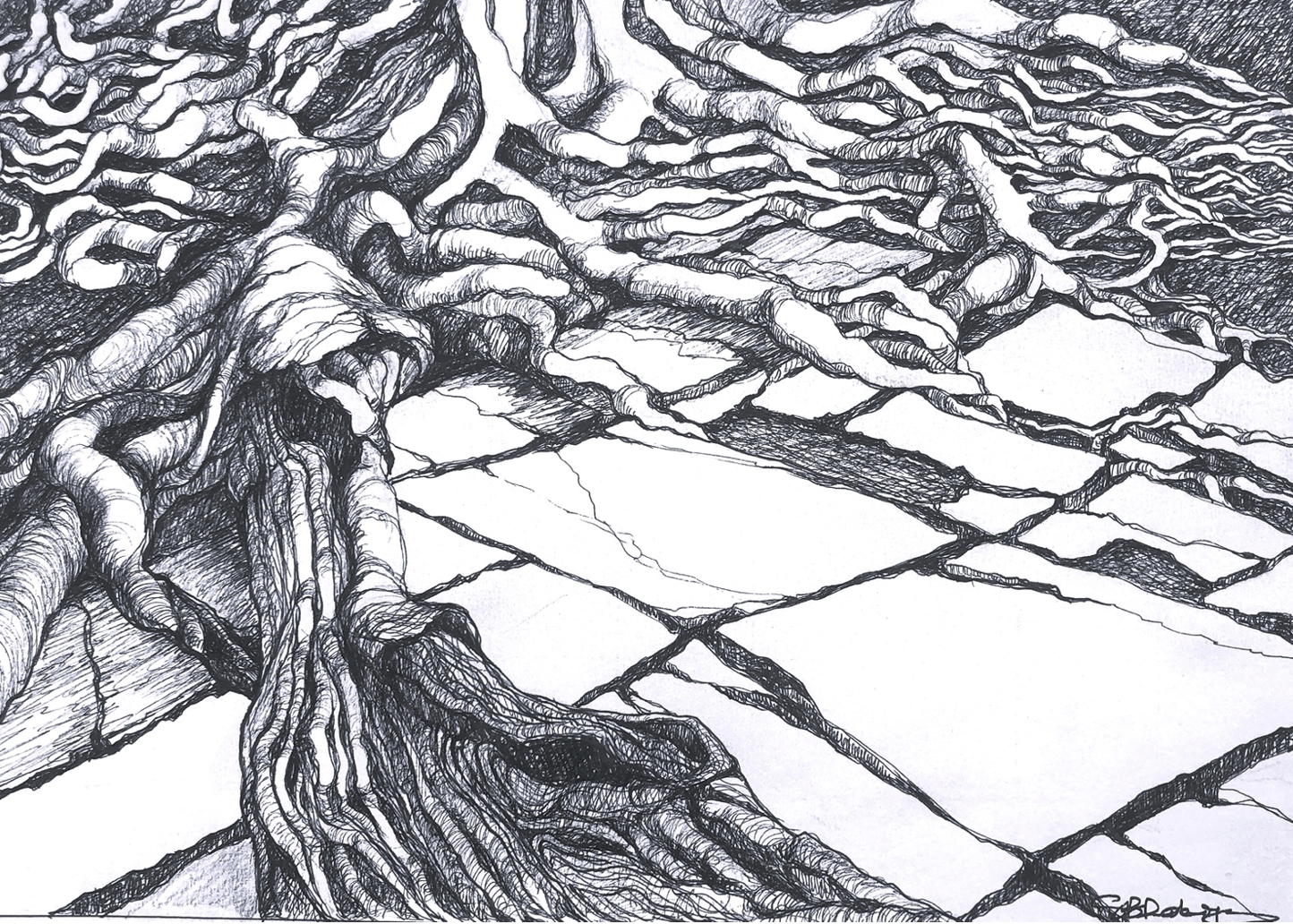
Banyan tree 2. New York, 2022, mixed media, 30x21 cm
Lecture II
Aesthetics of Historical Thinking/Writing
In this talk, my foundational proposition is that a historical text is in turn an artifact. It is a writing with its own interpretation, truth content, and form, or arrangement of events, hence its aesthetic. This means that these texts cannot claim to be objective and absolute re-enactments of events as they happened. This is a non-essentialist and critical perspective that is diametrically opposed to mainstream Armenian historical thinking/writing. Hitherto undiscovered, unstudied well-documented cases that I have discovered over three decades stand as counterpoints and counterarguments against commonly granted narratives and paradigms of explanation in this discipline. In addition to many references to almost all my works, I have dedicated several studies to a critique of Armenian historiography. [8]
My primary argument in the case of the Armenian historical experience, and from the beginning is that since the Armenian oikumene (habitat) has always been the entire region, including the homeland, things Armenian are also things Near/Middle Eastern and must be studied and conceptualized as such. This has not been the case and Armenian histories suffer serious problems in many respects, from methodological to philosophical and essentially historiographic. My critical and hermeneutical approach to historiography, phenomenological perspective and shift of paradigms opened a new and different panorama, a geoglyph of the Armenian historical experience in the broad Near Eastern region, and as a consequence, a novel discipline of Islamic-Armenian studies, to which I have dedicated six volumes and many studies.
[8] “A Phenomenology of Armenian Studies: The Discipline and the ‘National’ Meta-Polis”, Le Muséon, vol. 121(2008) 1-2, pp. 213-229.-“A Hermeneutic Phenomenology of the Armenian Experience in the Islamic World − Paradigms of Interaction and Historicity,” Lecture at the Workshop of Padus-Araxes Association, University of Venice (Ca’ Foscari), Department of Asian and African, Mediterranean Studies, May 5, 2015-“Taking Things Armenian Beyond the Pillars of Hercules: Plus Ultra - A Discourse”, Lecture at ARPA Institute (Analysis Research & Planning for Armenia), November 12, 2016.I. Historical narratives as artifacts
“Ceci n'est pas une pomme” (This is not an apple), is a painting by René Magritte (1898-1967) made in 1964. He means that the object that they see is an image of an apple, as he saw and painted it. Therefore, it is an artifact and as such a different entity with its own type of existence. The similitude of the object in the painting to something out there, in this case an apple, is irrelevant to its being an artifact.
The same can be said about a historical text, and this is a foundational concept and an argument that a historical text is not history. It is just an artifact made by someone at a certain point in time and circumstances, arrived at by certain methods, from certain sources, and with its own interpretation and arrangement of peoples and events. It is very common to have different, even contradictory accounts of the same episode. For instance, the history of the Peloponnesian War by Thucydides (d. c. 400 BC), a military man, is one of the earliest books of history, as we understand the discipline today, even though Herodotus (484-425BC) is known to be the “father of History.” In the form of a meticulous and critical report of the events of the war (431-404 BC) – as Thucydides repeatedly emphasized – the book is a sharp political-philosophical analysis of war through a superb narrative in refined language. It is an artifact created by a superior author, and a work of art at that, about an episode in Greek history. The other accounts of the war do not suggest a similar image of the war, even if the basic data are identical.
Another case of the same period is the story of the trial of Socrates (d. 399). The episode has two accounts by two very different contemporaries: Xenophon, a military man, and Plato, an erudite nobleman, then in his twenties. Both are writings about an event and as such artifacts. Even though the proceedings in both are almost identical, two distinct characters and radically different message emerge from each. While the Socrates of Xenophon is a common and slightly boastful, annoying and moralizing old man, it is hard to imagine Western philosophical thought and intellectual culture without the legacy and image of the Platonic Socrates, as drawn in The Apology of Socrates, Plato’s first dialogue, that put the beginning of an entire philosophical tradition. “All of Western philosophy”, said Alfred North Whitehead, “is a footnote to Plato.”
From epics, mythologies, poems, chronicles to modern histories, historical writing has been one of the most ancient and important literary genres. The Greek word historia meant inquiry, or search of knowledge, not story, account, report or record.
In recent times, and more so recently, historians have come under attack for logically loose narratives, unfounded criteria, unquestioned assumptions, and intuitive methods. Because traditional approaches to historiography, still maintained by many, are based on certain ideologies, questionable epistemology and rigid essentialism. The latter is the belief that all things have permanent essences, and that historical narratives are direct reflections of the past, as it happened exactly. Concerning the epistemological flaws, the confidence to have reached and provided certain knowledge of the past lacks methodological and empirical grounds.
The belief held by many mainstream historians that a historical writing “is history”, or an accurate report and a re-enactment of the past arrived at by ironclad research methods, is epistemologically untenable, and is no longer acceptable.[9] The impassioned observer, and the “objective chronicler” are impossibilities. There exists no comprehensive "recording machine.” [10] Canonical descriptions and grand narratives with claims to universality are just written texts and artifacts. As H. White (1928-2018) says, history is “invented” as much as it is “found.” [11] There is a subjective and deep structural content created by the historian/writer, which he calls the "metahistorical element”, that cancels the claim to universality.
Philosophy of history, or critical examination of historical thinking/writing is very recent. It concerns not just philosophers, but all scholars in social sciences and the humanities because historical knowledge concerns everyone. Furthermore, it is not only philosophers who ask questions. The opening up of historical analysis to interrogation is at the heart of contemporary thinking, and there can be no sharp distinctions between so-called history proper and philosophy of history. Furthermore, philosophically sound perspectives are vital for everyone, because people learn about themselves and their world from history books too. What they learn makes a difference in what they do or may and will do. History is too serious to be left to historians alone.
[9] See, Alun Munslow, Deconstructing History (London: Routledge, 1997), pp. 2-3.] [10] Gordon Graham, The Shape of the Past- A Philosophical Approach to History, p. 21.[11] Hayden White, “The Historical Text as Literary Artifact”, in Tropics of Discourse: Essays in Cultural Criticism (Baltimore, Johns Hopkins University Press, 1978), p.82. II. The aesthetics of historical thinking/writing
Both the process and the product have their aesthetic. By the aesthetics of historical thinking/writing I mean the totality of the questions, perceptions, sensibilities, contradictions, tensions, insights, visions, as well as the formal and methodological criteria that go into the making of a relevant and engaging text in historiography. I also posit that the same comment applies to any artifact in all disciplines and areas. Because all meaningful artifacts are/must be essentially autonomous responses to circumstances, and never commodities on the academic and the intellectual/academic “markets.” The concept of Heideggerian “situatedness”, that I totally adopted almost instinctively long before I read Heidegger, comes in this context.
For Martin Heidegger (1889-1976), a student of Husserl, the scientific attempt to step back and examine an object ‒ in the social sciences and the humanities one may add ‒ severs it from its living context. He therefore introduces his notion of “Dasein”, literally “being there/here”, in which the self and the world belong together in a single entity. The concept focuses on the contingent situatedness of the human condition in a set of spatio-temporal circumstances, that are not entirely of their own making, and that they cannot leave behind at will. There is an ontological unity in the concept of Dasein or “being-in-the-world.”
This is situatedness. It means the interconnectedness of perceptions, reactions, social-historical experiences, and circumstances. Understanding and reflecting human situatedness are simultaneously motives and objectives. We never achieve a complete or so-called objective interpretation since we are limited not only by language but our historical situation as well, our situatedness. [12]
Thus, philosophical hermeneuts, and Gadamer in particular, it is not the procedures of coming to an understanding that are important, instead it is what happens to us over and above them. Hermeneutics is not about the recovery of existing meanings, but instead, the creation of meaning itself. There is an intersection, a convergence, and a fusion of “horizons;” understanding combines previous and new meanings, Gadamer defines “horizon” as the range of vision that includes everything that can be seen from a particular vantage point. The horizon of the past, out of which all human lives and tradition come, is dynamic, and the hermeneutic act is a fusion of horizons of the past and present. In the end, as Gadamer suggests, truth does not necessarily exist in the world alone, it is continually fixed and unfixed in our continual relationships with our world/s.
In my case, both scholarship and art are essentially contexts for encounters and convergences. While the former mean confrontations and dynamic relationships with everything, the latter are meetings, and the generation of new “horizons”, where things come together both for understanding and aesthetic enjoyment. Circumstances change, so do the “horizons” of encounters and fusions. As new writings and artworks unfold new insights, and despite bleak foresights, possibilities of change seem to be more possible. The sensitivities of artists and intellectuals, also the depth of their understanding vary, but always their works reflect their distance from and concern for these issues. In the end, the “truth-content” of the given work becomes the measure of its significance and value.
[12] See, Shaun Gallagher, Hermeneutics and Education (Albany, NY: State University of New York Press, 1992). III. The counterpoints in my historical thinking writing
Clearly, my perspectives are non-essentialist, not Armenocentric and critical-hermeneutical. My philosophical and historiographic works deviate from, and often contradict mainstream traditions, norms and practices in Armenian Studies, on this occasion, but this is not the proper occasion to comment on the subject.
My last and sixth volume in the subject of Islamic-Armenian interactions was Islam in Armenian Literary Culture. Texts, Contexts, Dynamics (Louvain, 2021). I wrote and published a few dozen extensive studies in the same line. The discipline that I initiated is novel, not only for the novel data discovered, but because it could only be possible by a radical shift in philosophical and methodological vantage points on the Armenian historical experience. In other words, a phenomenological, holistic and critical approach to historiography as an interdisciplinary field opened novel aspects of the Armenian historical experience, which stand in direct contradiction to mainstream accounts, even the very recent ones. The resulting panorama, rather geoglyph manifested an infinite variety of Armenian historical experiences and new paradigms in the broad Near Eastern region.
In all my Islamic-Armenian studies, and from the beginning, my foundational argument has been the following: If, from the middle of the seventh century historic Armenia and the habitat, from Asia Minor to the South Caucasus and the Tigris, including the modern Republic have been part of the Islamic world, and if until a few decades ago the entire region, from the Black and Caspian seas to the Mediterranean, including Iran, Iraq, Syria, Lebanon, Palestine and Egypt, was still the oikumene or habitat of most of the Armenians, their history too was naturally part of these locations and peoples. Armenians lived there as integral elements and their world was governed by the same laws that governed the region. In elementary Newtonian terms, the law that makes the apple fall is the same that keeps the moon in orbit. This perspective finds solid grounds in Arab histories. In these texts, the Armenians and what is known as Armenia are very broad concepts. Not because this Armenia is much larger than the one referred to in Armenian histories, but because the Armenians, or al-arman are considered as natives of the larger region and referred to whenever and wherever found, in all capacities. In Armenian histories restrictions on class, faith and location greatly narrowed and distorted all accounts. Many episodes and phenomena that I have discovered in Arab sources, such as the Fatimid Armenians, are instances. Therefore, I argue that since history has no secret pockets and private laws, things Armenian are also things Near Eastern and must be conceptualized as such. This has not been the case, and this is where my historiographic position and work take their urgency, relevance and legitimacy.
My tools to initiate an overall and comprehensive critique were well documented paradigm cases that stood as counterpoints against traditional perspectives and narratives. Over more than three decades, the counterpoints that I excavated from primary, and mostly Arab sources, were counterarguments for a broader, multidimensional, and dialectical expanse of Armenian historical experiences in the Near and Middle Eastern worlds, that were Islamic as of the 7th century.
My philosophical-critical approach suspended commonly accepted narratives and practices of mainstream Armenian histories. Someone has said that cultural meanings and images are like traffic lights, they are valid only for those who move on those roads. However, if someone decides to take other, more direct and “scenic” routes s/he will bypass those lights, and they will simply lose their significance and legitimacy.
Obviously, mainstream “traffic lights” are not routes to so-called historic “truths.” But they seem to be paths to “legitimacy” and position. For fresh starts, these “lights” must be set aside, because explicitly and/or implicitly they are based on assumptions and often agendas. As accounts of the past or present, they are simply symptoms of existing problems. Furthermore, similar to Adorno’s “culture industry”, historical “goods” of mainstream narratives are not only mass produced, but also designed as per the criteria of the cultural diplomacy of local, partisan and/or national Armenian institutions in dominance in the Republic and elsewhere. In view of the relativity of most, if not all cultural “traffic lights”, therefore, all accounts will have to be deconceptualized, or simply overlooked. The paradigm cases that I found were practically counter-cases, counterarguments, or counterpoints. I therefore took counter-routes that led me to new and unbroken grounds.
IV. The Beginnings and the path
My interest in Islamic history was triggered by a “discovery” I made as a graduate student in philosophy. I demonstrated that an obscure medieval text entitled Views Gathered from the Writings of Tajik Philosophers by Vardapet Yovhannēs Erznkats‘i (d. 1292/3), written around 1260 – as I showed ‒ was simply a beginner’s summary of the 10th century Islamic esoteric compendium of sciences, known as the Epistles of the Brethren of Purity or Rasā‘il Ikhwān al-Ṣafā’. Previously, in Armenian Studies it was believed to be an original work made at a much later period in the career of Yovhannēs. I demonstrated that this could not be the case, and that the initiative revealed a social-cultural urban stage at the time in Asia Minor, that was very different from the one granted in Armenian sources.
“Humble” Vardapet Yovhannēs from Erzinjān/Erznka, as he called himself, threw an even bolder, more intriguing, and in turn undetected bridge into Islamic urban culture. In 1280, he wrote the Constitution for the “reform and regulation” of the urban coalitions, or the Armenian Brotherhoods of the manuks (synonym of Islamic fatā) of his city. As I demonstrated in detail and in several studies, this Constitution had no precedent in Armenian literature. Yovhannēs simply Christianized and Armenized ‘Abbāsid Caliph al-Nāṣir’s (r. 1180-1225) reform decree and futuwwa literature of the early 13th century. I also argued that it was the cosmopolitan urban circumstances and extra-ethnic and religious nature of the societies that allowed the application of an Islamic Constitution, by the Armenian Church, at Erznka and the other cities of the Eastern Asia Minor. Much later, in the 16th, 17th and 18th centuries, the Constitution was still applied in the Armenian communities of the East European cities as well.
Furthermore, based also on the poetry of a contemporary and compatriot of Yovhannēs, Costandin Erznkats‘i (b. circa 1250) – also closely related to Arab-Persian futuwwa poetry and coalitions, I argued that often described as hedonistic and chaotic young men of the cities — which in fact they were — both by medieval Armenian and Islamic authors, the folklore of these youth coalitions lay the grounds for the secular and post-medieval and cosmopolitan culture of the urban lower and middle classes in the entire Near East. This was basically my initial argument that the Armenians were integral parts of this wide world and the processes there, hence the interactive nature of their experiences and the necessity to reconsider mainstream historiography and literary culture in general.
In philosophical hermeneutics the Rasā‘il-Views case would be called “relevant information.” It implies new knowledge, which becomes a new tool for understanding a problem. It has an ontological significance too: given this new knowledge, the same topics and objects will not be seen in the same light anymore. New knowledge will smash our horizons and force us to seek and form new ones for inquiry and understanding. Our awareness of ourselves will increase and we may find alternative ways of seeing and doing things. Both as individuals and as interpreters, in the case of historical thinking/writing, “relevant information” may upturn all relationships, because it has transformative dimensions.
The case of Views-Rasā’il signaled the beginning of a long journey of decades. With no road map or institutional or even “moral” support, the journey into understanding the Armenian historical experience in the Islamic worlds started as a lone venture into twilight zones and unchartered territories of “things Armenian.” The initiative implied proceeding by specific cases, or counterpoints as factors in the dynamics of the process developing a new panaroma.
On the existential level, for me personally – a trilingual, multi-cultural Armenian native of the Arab world with ancestors from the East and the West of the Armenian World – being an intellectual and a historian meant actively participating in the traditions of my region and “being” historical and philosophical, not “doing” history and philosophy. Art too was just a manner of reacting, perhaps a talent too, but always a regulative-balancing force.
From the beginning, as a perceiver-thinker-writer-artist, in my responses, thoughts and praxis, I was aware of the inherently hermeneutical nature and the liminality of my position, rather opposition. My understanding of “things Armenian” seemed to cross the limins, or the thresholds, connecting different worlds, the known and the unknown, the concealed and the unconcealed.
The obvious hypothesis, which was also my foundational proposition and from the beginning, was that there are things in Armenian and Near Eastern intellectual and social cultures that must be specifically categorized and studied as primarily “things Islamic-Armenian.” Furthermore, taken as distinct themes, they generated their own peripheries for a novel discipline of Islamic-Armenian studies, which was relevant, contemporary, otherwise interdisciplinary, holistic, and critical.
The discipline, that I initiated was an alternative route that would break the impasse created by mainstream and often nationalist or presumably “academic” accounts of things Armenian. More importantly, it would also reveal the methodological and philosophical insufficiencies of the micro-Armenological and verbose studies recently at large.
After 1987, when I started my dissertation for the Doctor of Sciences degree, I excavated many novel cases. Practically, I composed – as one does in a painting or a musical piece ‒ a novel, rich, and beautiful geoglyph of things Islamic-Armenian with its unique patterns and dynamics.
As an Armenian native of the Near/Middle Eastern Islamic world, it meant my situatedness, and made sense to me, it pleased me to have created an artifact that was also a workspace for a discipline of Islamic-Armenian studies. I discovered new episodes, such as the phenomenon of Fāṭimid Armenians, that Armenian historiography had totally missed, paradigms of urban cosmopolitanism, connections through dissidence, realpolitik on all levels, the phenomenon of Muslim Armenians, images of Islam and the Prophet, the Armenian Ghurans, patterns of inter-religious debates and pacts, and the like. After a trilogy on the Armenians in the Medieval Islamic World, my sixth work was Islam in Armenian Literary Culture. Texts, Contexts, Dynamics (Louvian, 2021). It was a major phase, rather, a crowning of sorts of an existentially challenging and an intellectually complicated process.
My most recent study was prompted by the 850th anniversary of the death of St. Nerses IV Shnorhali (r. 1165-1173). In contradiction to most studies, and they are very many, I focused on the political-diplomatic aspect of the legacy of this “saint”, theologian and poet. At least two other “saints” of the Armenian church were shrewd political actors in the Islamic world, catholicoi Sahak III Dzorap‘orets‘i (r. 677-703), and Yovhan III Odzets‘i (r. 717-728). The initiative to view sainthood and diplomacy in a single context was a novelty. But the portrait of Shnorhali as a diplomat-saint has a far superior aesthetic, as well as truth-content than the two-dimensional medieval figure of the manuscripts. This compounded and complex portrait of the saint/diplomat is a counterpoint and as such a starting point to review similar personae over the entire expanse of Armenian history.
In general, the Armenian historical experiences in the medieval Near East as well as the modern Middle East were and still are too diverse, mobile and complicated. Constructs based on the idea of an ancient, heroic, persistent and struggling Christian people in the move, are too narrow.
To avoid dangerous essentialism and anachronisms, Armenian historians should try to comprehend and reflect this condition. Unfortunately, there is a politics of Armenian mainstream historical writing, and an underlying grid that is obstructive. Younger academics seem to float on the current too.
At present, being a historian and a scholar in general is more than just self-identification and self-categorization. It means making a choice between being part of this mainstream “politics of truth’ or a critic of it, being a contributor to the “culture industry” or its adversary and reformer. The latter describes my position. The arguments in my studies reflect this polarity. Despite the odds, this has been my path in an unchartered territory with “forbidden” stops as well.
To be an authentic historian will probably mean to face up to one’s career as an intellectual and stay away from “traffic lights” for easy fame, institutional validations and popularity. People will have to understand themselves not by mass-manufactured narratives and so-called scholarly “goods” at Armenian centers and clubs, but also from without and through their existential connectedness to all things, and their dynamic cognitive experiences. By its motives and objectives my historiographic work is a statement very different from what mainstream historians understand as history. It is an oeuvre of aesthetic concerns and dimensions by the existential tension in its making and methods, hence its truth content.
My most significant contribution to Armenian historiography will probably be the aesthetic of my historical thinking and writing, as mentioned. By the motto of Plus Ultra, or “further beyond” the Pillars of Hercules between the Mediterranean ‒ or the small pond of Armenian studies ‒ my journey aimed at crossing into the Atlantic, the broad ocean of contemporary Near Eastern studies. There is a more intriguing and aesthetically superior Armenian history out there, in the “land of unknown” beyond those pillars, as Plato would call it.
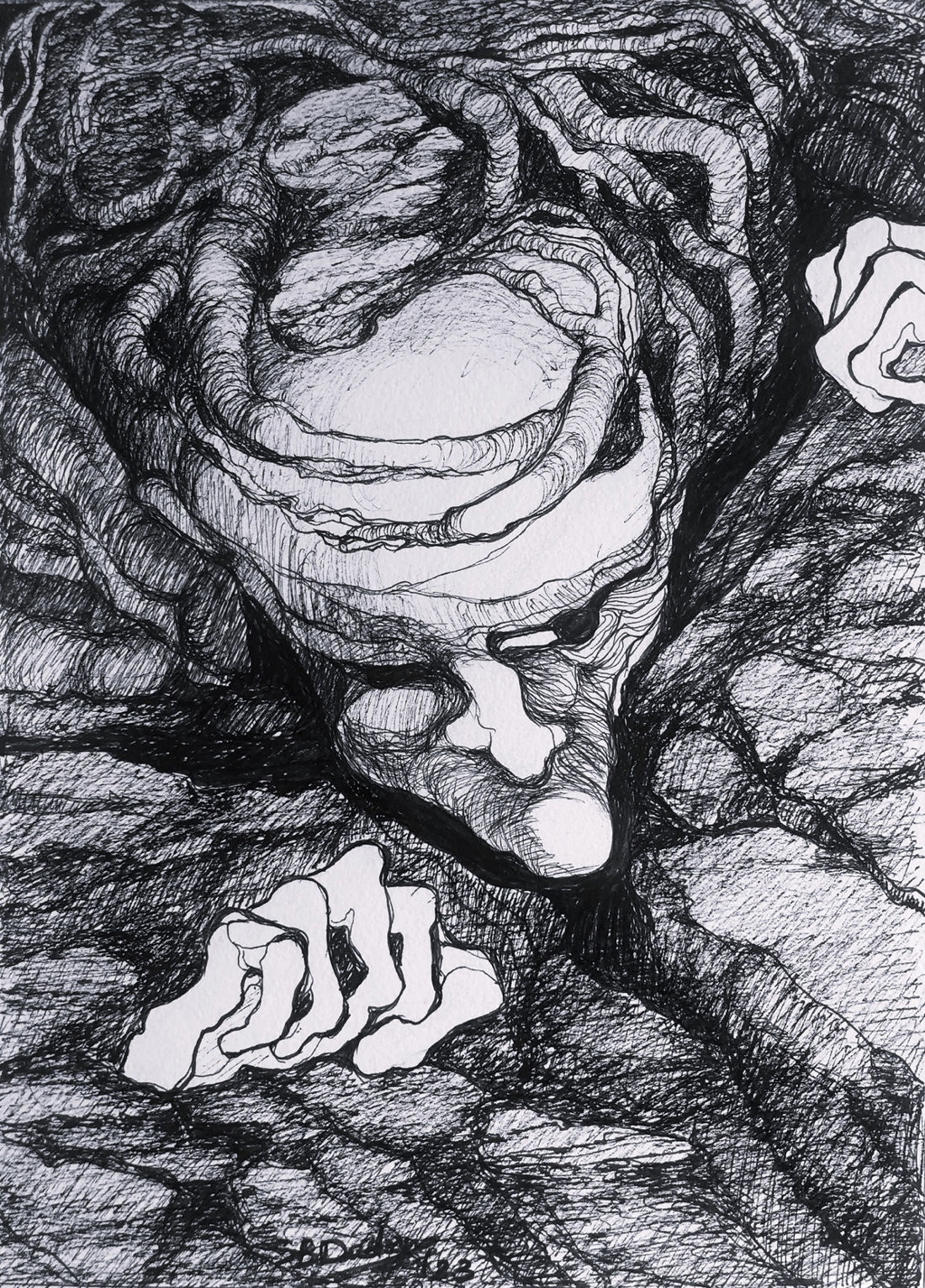
Resurrection of the thinker, New York, Jan 23, 2023. Mixed media, 18x25 cms
Lecture III
The Artwork and
The Dialectics of Truth Content
Technically, this is the most aesthetic part of the “dialectical-hermeneutical-discursive triangle.” The first was on philosophy and the second on historiography. Art is the third corner or pillar.
In Part One and following a brief discussion of aesthetics as a branch of philosophical sciences and its development, the focus is on some foundational concepts: the autonomy of art, its cognitive import, the social-historical embeddedness of arts, the ‘culture industry’, hermeneutical ‘horizons’, and ‘truth-content.’ In the end I propose my theory of concretization as an alternative theory of aesthetic judgment. Part Two is dedicated to the presentation of the book, Encounters and Convergences. A Book of Ideas and Art. Since both my scholarship and art took their beginnings and developed as responses to specific encounters and at specific phases. I briefly outline the processes as encounters in all my works as convergences, hence their aesthetic, underlying unity, and truth content.
PART ONE
I. Aesthetics and foundational concepts
Coined during the Enlightenment after the Greek word aesthetikos or sensory perception, aesthetics is the ‘science of perception’, because all artworks are objects of perception. Since they also are objects of knowledge, aesthetics is also called philosophy of art.
The first to reflect upon the arts were Plato, then Aristotle but more systematically. Most philosophers refer to art, focusing mainly on its ontology, or ‘what art is’, also its status and role. Art was defined as imitation, madness, catharsis, beauty, taste, judgment, pleasure, understanding, play, expression of emotion, psychological needs, spirituality, and insight. At present the question about the nature of art is considered too narrow and somehow anachronic, because it misses other essential matters related to the arts.
At the end of the 18th century, or the Age of Enlightenment, Kant’s (1724-1804) Critique of Judgment (the “third critique”, written in 1790, after the Critiques of Pure Reason, then Morals) was the first modern book of aesthetics. For the first time Kant introduced the concepts of formal autonomy of art and aesthetic judgment. A few decades later, in the 19th century, Hegel (1770-1831) brought up the intellectual import of art, and especially its cognitive and historical significance. Marx’s (1818-1883) contribution was to highlight the social embeddedness of the arts. Nietzsche (1844-1900) defined art as in existential terms as a necessity to survive the suffering and chaos of life. Soon, Freud (1856-1939) explained its deeper psychological dimensions. In 1930s and later, the Critical Theorists of the Frankfurt School, and Theodor Adorno (1903-1969) in particular, developed a most intriguing aesthetic theory since Kant, Hegel, Nietzsche, and Freud. Adorno made a synthesis of the previous theories but in an original and powerful critical-dialectical context. Practically, he is the initiator of a contemporary discipline of aesthetics as an mportant part of the humanities and social sciences.
II. My aesthetic and four foundational themes
A. The autonomy of art and the “culture industry”
B. The cognitive import of art
C. The social-historical comportment
D. An alternative approach: Concretization and the artwork
A. The autonomy of art and the “culture industry”
First formulated by Kant, the concept of the autonomy of art metamorphosed into a more comprehensive aesthetic theory in Adorno’s work. However, while by autonomy Kant meant the independence of art from desire and practical purpose, Adorno brought autonomy into the artist and the creative process. In this perspective art is defined as an autonomous expression of total human freedom, opposed to all that hampers it. This is indeed a hard, rather impossible to ignore or dismiss statement.
The concept of autonomy is central to the theory of “culture industry” (discussed in the first talk), initiated by Adorno and his teacher Max Horkheimer (1895-1973) around 1930s. A legacy of the Frankfurt School, it is now a widely accepted and adopted theory. According to this theory, the arts are mass-produced and controlled by an overwhelming and powerful “culture industry.” As such, they stand against, and prevent autonomy of thought and taste.
Furthermore, a monolithic culture industry needs a conformist society to dispense its goods. Therefore, opposition by autonomous individuals or groups will not be tolerated or accommodated. Because the culture industry relies on the passive acceptance by the reader, listener, cinemagoer and generally the consumers of cultural goods. Consequently, to be true to themselves and the society from which they spring and must reflect, artists and intellectuals must be critical and oppositional. The arts and scholarship must be in a continual state of awareness and dissatisfaction.
The basic idea is that as a societal phenomenon, the content of an artifact – be it scholarly or artistic – is inseparable from its truth content, legitimacy and success, and their contraries, that is untruth, irrelevance and failure. Indeed, as we look at the marketplace of the arts, culture and entertainment, and despite seeming and apparent liberalism, abolition of criteria and rules everywhere, there is massive standardization. Because standardization is a diplomacy and a tool to even out, so to speak, society and cancel individuality, autonomy and critical spirit by consequence.
There is an artworld (as A. Danto, 1924-1913, puts it), and there are art-markets, therefore the focus is on the marketability of the artworks. Inevitably, artworks have become commodities, accents and often screams. Mixed with mass media, also social media and entertainment, the arts are also instruments of homogenization. The public stands outside and anyway is a captive audience that often cannot even enjoy the artworks because it cannot relate to or understand them. Fashion and pop arts are in the same situation as instruments of homogenization.
Over a century ago, most artists of the absurd, Dada, readymade, avant-garde, and related movements presented their works, and still do, on wings and cushions of certain philosophies of art. They are now assimilated into the fabric of consumer society, and as Habermas (1929-) says, their modernism is now “dead.” One cannot talk in any seriousness on the aesthetic path drawn by works like Tracey Emin’s (1963-) “My bed” (an actual filthy bed), Mary Kelly’s (1941-) postpartum and other “stuff”, the cut-out-dead animals of Damien Hirst (1965-), and thousands of similar works. Their aesthetic message and legacy are limited and consumed in the initiatives. There is no cognitive nucleus or challenge, and it is hard to imagine that an artwork can stand on an abstraction, a reification in the mind of the artist, or an article in a national paper by a self-proclaimed art-expert. Major museum shows, verbal appendices in papers, publicity and sale value may have a temporary role in the propaganda and sales, but they are not part of the work, therefore aesthetically and in the long run irrelevant.
B. The Cognitive import
A legacy of Hegel, the cognitive aspect of art was further elaborated by Adorno, again differently. “Every artwork”, he wrote, “if it to be fully experienced, requires thought, therefore stands in need of philosophy.” [13] As carefully planned and made artifacts, artworks have their inner logicality, which however is different from discursive reasoning. Yet, like in a syllogism, one step follows the next by a formal necessity, and the work gains its logical consistency, coherence, and unity. Aesthetic logic has a greater degree of latitude than ordinary logic, said Adorno. [14] I believe that great artworks defy ordinary reasoning without negating it.
[13] Theodor W. Adorno, Aesthetic Theory, Trans. Introd. Robert Hullot-Kento (New York: Continuum, 2002), p. 262.[14] Ibid. p. 136.C. The social-historical comportment and embeddedness of the arts … was an aspect of aesthetics that developed during the 19th century and metamorphosed with greater force through Critical Theory. According to the latter, contradictions in social-political circumstances crystallize in the “truth content” of the work, hence their social comportment.[15] Therefore, the “truth content” (in Adorno’s phrase) of an artifact is necessarily historical by the objectivation of genuine perception and social consciousness. [16] It is the historical outcome of an artist’s response and treatment of an experience. Authentic works, says Adorno, are the “self-unconscious” historiography of their times, [17] and La Guernica of Picasso immediately comes to my mind.
[15] Ibid., p. 133.[16] Ibid., p. 191.[17] Ibid. p. 183.D. An alternative hypothesis: Concretization and the artwork
Based on these few concepts outlined above, and as an alternative approach to aesthetic judgments, I suggest a paradigm shift from the artist to the artwork. In sum, my alternative theory is that artwork is all there is. I suggest shifting the focus from the ontology of art, or “what art is/should be,” to the artwork itself as a concrete entity, a thing-in-itself. It is something created in superior aesthetic form and a content that has a specific social and historical comportment or a bearing.
By truth content I understand the unity of the formal structure and the core or the meaning of the artwork, which develops through the internal tension between them. Critical judgments about the work must therefore consider the internal dynamics of the work and the aesthetic-intellectual-social-historical totality, or its situatednesse at which it starts and which it reflects. Therefore, truth content is not a metaphysical concept, or some sort of “essence” hovering outside the artwork in the mind of the artist, nor it is a construct. It is deeply human, historical, utopian in its reach, yet firmly rooted in specific circumstances. It is the way in which an artwork simultaneously challenges the way things are and projects how they could be existentially more relevant. [18] A true artifact is an existential journey, both by the artist and the viewer. And it must be worth taking to encounter new knowledge and sensibilities. The more enriching they are, the more valuable the work is.
[18] Ibid., p. 132. PART TWO
I. Encounters and Convergences. A Book of Ideas and Art
An amalgam of philosophy and art, my last book was written as an oeuvre, or a statement about my art and scholarship in terms of encounters and convergences. While encounters meant confrontations and dynamic relationships with everything, convergences were meetings and the generation of new “horizons” where things come together for my understanding and aesthetic enjoyment. Circumstances changed, so did the “horizons” and my works, both in writing and art. In the case of my scholarship and art, the effort to arrive at horizons for convergences has been existential or directly related to the meaning of my existence. I strongly share the hermeneutical perspective on the relationship between the inquirer and the object of knowledge. The researcher is part of the research; they are one in the cognitive as well as the creative process to reach new meanings and understanding. The sensitivities of artists and intellectuals, as well as the depth of their understanding, vary, but their works always reflect their distance from and concern for these issues. In the end, the truth-content of the given work becomes the measure of its comport and value.
Understanding my social-historical situatedness, or my condition, has always been both a motive and a purpose. This condition, that I share with a great number of Armenians, is being a multilingual and multicultural Armenian native of the Near East, with immediate family and ancestors driven from the extreme West and the extreme East of the Armenian World. It means having multiple hyphenated identities and inheriting multiple legacies of ancient and modern civilizations, peoples, cultures and faiths, including my own. In the processes of acculturation, this condition required an urgency to understand the Armenian historical experience in comprehensive and critical terms, and not through assumptions and semi-epic narratives on the cultural marketplace. Hence my work in philosophy and history. Researching, writing and painting meant engaging in discourses and debates within myself and with the different worlds and communities I was part of. Both my scholarship and art required “being” historical and artistic in a personal and direct manner, and not just “doing” history, philosophy and art by training and career. I wrote and painted at specific periods and in response/reaction to specific circumstances.
The second part of the book had to be structured on a schematic autobiographical grid. It is entitled The Quest and the Path. Opposed to conventional and so-called strictly academic or primarily artistic practices, this Book of Ideas and Art is also an illustrated argument, of sorts, in support of my aesthetics, as briefly outlined earlier, and my interdisciplinary perspectives and career. Like other contemporary thinkers, I consider dichotomies between disciplines, and narrow specializations artificial and “schizophrenic,” as F. Jameson (1934-) puts it brilliantly.
Furthermore, looking at artists as “peculiar” people with a carte blanche to total no-sense, also, considering the arts as distinct areas, and judging artworks based on random concepts, miss and distort their social, historical, intellectual and aesthetic significance and dimensions.
Primarily as a critical, creative, and not descriptive or expository work, my Book of Ideas and Art is written with these concerns. The objective is to communicate in words and images encounters and convergences with challenges and contradictions at different phases of my life. It is therefore self-reflective in conception, cross-disciplinary in scope, dialectical in method, hermeneutical in approach, and artistic in expression.
II. The Quest and the Path
The second part of the book, entitled The Quest and the Path, is in four chapters. I trace my path from my birthplace Aleppo to universities in Beirut (majoring in fine arts and philosophy), marriage, travel to London to study figure drawing, then back to Beirut for graduate studies in philosophy, teaching at AUB and working for my Doctor of Philosophical Sciences. A cataclysmic experience with an art instructor in my undergraduate years interrupted my journey as a painter. I have kept only two sculpture pieces. In London I focused on the personalities of the models and enjoyed figure and portrait drawing immensely.
We were in Dayton, Ohio when the war started in Lebanon in the spring/summer of 1975. Back home, “encounters with strife and suffering”, as I put it, drew me to the drawing board. From 1975 to 1980, I made seven drawings that marked the initial phase in my wartime aesthetics.
Encounters with human catastrophes were the motive force for two important studies, the first in art history and the second in philosophy, both in Armenian. My first book was on Armenian painting in Lebanon, an art that first appeared in Lebanese post-Genocide circumstances. It was a social phenomenon, as I argued, and classifications had to be based on the types of responses to the Armenian condition and crises of identity. The book was entitled Lebanese-Armenian Painting in the Light of the Crisis of Identity (1984). My next study was in West Armenian Philosophical Thought (1987). [19]
Clearly, I wrote and painted in response to challenges and contradictions. I sought a convergence in understanding and coming to terms with my situatedness. My research and artworks simply summed up my encounters and convergences in the process. The initiative was a Nietzschean reversal of the Cartesian cogito. Instead of ‘Cogito ergo sum’—I think therefore I am—, I started at my existence and moved to the thinking about it, I exist therefore I think or must think, ‘Sum ergo cogito’.
The third chapter of the book is under the title of “Wartime art and Aesthetic.” Thirty-three works, from over sixty, are featured, all made between 1980 and 1987. Some of the titles are: “The wait”, “The shelter”, “The comrade”, “Worlds of silence”, “The friend”, “Qasf (bombardment/shelling), “Malja'” (shelter), “Fresh air”, “Departure”, “Ideology in crisis”, “Situatedness”, “The stride”, “Morning after bombardment.”
During the 17-year war in Lebanon, from 1975 to 1991, just as life was wartime-life, art in turn art could only be wartime-art. It traced a trajectory which took its beginning in the immediate realities of the war, and by the force of its convergence in the present moment, gave the work its truth-content and aesthetic legitimacy. Under the circumstances, I could not understand salon, studio, “abstract”, and decorative artworks, nor the assumed “freedom” of art of the mundane. I often wrote in the papers but was not lauded for my critique.
The human condition in wartime and massive suffering were central to my thinking, and inevitably, the human figure became dominant in my work. For right or wrong reasons, wars were fought by people, and affected all people in every possible respect. While somehow life went on, many suffered, many died, many survived, yet everywhere all waited for deliverance. In 1991 the war ended in Lebanon, so did my art, temporarily. Begun in 1987, my dissertation for the degree of Doctor of Sciences in Philosophy literally marked the beginning of a new discipline, Islamic-Armenian Studies. This was the beginning of my scholarly response to my condition as an Armenian native – including all my ancestors – of the Islamic World, simple as that. My Dasein, or being there, my situatedness in that world of which I was part, was the context for all the processes. My critical/philosophical approach to historiography – in this case Armenian/Near Eastern – was a natural outcome of my condition as a native of that world.
My American-Armenian experience began in in 2002, when I was appointed visiting professor at Columbia University (and again four years later, in 2006, after which we did not return to Lebanon. The Centenary of the Genocide prompted my bilingual book on the Armenian Condition in Hindsight and Foresight. [20] On this occasion, I shall make only one comment on my American-Armenian experience, to which I have dedicated a whole chapter in the book. This experience caused a radical intellectual re-positioning and change of perspectives on things Armenian. Hoping that new ideas would stir questions beyond the marketplace of recycled concepts and folkloric practices, I tried to reach the public and academics. I lectured and interacted quite frequently. By the end of 2016 I realized that my perspectives and dispositions seemed to run counter to local norms as well as those of the Armenian Studies centers. I withdrew from Armenian social circles and events, despite the popularity of the talks and my genuine enthusiasm to meet people and audiences.
Exposure to and interaction with changing, contradictory, and sometimes disappointing encounters kept me at a distance; I pondered about the ethnic background I shared with the community here. In lieu of a comment, I will re-cite a paragraph from the first lecture. “National identity is not an immutable essence. It is like a flowing stream of water that starts at a source and flows in a bed. As Heraclitus said, the waters flow, and “no man ever steps in the same river twice.” Even though the source, my spirit is the same, my American-Armenian experience made me seek different terrains and horizons to flow freely. As in previous encounters too, I metamorphosed differently yet kept flowing.
In 1916, happily, but with a heavy heart, I began very extensive research for my magnum opus, Islam in Armenian Literary Culture. Texts, Contexts, Dynamics. [21]
[19] Լիբանանահայ Նկարչութիւնը Ինքնութեան Տագնապին Լոյսին տակ (Beirut, 1984); Էջեր Արևմտահայ Մտածումէն (Beirut,1987).[20] 2015 −The Armenian Condition in Hindsight and Foresight – A Discourse/ 2015− Հայ Վիճակը Յետահայեցութեամբ և նախահայեցութեամբ - Վերլուծում մը (Canada: 2015).[21] Islam in Armenian Literary Culture. Texts, Contexts, Dynamics (Louvain: Peeters, 2021), my 12th book and the sixth in Islamic-Armenian Studies.
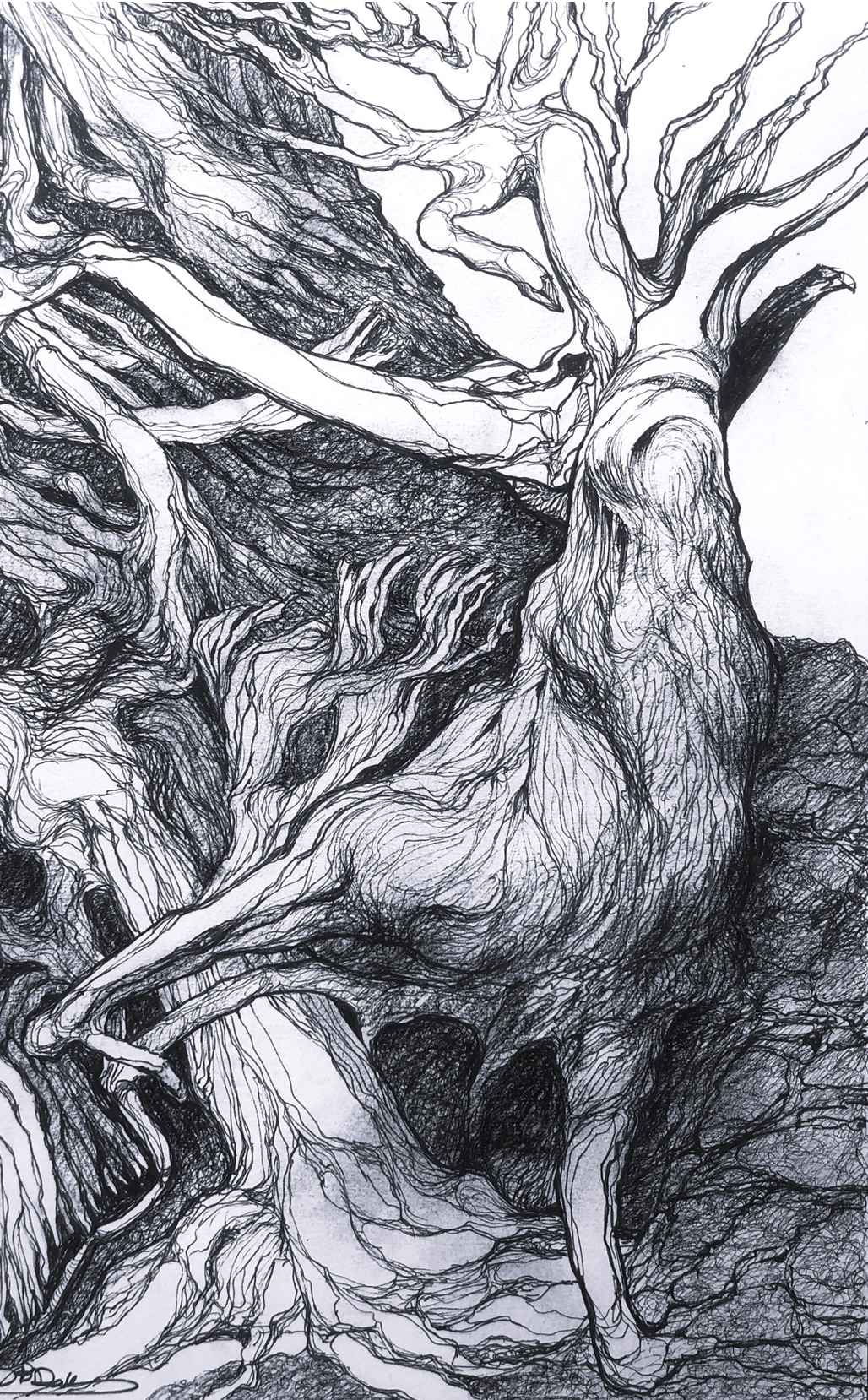
The spirit of matter. New York, 2022, mixed media, 21x33 cm
III. Spirit of matter
After the publication of the book and some months of meditation and planning, when in January of 2022 I sat at the drawing board with a range of themes in mind, to my surprise I realized that as a form and means of expression, the human figure did not come forward. I also realized, sadly too, that a part of me had gone into “concealment” and decided not to pursue the matter. Even though I have always been, and still am, a politically and ideologically very concerned and committed person, on the immediate level of human relations I sometimes hesitated to connect. Here in New York, where everyone and everything intrigues me, and despite my absolute fascination with every aspect of this city, still, I could not return to the human figure.
I turned to nature, as many have and still do, at least artistically. Rocks, and especially the dark gray/green rocks of the state of New York fascinated me since 1970, when I first visited. I see infinitely intriguing shapes, volumes, and movements in the rocks by the side of roads and highways, in vast expanses and mountains, yet did not stop to draw them. When I finally decided to go back to the sketchpad, I could think of no other subject than the rocks.
Also, like my wartime drawing, I could only think and work in black. At the time I did not seek an explanation. Later, while doing research for this book and reviewing some basic texts, I came across a paragraph in Adorno’s Aesthetic Theory that I had read much earlier: “… to survive reality at its most extreme and grim, artworks that do not want to sell themselves as consolation must equate themselves with that reality. Radical art today is synonymous with dark art; its primary color is black. Much contemporary production is irrelevant because it takes no note of this and childishly delights in color. The ideal of blackness regarding content is one of the deepest impulses … It may well be that the current trifling with sound and color effects is a reaction to the impoverishment entailed by the ideal of black; perhaps art will one day be able to abolish this axiom without self-betrayal…” [22]
After three decades of a withdrawal of sorts, my return to art was a crossing, and the idea of a bridge seemed most appropriate. Simultaneously connecting, and dividing, as well as suggesting passages to other worlds, bridges are also things-in-themselves, or entities. I drew a natural rock-bridge that swirled into another unseen platform outside the frame. The climber on this rock-bridge would simultaneously escape and defy the Nietzschean “abyss” below. Dangerous stairs lead to a couple of dark and narrow entrances into another level, or a world, perhaps into a part of me that is in concealment there.
Stairs in turn, are intriguing entities. So far, no artist other than Moritz Escher (1898-1972) has even come close to expressing the complexity, the beauty, and the symbolism of stairs. The “Stairs”, the next work, is a dramatization of dangerous movements into other levels with feelings of instability in perilous and dark spiritual states.
I was soon surprised by another direction that I had not planned nor predicted. It was my “humanization” of matter, in this case the rocks, the earth and trees. I seemed to be trying to “reveal” and “speak” of the “spirit of matter”, the title of this last group. I was not avoiding my basic humanism; I had developed a form of “hard humanism.” The 28 works I made within a year started at the “Bridge” and ended at a drawing called “Homes and graves” following the earthquake in southeastern Turkey, Cilicia an Armenian habitat, even my hometown Aleppo. The images brought back memories of the war when bombardment buried people under the rubble of their homes.
[22] Adorno, Aesthetic Theory, p. 40. 
The unconcealment. New York, mixed media, 34x18.5 cm
Epilogue
In the past four decades, after a dozen books, a few dozen studies and over a hundred artworks (I have kept) were distributed over specific phases. I have devoted more time to my scholarship, because of the demanding nature of historiographic research.
Encounters led to the creation of contexts or “horizons” to understand and come to terms with my circumstances, through scholarship or art; convergences happened both in the artwork and scholarship. This is what I mean by my situatedness, and the criteria for the truth-content of all my works, in writing and images. If wartime Lebanon re-triggered my art, my condition as an Armenian native of the Islamic World put me on a long and difficult path of research into unbroken grounds. The objective of both activities was not capturing immutable truths or eternal beauties, there are no such things.
My works were simultaneously counterpoints and paths to deeper yet not final understandings. An interdisciplinary look at my last drawings and my recent literature will immediately detect their unity, even in style and the aesthetic of writing and drawing. The banyan trees penetrating the forest and breaking through brick walls, spiraling rock-bridges, steep stairs, and rocks sprouting spirits are essentially images of confrontations and convergences, in drawing and writing.
Bibliography
Adorno, Theodor W. Aesthetic Theory, Trans. Introd. Robert Hullot-Kento. New York: 2002.
Bal, Mieke. Travelling Concepts in the Humanities: A Rough Guide, Toronto:2002.
Barker, Philip. Michel Foucault—An Introduction. Edinburgh: 1998.
Dadoyan. Seta B. Encounters and Convergences. A Book of Ideas and Art. USA: 2023.
Eyerman, Ron. Between Culture and Politics: Intellectuals in Modern Society. Cambridge UK, 1994.
Foucault, Michel. Power/Knowledge. New York: 1977.
Gallagher, Shaun. Hermeneutics and Education. Albany, NY: 1992.
Graham, Gordon. The Shape of the Past- A Philosophical Approach to History. Oxford, UK: 1997.
Munslow, Alun. Deconstructing History. London: 1997.
Nietzsche, Friedrich, (trans. C. Diethe, ed. K. Ansell-Pearson), On the Genealogy of Morality. A Polemic (Revised Student Edition).
Cambridge: 1997.
White, Hayden. “The Historical Text as Literary Artifact”, in Tropics of Discourse: Essays in Cultural Criticism. Baltimore, 1978.